
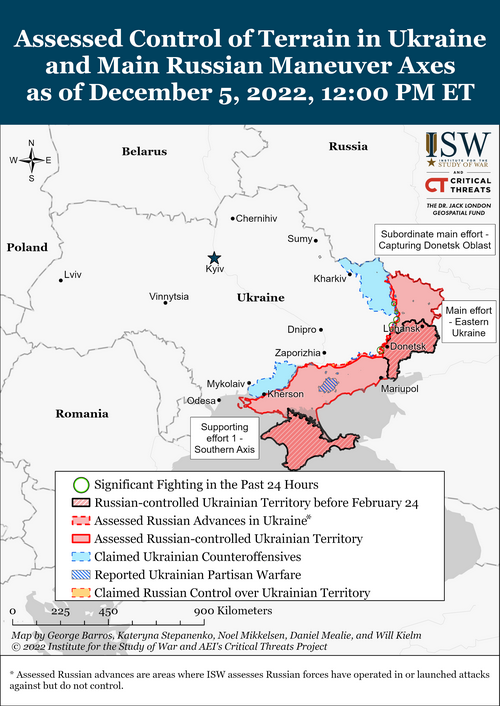
From The Institute For The Study of War:
Russian Offensive Campaign Assessment, December 5
Layne Philipson, Kateryna Stepanenko, and Mason Clark
December 5, 3:00 pm ET
Click here to see ISW’s interactive map of the Russian invasion of Ukraine. This map is updated daily alongside the static maps present in this report.
ISW is publishing an abbreviated campaign update today, December 5. ISW will resume regular updates on December 6. This report discusses today’s wave of Russian strikes against Ukrainian critical infrastructure and the likely Ukrainian UAV strikes against Russian strategic air bases on December 5.
Russian forces conducted another wave of missile strikes targeting Ukraine’s energy infrastructure on December 5. Russian and Ukrainian sources reported on December 5 that Russian forces conducted missile strikes targeting Ukrainian civilian and energy infrastructure in Kyiv, Odesa, Vinnetysia, and Zaporizhia Oblasts.[1] The Ukrainian General Staff reported that Ukrainian air defenses shot down 60 of over 70 missiles launched.[2] Deputy Head of Ukraine’s Presidential Office Kyrylo Tymoshenko Kyrylo Tymoshenko stated that the Russian strikes damaged a power supply line in Sumy Oblast.[3] ISW previously assessed on December 2 that while Ukrainian and Western-provided air defenses are further reducing Russia’s dwindling supply of precision munitions, the small percentage of Russian strikes getting through Ukraine’s air defenses are nevertheless having significant effects on Ukrainian critical infrastructure.[4]
Ukrainian forces likely conducted strikes on two Russian strategic airbases on December 5, inflicting light damage while demonstrating Ukraine’s ability to strike Russian rear areas and possibly disrupt Russia’s campaign of strikes against Ukrainian infrastructure. The Russian Ministry of Defense and several milbloggers reported that Ukrainian forces used UAVs to strike the Engels-2 airbase in Saratov Oblast (approximately 315 miles from Ukrainian territory) and the Dyagilevo Air Base in Ryazan Oblast (approximately 285 miles from Ukrainian territory).[5] Both airbases house elements of Russia’s strategic bomber fleet, which Russia has employed to strike Ukraine throughout the war. Ukrainian Presidential Advisor Mikhail Podolyak tweeted that the Kremlin should have known that “if something is launched into other countries’ airspace, sooner or later unknown flying objects will return to departure point.” Still, Ukrainian authorities have not formally claimed responsibility for the strikes as of publication.[6] Russian sources claimed that a Ukrainian drone struck aircraft at the Engels-2 Airbase in Saratov Oblast, Russia, damaging strategic bombers and missile carriers.[7] Russian sources also claimed that a Ukrainian drone destroyed a Russian fuel truck at the Dyagilevo Air Base in Ryazan Oblast, Russia.[8] The Russian Ministry of Defense claimed that the strike intentionally targeted Russian long-range aircraft.[9] Ukrainian forces likely sought to disrupt Russian strikes against Ukrainian critical infrastructure and demonstrate Ukraine’s ability to target Russian strategic assets.
Anger over the Russian military’s inability to prevent the Ukrainian strikes on Russian strategic airbases over 280 miles from Ukrainian positions outweighed praise for the latest round of strikes against Ukraine within the Russian milblogger community. Russian milbloggers criticized Russian officials for failing to anticipate and prevent the drone strikes at the Engels-2 and Dyagilevo Air Bases on December 5.[10] Select milbloggers noted that Russian military officials have not adequately protected the airbases, with some suggesting that Russian officials did not adequately defend the bases despite knowing that they were clear targets for Ukrainian strikes.[11] Several prominent Russian milbloggers claimed that Ukrainian sabotage and reconnaissance groups must have launched the strike against the Engels-2 air base from inside Russian territory, asserting either that Ukrainian sabotage and reconnaissance groups are active inside Russia or – if the UAVs were launched from Ukrainian territory – that Moscow is under threat from Ukrainian territory.[12]
Russian milbloggers also called on Russian military officials to authorize significant retaliation strikes against Ukraine and intensify counter-terrorism measures within Russian territory.[13] The milblogger community complained that Russian military officials do not consider their suggestions and ignore open-source intelligence (OSINT) and that, had Russian officials taken milbloggers’ warnings into account, the two strikes on Russian military bases would have likely been prevented.[14] Select milbloggers suggested that the strikes on Engels-2 and Dyagilevo Air Bases threaten Russia’s legitimacy as a nuclear power as the strikes damaged aircraft capable of carrying multiple nuclear weapons.[15]
Go here to read the rest.
From Strategy Page:
December 5, 2022: Russia has been unable to deal with the impact of Western economic sanctions on its war production. Its government claims that production levels have been sustained and, in some cases, increased. This was contradicted by government-approved publications providing a different picture, one that depicted problems and failure to sustain pre-sanctions production levels.
One thing certainly has increased; military spending. While the national budget has increased by $80 billion (to $480 billion) since 2021, the defense budget has nearly doubled, going from $57 billion to $83 billion, and the budget for the national police and other internal security forces has gone from $47 billion to $77 billion. Some of this is spent in Russian-occupied Ukraine, especially Donbas and Crimea. These two areas were illegally annexed and have growing problems with local security, not all caused by Ukrainians. Another problem is that much of the increased spending was made possible by borrowed money. These loans had to be made at very high interest rates because the domestic and international financial industries agree that Russia is currently a bad credit risk.
Most of the additional defense spending has gone to replace heavy equipment losses suffered in the first few months of fighting. While government claims stress continued production of hi-tech items, the weapons and equipment most in need, like armored and unarmored vehicles as well as artillery, infantry weapons and equipment, are in short supply. Russia has been unable to replace most of the thousands of tanks and other armored vehicles lost. Same with losses of artillery, anti-aircraft weapons and EW (Electronic Warfare) systems. Basic infantry gear like protective vests, helmets are in short supply and replacements are imported from Iran. The new tactical radios the troops used in Ukraine proved to be colossal failures. Chinese commercial walkie-talkies were also imported but underperformed in combat, were unreliable and had no encryption.
Since the Ukrainians captured many of these walkie-talkies, they passed them around to their own troops so Russian discussions could be overheard. In some cases, Ukrainian troops would pretend to be Russian and report false information or, in a few cases, cause Russian artillery to fire on Russian troops. Meanwhile Ukrainian forces were using encrypted radios that provided much more reliable service using Starlink’s satellite network. Ukraine also received encrypted conventional Western tactical radios. There are also problems supplying Russian troops with accurate maps of Ukraine because Russian troops are often using Cold War era maps that contain deliberate errors to confuse enemy troops who capture these maps.
A lot of the defense budget is spent on combat aircraft and replacement parts for them. The reality is that production rates are sharply down because of component shortages. This is particularly true with helicopters, which until 2015 got engines from Ukraine. Since then, new Russian-made helicopter engines have been available only in lower numbers and reliability. Even basic infantry weapons cannot be produced quickly enough to replace the large losses in Ukraine and to partisan attacks in the occupied areas.
Go here to read the rest.
The Ukrainians have shown an adaptibility and ease at utilizing the technology at hand to fight their War, reminiscent of the Israelis. The Russian military reminds me of the Imperial Russian military circa 1905: bad morale, outdated technology and poor leadership.


Even more telling of the effects on the Russian people is that the local company, probably controlled by one of Putin’s oligarchs, still has not mastered the proper preparation of French fries at the former McDonalds.