
From The Institute For The Study of War:
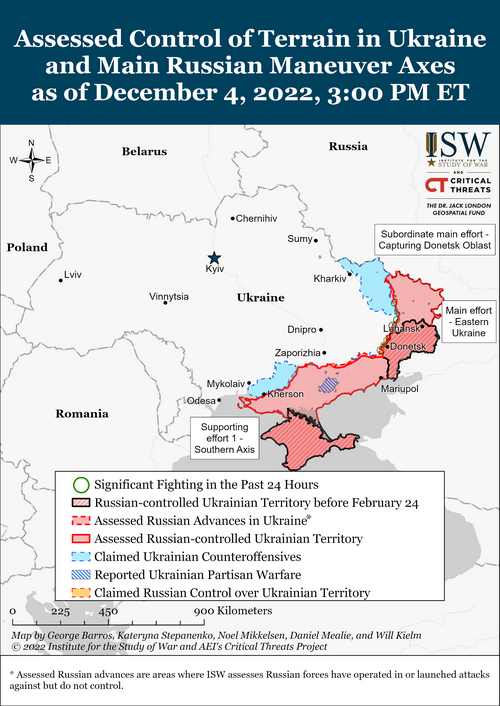
Russian Offensive Campaign Assessment, December 4
George Barros, Grace Mappes, Riley Bailey, Karolina Hird, Layne Philipson, Angela Howard, and Frederick W. Kagan
December 4, 6:15pm ET
Click here to see ISW’s interactive map of the Russian invasion of Ukraine. This map is updated daily alongside the static maps present in this report.
Ukrainian officials have indicated that Ukrainian forces plan to continue offensive operations over the coming winter to capitalize on recent battlefield successes and prevent Russian forces from regaining the battlefield initiative. Spokesperson of the Ukrainian Armed Forces Eastern Group Serhii Cherevatyi stated on December 4 that frozen ground enables heavy wheeled and tracked vehicles to advance and that Ukrainian forces are preparing such vehicles for winter operations.[1]Cherevatyi also stated that low-quality mobilized recruits and Wagner Group personnel recruited from Russian prisoners are unprepared for combat in the winter.[2] The Ukrainian Ministry of Defense (MoD) stated on November 20 that those who suggest the winter will pause hostilities “likely never sunbathed in January on the southern coast of Crimea,” suggesting that Ukrainian forces intend to continue counteroffensive operations over the coming winter that contribute toward the goal of retaking Crimea.[3] Ukrainian Deputy Defense Minister Volodymyr Havrylov stated on November 18 that Ukrainian forces will continue to fight in the winter because any type of pause will allow Russian forces to reinforce their units and positions.[4] Ukrainian officials’ prior statements on ongoing Ukrainian counteroffensive actions in Kherson Oblast are further evidence that these official statements on winter counteroffensive actions are indicators of continuing counteroffensive operations.[5]
Senior US government officials are mistakenly identifying the optimal window of opportunity for Ukraine to conduct more counteroffensives as the spring rather than winter, despite Ukrainian officials’ statements to the contrary. US Director for National Intelligence (DNI) Avril Haines assessed on December 3 that the pace of the war in Ukraine will slow over the winter so both sides can refit, resupply, and reconstitute, despite evidence that conditions on the ground favor a renewed offensive and despite the demonstrated tendency of Ukrainian forces to initiate new counteroffensive efforts relatively quickly after the previous effort has culminated.[6]
Ukraine’s ability to maintain the military initiative and continue the momentum of its current operational successes depends on Ukrainian forces continuing to conduct successive operations through the winter of 2022-2023. Russia lost the initiative in summer 2022 after its offensive in Donbas culminated.[7] Ukrainian forces gained and have retained the initiative since August 2022 and have been conducting a series of successful successive operations since then: Ukraine liberated most of Kharkiv Oblast in September, Kherson City in November, and is currently setting conditions for more Ukrainian pushes elsewhere this winter.[8] Successive operations are a key part of Ukraine’s campaign design. A series of successive Ukrainian counteroffensive operations in Kharkiv and Kherson oblasts demonstrates the Ukrainian military‘s remarkable operational planning skill and knowledge of the strengths of Soviet operational art. Soviet operational art emphasizes that militaries can only obtain their strategic objectives through the cumulative operational success of successive operations ideally conducted without operational pauses between them.[9] Recent official Ukrainian statements make clear that Ukraine’s campaign design is designed to allow a series of successive operations to deprive Russia of the initiative, defeat the Russian military, and liberate more Ukrainian territory.
Weather conditions in winter 2023 likely will dictate a timeframe in which Ukraine can conduct maneuver warfare and continue its string of operational successes with minimal pauses that would increase the risks of Ukraine losing the initiative. The fall mud season in November hampered maneuver warfare, as ISW previously noted.[10] Both Russia and Ukraine nevertheless continued aggressive offensive and counter-offensive operations throughout this muddy period despite some Western predictions that the mud would suspend operations. As the hard freeze approaches in late December, Ukrainian forces will be again able to exploit the weather conditions. Winter is usually the best season for mechanized warfare in Ukraine whereas spring is the nightmare season for fighting in Ukraine.[11] The thaw swells rivers and streams and turns fields into seas of mud.[12] Ukrainian forces likely are preparing to take advantage of frozen terrain to move more easily than they could in the muddy autumn months.[13]
If Ukraine’s allies and partners do not support Ukrainian forces to conduct large-scale decisive counteroffensive operations this winter—as the DNI’s statements might be construed to suggest – then Ukrainians‘ ability to conduct maneuver warfare will be constrained until likely at least after the spring mud season in March 2023.[14] Such a course of action will likely prematurely culminate Ukraine‘s current momentum and grant shattered Russian forces a valuable three-to-four-month reprieve to reconstitute and prepare to fight on a better footing.
Key Takeaways
- Ukrainian officials have indicated that Ukrainian forces will continue counteroffensive operations over the upcoming winter.
- Ukraine’s ability to maintain the military initiative depends on Ukrainian forces continuing counteroffensive operations in the winter of 2022-2023.
- Russian sources reported that Ukrainian forces continued counteroffensive operations in the directions of Kreminna and Svatove.
- Russian forces continued to conduct offensive operations around Bakhmut and Avdiivka.
- Groups of mobilized Russian soldiers continue to disrupt Russian force generation efforts with refusals to fight, insubordination, and defiance.
- Russian forces likely publicly executed residents in occupied Luhansk Oblast on accusations of partisan activity.
Go here to read the rest.
From Strategy Page:
December 4, 2022: Russia has stopped sending troops to Ukraine as members of Battalion Tactical Groups or BTGs, starting in August. This was done quietly and there were practical reasons for this. First, most of the Russian troops sent to Ukraine since August have been poorly trained light infantry and were often just used to build fortifications.
Russian losses of junior officers and NCOs (soldiers with a few years of service) were heavy in the first few months of fighting, and with few replacements for them. Normally, officers require several years of training and even the effective World War II practice of promoting combat experienced enlisted soldiers to officer rank failed because any Russian soldier with several years of service, and several months of experience in Ukraine, is reluctant to return to Ukraine in any capacity. The volunteer soldiers in the Russian army are called “contracti” because they sign a contract to serve a number of years with higher pay than conscripts. Russia has still not been able to develop Western-style NCOs (Non-Commissioned Officers). The best they can do is use veteran soldiers with a few years of experience and sense of responsibility who are willing to carry out some NCO functions, like telling new recruits what equipment they will receive and where to go next. Unlike Western NCOs, most Russian NCOs are less eager, or able, to train and lead new recruits.
With all this in mind, the big surprise (to Russian generals) was general failure of the BTGs as they took part in the February invasion of Ukraine. The current BTG composition has been around for about a decade and began to evolve from earlier “battle group” ideas formed in the 1980s. Until 2022 the Russian version of the battle group had consistently proved successful in many small wars, including the rather large operation in Afghanistan during the 1980s. BTG development began during World War II when it was found that forming temporary task forces containing tank and infantry units were more effective. The Germans did the same thing, calling them battle groups and the Americans adopted the practice after World War II.
The Russians did not take into account that there was an important difference between the Western battle groups and the current BTGs. The Western battle groups were kept simple (mainly infantry and tank companies) with the addition of combat engineers or artillery as needed. American infantry officers got lots of realistic training using these battle groups. Western armies had many career NCOs to make sure their troops performed well in battle groups.
Russia expanded their BTG concept after 2000 by adding more support units. Eventually this meant that each BTG had most of the support capabilities usually found in a division. These support units were smaller in the BTG, often just a dozen or so specialists riding in a few trucks. The BTG commander put an officer in charge of all these non-combat support troops and the dozens of trucks they traveled in. The combat element of a BTG always consisted of a few hundred infantry and ten or twenty tanks. But now there were small (platoon sized) detachments of specialists. The only ones that were always present were a dozen or so self-propelled artillery (152mm guns) and somewhat more 82mm and 120mm mortars. There was also a medical detachment. In the last decade a detachment of fire control troops was added to coordinate all that firepower with some UAVs to scout for targets. There was also a small number of self-propelled anti-aircraft weapons in addition to the portable anti-aircraft missiles carried by individual soldiers. There were several other specialist units that could be added as needed. Total strength of a BTG varied depending on how it was assembled. Personnel strength could vary from 600 to 800 personnel.
These new BTGs became the standard for Russian divisions, which now consisted of two or three brigades. Each of these usually had just two BTGs. The division had fewer support units because most of these troops were now assigned to BTGs or brigades. By 2021 there were 170 BTGs. The combat elements (one tank company, two or three infantry companies and one or two batteries of artillery) contained contract (volunteer) troops while most of the rest of the BTG depended on conscripts. The conscripts had several shortcomings. They could not be used in a combat zone; their term of service was only one year and they were not as well trained as the contract troops. Conscripts were often not formally trained at all. By law conscripts were not allowed in a combat zone unless it was wartime and they were defending Russia.
This massive adoption of BTGs was a mistake that became obvious after nearly half the available BTGs were sent into Ukraine in early 2022. Many newly formed BTGs were sent to the Ukrainian border in late 2021 to threaten Ukraine and if that did not work, to invade.
The flaw in the BTGs was not obvious until they encountered well-armed and motivated opponents. That happened soon after they crossed the border into Ukraine. The leadership of these BTGs could not handle the complex composition of BTGs. Senior Russian leaders knew this from the performance of BTG leaders during military exercises. This was not a surprise as the quality of officers had declined in the last decade and there were still not enough experienced NCOs while contract soldiers with a few years’ experience were not an adequate substitute in combat.
The lack of competent leadership meant the troops in the BTGs were poorly used during combat. That led to many troops abandoning their vehicles and fleeing or surrendering if they encountered Ukrainian troops. The Ukrainians concentrated on hitting the very vulnerable tanks and light armored vehicles (like BMPs or wheeled armored infantry carriers) with a variety of modern portable anti-tank weapons that often destroyed or disabled tanks or BMPs quickly. This was made worse because BTG leaders failed to carry out effective reconnaissance or get the infantry out of their armored vehicles to protect the vehicles from Ukrainian infantry armed with anti-tank weapons.
Worse for the Russians, Ukrainians concentrated on attacking the BTG trucks carrying supplies and maintenance personnel. The trucks were the last to enter Ukraine because there were a lot of conscripts driving the trucks and these conscripts were not told they were driving into Ukraine. Instead, many were told they were on another training exercise. Most of these vehicles were destroyed or abandoned because of Ukrainian airstrikes, artillery fire and ground troops using whatever weapons they had. In one case a retired Ukrainian soldier was given a single-shot RPG (Rocket Propelled Grenade Launcher) by some passing Ukrainian troops. The elderly veteran used that one RPG to destroy a Russian fuel truck, after allowing many cargo trucks to pass. The fiery explosion ignited other trucks including some carrying fuel. Soon the truck column was in flames and the surviving drivers were walking back to the border. The attacks on the trucks meant that the combat units could not refuel and had to stop before they reached their objectives. Ukrainians now had lines of stationary Russian vehicles to attack. The few competent or determined BTG officers were soon killed as they tried to get their troops to put up an effective fight. These young officers had no experience and many had little or no training for combat, such as a weather officer ordered to try and perform as an armored reconnaissance officer. Senior Russian officers (colonels and generals) who did have experience were under tremendous pressure from their military and political commanders to get the problem fixed. Many went to the front line BTGs to show the junior officers how it was done, often by example. At least 150 senior officers were killed and many more wounded. This further weakened the leadership of the brigades and divisions that went into Ukraine dependent on their BTGs.
The BTGs and leadership problems were known to many senior civilian and uniformed military leaders. There had been several reform efforts after the Soviet Union dissolved in 1991. The Russian Defense Ministry introduced some unexpected changes in 2013. For the first time the “Command Center ” for the military was physically separate (in a new building complex) from the Stavka, which was the traditional General Staff that had long handled planning and administration of the military. This was part of a trend towards installing more Western style civilian control over the military high command.
At the same time there was an effort to placate military traditionalists. A new Defense Minister reversed the conversion of the two elite divisions stationed in Moscow; the Kantemyrovskaya tank division and the Tamanskaya motor-rifle division, to the new brigade/BTG structure. The ministry also ordered the return of ideological training for troops and increased the use of informants and opinion surveys to monitor morale and loyalty in the military. This included a return of the Soviet era “Zampolit ” (political officer). In Soviet times every unit commander had a deputy (Zampolit) who represented the communist party and could veto any of the commanders’ decisions. The Zampolit was responsible for troop loyalty and political correctness; sort of a communist chaplain. In 2010 the army reintroduced chaplains, something that the communists did away with in the 1920s. The new chaplains were, however, expected to report on the loyalty of the troops to church and state. Additional officers were added to handle ideological training and monitoring morale. Not exactly the return of the Zampolit but a return of most of the Zampolits’ duties.
This was not what a lot of senior officers expected when the reformist Defense Minister (Anatoly Serdyukov) took over in 2007 and was replaced by Sergei Shoigu in 2012. At first it was believed that Shoigu was going to reverse a decade of military reforms, but that did not happen. Some senior members of the Defense Ministry were openly advocating returning to the use of divisions, instead of Western style brigades, which had proved successful in Iraq and Afghanistan.
Mixing BTGs with a large reserve force was something that was only talked about and rarely acted on. The reason for the demand to keep the divisions was the possibility of a large war in the east. The only major foe out there was China, but was not mentioned because China had become an economic and diplomatic asset for Russia. Nevertheless, China is and remains the major potential threat to Russia. The Chinese Army is three times larger and has 15 tank and mechanized infantry divisions it could place on the Russian border. China is also reorganizing its ground forces into one based on brigades rather than divisions. China believes that will be more effective than divisions and they may be right.
Officially Russia ceased to consider Chinese ground forces a threat as Russian nuclear weapons are supposed to stop a Chinese ground assault. This is what kept the Russian brigade reorganization efforts alive, because brigades are more effective in dealing with insurrections and low-level unrest.
Traditionalists in the Defense Ministry pointed out that nuclear war would destroy both nations and that the current situation allows China to quickly grab the Russian Far East (which China has long claimed) and then call for a peace conference. This is the sort of tactic China has used in the past and the Chinese are big fans of their imperial past and its “ageless wisdom”, but senior Russian leaders believed they could use diplomacy and new, faster moving conventional forces to prevent any Chinese use of “grab and declare peace” tactics.
For a while it seemed that Russian reformers were on the defensive. Since the end of the Cold War in 1991, there have been growing efforts to drag the army out of the 19th century. There was substantial resistance to change, especially when it involved ancient and often uniquely Russian practices. All these new ideas from the West were seen as, well, un-Russian. A year after reformist Defense Minister Serdyukov was replaced, most of his reforms continued and some, like making life more comfortable for the troops. were expanded. Soldiers now had showers in the barracks and lots of hot water. The food was getting better and buffet style dining, used for decades in the West, was introduced. New barracks were built and life in the military was much less like being in prison, which is what it resembled until the reforms began.
For generations Russian conscripts were confined to their barracks when not on duty. This was unpleasant, as the barracks were often decrepit and uncomfortable. The barracks were upgraded over the last decade to include flush toilets, showers, central heating, washing machines, and many other amenities Western troops take for granted. In these old barracks troops were allowed to bathe once a week in a bathhouse that was often improvised for the occasion. In addition to showers in all barracks, along with wi-fi in some and new furnishings, the new barracks had flush toilets and central heating. During the Cold War Russian troops stationed in East Germany lived in modern barracks, often ones formerly used by the Nazis, and that was one reason why duty in Germany was considered a choice assignment.
Military reform has never come easily to Russia and usually occurred when a particularly strong and harsh ruler was in charge. In modern times Russia has undergone four periods of major military reform. The first was in the early 18th century, under Czar Peter the Great. The next was under Field Marshall Milyutin in the late 19th century. In the 1930s over a dozen daring reformers made the military ready for modern warfare. However, most of these men were executed by a paranoid dictator, Josef Stalin, just before World War II. For over 60 years there was not much real reform, until 2008, when Defense Minister Serdyukov sought to make the Russian military similar to what the West had long possessed. This meant fewer officers and conscripts, more NCOs and volunteers, plus new equipment, weapons, training methods, and tactics. Serdyukov made a lot of enemies in the military with his reform efforts and was replaced in 2012. One of Serdyukov’s most unpopular moves was to shrink the size of the officer corps. Despite the fact that most of the officers being let go were not really needed, this elicited a lot of protests from active duty and retired officers.
Go here to read the rest. It takes time to train good combat troops and the officers to lead them. The exception to this rule is if a country is invaded and the people rally patriotically to her defense. The Russians had that advantage in World War II and the Ukrainians have that great advantage in the current war.


A so-called “Russian independent news organization,” “The Insider,” (translated), reports that failed field commanders are being executed apparently it is inferred on orders from Wagner Group CEO Yevgeny Prigozhin. A captured phone conversation between Victor Sevalnev and his wife before his death “from injuries and a blow to his head” accuses Wagner Group leaders of orchestrating his murder:
“The outlet [“The Insider”] cited information it obtained from Vladimir Osechkin, a Russian human rights activist who runs the anti-corruption website Gulagu.net.
Victor Sevalnev headed the 7th Motorized Rifle company of the so-called Luhansk People’s Republic (LPR) in eastern Ukraine, and had been hospitalized after sustaining injuries in battle.
The Insider said a recorded conversation between Sevalnev and his wife in November revealed that he had been threatened with execution because soldiers in his unit had deserted.
“Don’t send people here…they want to kill everyone,” he said in a phone call with his wife Lilia, according to the report.
“Today it’s me, tomorrow another, that’s all. We’re just murder material [to them]. The Ministry of Defense executes people. They know that we’re [dead men] and they don’t give a damn,” he also reportedly said.”
It is hard for us in the West to understand the absolute cold disregard for human life and the propensity for murder among many military leadership organizations in the East (and we may presume the same for the Ukrainians),
It is also interesting–and disturbing, but we all expected it—that large dollar amounts of US military weaponry supposedly designated for Ukraine is ending up in Africa in various civil wars. Finland reported that “biker gangs” in Ukraine are seizing large amounts of the equipment and selling it to the highest bidders.—probably how intact hi-tech HIMARS rocket shells have apparently ended up in the hands of the Russians (This story is largely blocked on standard search engines, especially Google, but quickly found on alternate systems like Duckduckgo.
https://www.wilsoncenter.org/blog-post/soviet-unions-demise-seen-todays-russians
Some of what animates support for the Putin adventure may be delineated here. I do wish ordinary Russians were more inclined to ask “what can we build with what we’ve got?” and more resistant to hoo ha of the Soviet nostalgiac and of the Russian nationalist variety.