
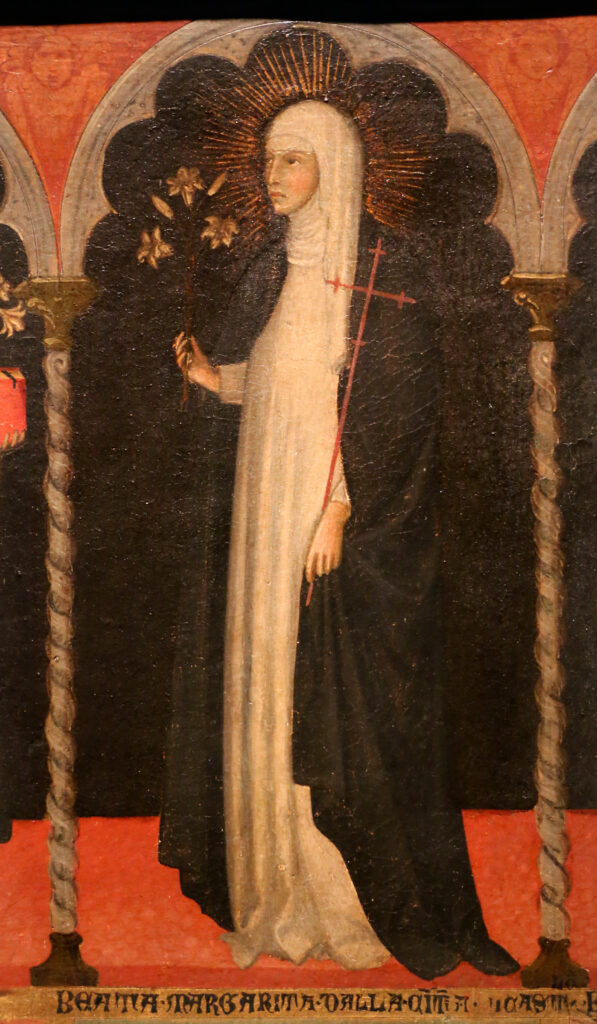
Margaret della Metola was born in Perugia in 1287 to the nobles Parisio and Emilia in the Metola Castle near Mercatello sul Metauro. Her father served at the garrison at the castle.
Metola was born blind with a severe curvature of the spine and had difficulties in walking; she was also a dwarf. Though her parents were embarrassed and hid her from all, a kind maid found her and gave her the name Margaret (derived from the Greek word “margaron”, meaning “pearl”).[4] When she was almost publicly discovered at age six, her parents walled her for about a decade in a room attached to their residence’s chapel, to ensure no one would see her, although she could attend Mass and receive the sacraments. Her parents’ chaplain instructed her in the faith.[5]
But soon there was an imminent threat of invasion at the castle, so Parisio ordered his wife to place a dark veil upon their daughter so the two could flee to his other castle at Mercatello. There she was again imprisoned in a vault-like cubicle containing nothing more than an old small bench. There were some who knew of Margaret and were furious at her treatment, though they never dared broach the subject with the sometimes temper-prone Parisio. Her mother soon suggested taking her to a church where miracles were said to occur. Emilia was timid asking her husband but was surprised to see that he showed a keen interest.
In 1303 her parents took her one morning to a shrine in the Franciscan church in Castello – where miracles were said to have happened, in hope of a cure for Metola’s birth defects. When no such miracle happened, her parents abandoned her there. But she never came to resent or be bitter over her parents’ decision.[4][3] Some women at the church noticed her there. The town’s poor took her in as one of their own and she was passed to several poor families who helped prisoners and other poor people. Metola was soon granted safe haven in a local convent. Their lax manner of life, though, soon conflicted with her intense faith and she was expelled from the convent since her fervor was a tacit reproach to the nuns who came to detest her presence.[1] It was after this that she took up residence in the town where the townsfolk resumed caring for her. To thank them for their kindness, she opened a small school for the children of the town where she instructed them in the faith and the psalms, which she had learnt during her time with the nuns. Metola also looked after the town’s children when their parents went to work.[3][5]
In 1303 she came to know the friars from the Dominicans who had become established in the town not long before. Margaret came under their spiritual guidance and was admitted to the local chapter of the Third Order of Saint Dominic; she received the religious habit of the order.[7]
Metola died on 12 April 1320 and the crowds at her funeral demanded that she be buried inside the church against the resistance of the parish priest. But after a disabled girl was cured at the funeral he allowed for Metola’s burial inside.
Go here to read the rest.

