
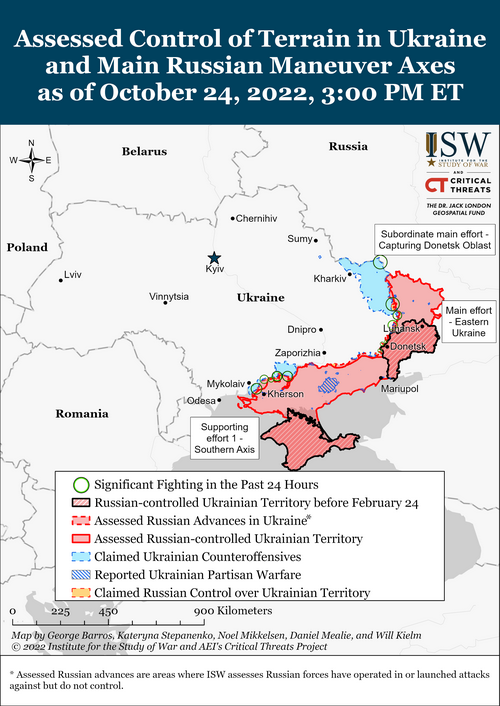
From The Institute For The Study of War:
Kateryna Stepanenko, George Barros, Grace Mappes, Angela Howard, and Fredrick W. Kagan
October 24, 8:30 PM ET
Click here to see ISW’s interactive map of the Russian invasion of Ukraine. This map is updated daily alongside the static maps present in this report.
The Kremlin intensified its information operation to accuse Ukraine of preparing to conduct a false-flag attack using a dirty bomb for a second day in a row on October 24. Russian Chief of the General Staff Valery Gerasimov separately called his counterparts from the United Kingdom and United States about the “situation connected with Ukraine’s possible use of a dirty bomb” (a conventional explosive laced with radioactive material that is not a nuclear weapon) on October 24.[1] Russian Defense Minister Sergei Shoigu made similar calls with his counterparts from the United Stated, United Kingdom, France, and Turkey on October 23.[2] The Chief of Russia’s Radiation, Chemical, and Biological Protection Forces, Lt. Gen. Igor Kirillov, gave a lengthy briefing accusing Ukraine of planning a dirty bomb false-flag provocation to accuse Russia of detonating a low-yield nuclear weapon in Ukraine on October 24.[3] Russian military bloggers are amplifying this information operation.[4] ISW assesses the Kremlin is unlikely to be preparing an imminent false-flag dirty bomb attack.[5]
Russian forces conducted air, missile, and drone strikes against targets in Ukraine at a markedly slower tempo than in previous days. The Ukrainian General Staff reported on October 24 that Russian forces conducted 2 missile and 28 air strikes, and Ukrainian forces shot down 16 Shahed-136 drones on October 23.[6] The slower tempo of Russian air, missile, and drone strikes possibly reflects decreasing missile and drone stockpiles and the strikes’ limited effectiveness of accomplishing Russian strategic military goals.
Ukraine’s Military Intelligence Directorate (GUR) Chief, Major General Kyrylo Budanov, stated on October 24 that the impact of Russian terrorist strikes against critical Ukrainian infrastructure is waning as Russian forces further deplete their limited arsenal of cruise missiles.[7] Budanov stated that Russian forces have stopped targeting Ukraine’s military infrastructure, instead aiming for civilian infrastructure to incite panic and fear in Ukrainians. Budanov noted, however, that Russian forces will fail as Ukrainians are better adapted to strategic bombing than at the beginning of the war. Budanov claimed that Russian forces have used most of their cruise missile arsenal and only have 13 percent of their pre-war Iskander, 43 percent of Kaliber, and 45 percent of Kh-101 and Kh-555 pre-war stockpiles left, supporting ISW’s prior reports on dwindling Russian precision-guided munition stockpiles.[8] Budanov noted that Russian cruise missiles lack precision, as a missile likely intended to hit the Ukrainian Security Service (SBU) building in Kyiv missed its target by 800 meters. Budanov stated that Russia’s dwindling supply of cruise missiles is forcing the Russian military to rely on Iranian drones but that Iranian suppliers only send 300 drones per shipment and that the drones take a long time to manufacture. Budanov stated that Ukrainian air defenses shoot down 70 percent of all Shahed-136 drones, including 222 of the 330 Russia has used so far. It is impossible to assess the degree to which ongoing unrest and growing strikes in Iran might interfere with Tehran’s ability to manufacture and ship drones to Russia.
Russian President Vladimir Putin’s annexation of four Ukrainian oblasts on September 30 ignited a schism within the Kremlin, which will likely intensify as Ukraine liberates more territories, according to Budanov. Budanov stated that Kremlin elites largely did not support Putin’s decision to annex Kherson, Zaporizhia, Donetsk, and Luhansk Oblasts prior to securing those territories, prompting many officials to contact their Western counterparts to express their disinterest in continuing the war in Ukraine.[9] Budanov claimed that some Kremlin officials began advocating for negotiations with Ukraine to their Western counterparts while the Russian military-political command plotted missile strikes to scare Ukrainians into negotiations. Budanov‘s statement is consistent with the influx of Western reports about direct criticism of Putin within the Kremlin less than a week after the annexation announcement around October 6.[10] Wagner Group–affiliated Telegram channels also noted the emergence of the pro-war and pro-negotiations factions within the Kremlin within the same timeframe.[11] Wagner Group financier Yevgeniy Prigozhin has been consistently referencing the factionalization within the Kremlin since, even explicitly stating that he is part of the “war until victory” faction.[12] These observations raise the possibility that hints from insiders of a Kremlin readiness to engage in serious negotiations may not reflect Putin’s own views or any decisions he has taken but may instead be part of efforts by those who have lost the internal argument with him to persuade the West and Ukraine to offer concessions in hopes of bringing him around to their point of view.
Prigozhin continues to accrue power and is setting up a military structure parallel to the Russian Armed Forces, which may come to pose a threat to Putin’s rule — at least within the information space. Russian milbloggers reported that Prigozhin is sponsoring the formation of a Wagner-based volunteer battalion recruited by a Russian war criminal and former Federal Security Service (FSB) officer Igor Girkin.[13] Girkin is an avid critic of the Russian higher military command and a prominent figure among the Russian ultra-nationalists who participated in the annexation of Crimea or the illegal Russian seizures of Ukrainian territory in Donbas in 2014. Milbloggers noted that the structure of the Russian Armed Forces has long prevented Girkin from forming his own volunteer battalion due to lack of supplies and other bureaucratic restrictions, while Prigozhin has the luxury to operate Wagner forces without the direct supervision of the Russian Ministry of Defense (MoD). Milbloggers also noted that the Prigozhin-Girkin collaboration is likely making a large nationalist constituency accessible to Prigozhin in support of his maximalist goals for the war in Ukraine.[14]
Prigozhin holds a uniquely advantageous position within the Russian state structure and information space that allows him to expand his constituency in Russia more readily than the disgraced Russian higher military command. Prigozhin can freely promote himself and his forces while criticizing Kremlin officials or the Russian Armed Force without fear of pushback.[15] Putin depends on Wagner forces in Bakhmut and is likely attempting to appease Prigozhin despite the fact that Prigozhin is undermining the conventional Russian military. Prigozhin, for example, sarcastically stated in an interview that he is constructing the “Wagner Line” in an effort to make Russian Armed Forces that “hide behind Wagner’s backs” feel safe.[16] Prigozhin also frequently levies his critiques of the Russian military in interviews with Russian online publications and among Wagner-affiliated Telegram channels, which allow him to reach and interact with audiences inaccessible to the Russian MoD, which is restricted in its public statements and means of communication. Prigozhin also benefits from holding no formal position of responsibility. He is not in command of any axis in Ukraine nor in charge of any major bureaucratic effort. He can critique those who are in positions of authority freely without fear that anyone can point to something he was specifically responsible for that he failed to achieve.
Prigozhin has seemingly distanced himself from a fellow strongman, Chechen leader Ramzan Kadyrov, after their joint critiques of the Russian higher military command on October 1 drew much attention.[17] This rhetorical shift may indicate that Kadyrov is losing influence and standing and may fear losing his control over the Republic of Chechnya amid the Chechen public’s growing disapproval of his demands in support of Putin’s war.[18]
Racism and bigotry continue to plague the Russian Armed Forces, increasing the likelihood of ethnic conflicts. Russian social media footage showed a Russian officer beating a Muslim soldier for attempting to pray at a certain time.[19] While Russian milbloggers denied the authenticity of the footage, previous instances of violence along religious or ethnic lines, such as the shooting on a Belgorod Oblast training ground on October 15, indicate that such problems will intensify throughout time.[20] Racial and religious tensions may also help explain Kadyrov’s relative quieting and Prigozhin’s apparent separation from him.
Russian forces are likely preparing to defend Kherson City and are not fully withdrawing from upper Kherson Oblast despite previous confirmed reports of some Russian elements withdrawing from upper Kherson.[21] Budanov stated on October 24 that Russian forces are not retreating from Kherson City but are instead preparing the city for urban combat.[22] This report is consistent with indicators that ISW has observed in late October.[23] Recent reporting about Russian military operations in Kherson have not always distinguished clearly enough between activities in Kherson City and those in western Kherson Oblast generally. Russian forces have begun a partial withdrawal from northwestern Kherson Oblast even while preparing to defend Kherson City. They have not launched into a full withdrawal from the city or the oblast as of this report.
The Russian position in upper Kherson Oblast is, nevertheless, likely untenable; and Ukrainian forces will likely capture upper Kherson Oblast by the end of 2022. A Russian milblogger stated that Russia’s surrender even of Kherson City is overdue, as an attempt to hold the city will likely result in defeat.[24] This milblogger argued that if Russia’s military command decides to wage the war in Ukraine to a successful end, then the surrender of Kherson City is “nothing terrible” in the long run. The Russian military likely has not prepared the information space for a military defeat in Kherson Oblast as of October 24. A Russian milblogger wrote that his Russian military contacts in Kherson Oblast do not want to nor plan to retreat.[25] Russian media has not discussed the possibility of a major military loss in Kherson Oblast besides promoting information operations about a Ukrainian false-flag attack against the Kakhova Hydroelectric Power Plant (HPP) Dam.[26]
Ukrainian intelligence reported that Russian forces have not yet laid enough explosives to fully destroy the HPP Dam as of October 24.[27] Budanov observed that the Russians have prepared parts of the dam for limited explosions that would not unleash the full force of the reservoir’s waters. The Russians may seek to damage the top portion of the dam, including the road that runs across it, to prevent the Ukrainians from following after retreating Russian forces if and when the Russians abandon the western bank of the Dnipro River.
Key Takeaways
- The Kremlin intensified its information operation to accuse Ukraine of preparing to conduct a false-flag attack using a dirty bomb for a second day in a row.
- Ukraine’s Military Intelligence Directorate (GUR) Chief Major General Kyrylo Budanov stated on October 24 that the impact of Russian terrorist strikes against critical Ukrainian infrastructure is waning.
- Russian President Vladimir Putin’s annexation of four Ukrainian oblasts on September 30 ignited a schism within the Kremlin, which will likely intensify as Ukraine liberates more territories according to Budanov.
- Prigozhin continues to accrue power and is setting up a military structure parallel to the Russian Armed Forces, which may come to pose a threat to Putin’s rule – at least within the information space.
- Russian forces are likely preparing to defend Kherson City and are not fully withdrawing from upper Kherson Oblast despite previous confirmed reports of some Russian elements withdrawing from upper Kherson Oblast.
- The Ukrainian General Staff confirmed that Ukrainian forces captured Karmazynivka, Miasozharivka, and Nevske in Luhansk Oblast and Novosadove in Donetsk Oblast.
- Kursk Oblast Govenor Roman Starovoit announced the completion of the construction of two reinforced defense lines on the border with Ukraine on October 23 — likely an act of security theater designed to target a domestic Russian audience since there is no danger whatsoever of a Ukrainian mechanized invasion of Russia.
- Wagner Group financer Yevgeny Prigozhin acknowledged the slow pace of Wagner Group ground operations around Bakhmut as Russian forces continued to lose ground near the city.
- Ukrainian forces continued targeting Russian force concentrations near the Zaporizhia Oblast front line on October 23–24 and struck a Russian force and equipment concentration in the vicinity of Enerhodar on October 22.
- Hurried Russian mobilization efforts to fix personnel shortages on the front lines have cannibalized the Russian force-generation staff and diminished Russia’s ability to effectively train and deploy new personnel and to staff domestic industries.
- Occupation administration officials have taken down communications systems in Kherson City in an attempt to limit civilian reporting on Russian positions to Ukrainian forces ahead of anticipated Ukrainian advances.
Go here to read the rest.
From Strategy Page:
October 24, 2022: The October 8th explosion on the Kerch Strait bridge was apparently one of several attack plans developed by Ukrainian and British special operations personnel. This planning began back in April and several plans were developed. One involved cruise missiles hitting concrete pillars supporting the bridge where it consisted of a long span over the shipping channel. A similar attack plan called for divers to approach at night and place explosives on these pillars. In both cases the key central span would be destroyed and cut road and rail traffic for months while repairs were made. The Russians were apparently aware of this vulnerability and soon after the invasion began defenses around the central span were increased to defeat or disrupt missile or underwater attack. This did not deter the Ukrainians who continued to consult with their British counterparts on other plans for destroying key portions of the bridge.
Ukraine wants the bridge gone because it enables easy access to Crimea by the Russians and restricts the size of ships that can enter that portion of the Ukrainian coast.
In 2019 the railway link across the new Kerch Strait bridge connecting Russia with Crimea was opened for service. This enabled the bridge to move 13 million tons of freight and 14 million passengers a year. The bridge cost nearly $4 billion and is mainly a prestige and diplomatic project as it enables Russia to control the Sea of Azov. In April 2018 Russia declared the Sea of Azov, reached from the Black Sea via the 4.5-kilometer-wide Kerch Strait, was now under Russian control.
The Crimean Peninsula, when it was part of Ukraine, was separated from Russia by the Kerch Strait. Maximum depth of the strait is 18 meters (59 feet) and there had long been talk of building a bridge between Crimea and the Kerch Peninsula (now and always part of Russia). After Russia seized Crimea in 2014, proposals that a bridge be built actually turned into reality. The Kerch Bridge opened in March 2018, at least the highway part, the sturdier railroad section took longer to complete. With that Russia declared the Sea of Azov under Russian control and no foreign ship could enter with Russian permission. The Russians seized ships trying to reach the Ukrainian ports of Berdiansk and Mariupol that are on the shore of the Sea of Azov. Russia was putting these two ports out of business. Ukraine accused Russia of violating international law as well as a 1990s Russia-Ukrainian treaty that prohibited the seizure of Crimea or building the bridge and restricting access to the Sea of Azov. The problem with the bridge is that it only allows about 30 percent of the large bulk carrier ships that visit Ukrainian ports to get into the Sea of Azov. Taking down that portion of the bridge would reopen the Sea of Azov to large ships.
The October 8th dawn attack on the bridge was only partially successful. This attack involved a special bomb weighing several tons carried by a truck crossing the bridge. It was a suicide mission for the driver and the explosives went off short of where they were intended to detonate for maximum damage. It is unclear if this was a driver error or timing error on the detonator. If the bomb had gone off at another point, three deck sections would have dropped into the water rather than one. With one span down the Russians were able to make temporary repairs and resume limited vehicle traffic within a day. The explosion did ignite adjacent railroad cars carrying fuel. The light from these fires could be seen from a long distance. The fire weakened the structure but the Russians were unsure of how much. They continued running normal rail traffic. Fully restoring the highway span is taking longer, limiting vehicle traffic until it is completed. If three deck spans had gone into the water, vehicle traffic would have been halted for weeks and limited traffic only for months. Russian leader Putin was furious about this attack and regarded it as yet another unpredictable and effective Ukrainian innovation that Russian forces were unable to cope with. If the railroad portion of the bridge collapses, Russia is one step closer to losing Crimea to the advancing Ukrainian forces.
The rail line just to the north of the two road lines was much more important as only it could carry the vast quantities of fuel required by Russian aircraft based in the Crimea, plus the supply and armored vehicles in the Kherson area to the north. The Russians had declared the bridge essential for the defense of Crimea and the support of military operations north of Crimea. At the time of the bridge attack the Ukrainian offensive was making progress in capturing all the Russian occupied territory north of Crimea. Once that is done, the only supply route into Crimea will be the Kerch bridge. The Ukrainian advance also brings Ukrainian HIMARS trucks close enough to launch attacks on the Kerch bridge.
The new Russian commander of forces in southern Ukraine admitted that his depleted ground forces were unable to halt the advance. While admitting to the worst-case scenario, the new commander does have some units he can depend on and is deploying them to slow the Ukrainians down as much as possible. The recent “partial mobilization” declared by Russia in mid-September was only able to put about two-thirds of the men it expected into uniform. Most of those new troops were dismayed to find themselves sent to Ukraine after a few days or weeks of training and with inadequate equipment. When these new troops reached southern Ukraine, they found the supply situation worse and they were assigned to depleted (by casualties and desertion) units led by uninspiring officers. These are the units that are unable to halt the Ukrainian advance. Russia is putting some new troops through longer training but the equipment shortage is everywhere and few Russian troops are really enthusiastic about fighting to keep Ukrainians from taking back their territory.
Go here to read the rest. The Russians hope to engage in urban warfare in Kherson. I think it more likely that the Ukrainians will surround the city and starve them out.

