
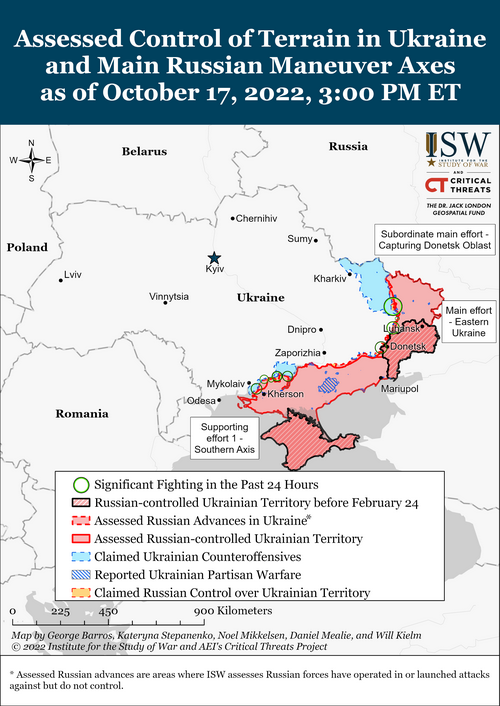
From The Institute For The Study of War:
Russian Offensive Campaign Assessment, October 17
Karolina Hird, Kateryna Stepanenko, Riley Bailey, and Frederick W. Kagan
October 17, 8:30pm ET
Click here to see ISW’s interactive map of the Russian invasion of Ukraine. This map is updated daily alongside the static maps present in this report.
Russian forces conducted a series of drone and missile strikes against residential areas and critical infrastructure throughout Ukraine on October 17. Russian troops struck Kyiv, Zaporizhzhia City, and areas in Vinnytsia, Sumy, Dnipropetrovsk, and Mykolaiv Oblasts and launched nine missile strikes and 39 air strikes on October 17.[1] Ukrainian Air Force spokesperson Yuriy Ignat noted that Russian forces launched 43 drones from southern Ukraine, 37 of which Ukrainian troops destroyed and the majority of which were Iranian Shahed-136 drones.[2] Five Shahed-136 drones struck infrastructure in the Shevchenkivskyi district of Kyiv, including the UkrEnergo (Ukrainian electricity transmission system operator) building.[3]
The October 17 drone attack on residential infrastructure in Kyiv is consistent with the broader pattern of Russian forces prioritizing creating psychological terror effects on Ukraine over achieving tangible battlefield effects. US military analyst Brett Friedman observed on October 17 that a Shahed-136’s payload is 88 pounds of explosives, whereas a typical 155mm M795 artillery round carries 23.8 pounds of explosives, which means that one Shahed-136 drone carries about three shells worth of explosive material but without the consistent pattern of fragmentation.[4] Friedman suggested that the five Shahed-136s that struck Kyiv had the effect of 15 artillery shells fired at a very large area.[5] Such strikes can do great damage to civilian infrastructure and kill and wound many people without creating meaningful military effects. This analysis suggests that Russian forces are continuing to use Shahed-136 drones to generate the psychological effects associated with targeting civilian areas instead of attempting to generate asymmetric operational effects by striking legitimate military and frontline targets in a concentrated manner.[6]
A fratricidal altercation between mobilized servicemen at a training ground in Belgorod Oblast on October 15 is likely a consequence of the Kremlin’s continual reliance on ethnic minority communities to bear the burden of mobilization in the Russian Federation. Russian sources reported that the shooting took place after mobilized servicemen from Dagestan, Azerbaijan, and Adyghe complained to their commander that the war in Ukraine is not their war to fight, to which the commander responded that they are fighting a “holy war” and called Allah a “coward,” causing a fight to break out between Muslim and non-Muslim servicemen.[7] Russian sources then claimed that three mobilized Tajik servicemen opened fire at the training ground, killing the commander and both contract and mobilized soldiers.[8] Eyewitnesses claimed that the shooters told Muslim servicemen to stand aside as they opened fire.[9] The Russian information space immediately responded to the incident with racialized rhetoric against Central Asians and called for the introduction of a visa regime in Russia.[10]
Much of the Kremlin’s campaign to avoid general mobilization has fallen along distinct ethnic lines, and ethnic minority enclaves have largely borne the brunt of Russian President Vladimir Putin’s force generation efforts.[11] ISW previously reported on the prevalence of volunteer battalions formed in non-Russian ethnic minority communities, many of which suffered substantial losses upon deployment to Ukraine.[12] This trend continued following Putin’s announcement of partial mobilization, after which authorities continued to deliberately target minority communities to fulfill mobilization orders.[13] ISW also previously noted that the asymmetric distribution of mobilization responsibilities along ethnic lines led to the creation of localized and ethnically based resistance movements, which ISW forecasted could cause domestic ramifications as the war continues.[14] The Belgorod shooting is likely a manifestation of exactly such domestic ramifications. Ethnic minorities that have been targeted and forced into fighting a war defined by Russian imperial goals and shaped by Russian Orthodox nationalism will likely continue to feel alienation, which will create feed-back loops of discontent leading to resistance followed by crackdowns on minority enclaves.
Wagner Group financier Yevheny Prigozhin and Wagner-affiliated social media outlets are increasingly commenting on the ineffectiveness of traditional Russian military institutions and societal issues, which may indirectly undermine the Kremlin’s rule. Prigozhin reiterated that only Wagner troops are operating in the Bakhmut direction, seemingly denying the Donetsk People’s Republic’s (DNR) claims DNR forces are operating in the area.[15] Prigozhin also emphasized that he fully sponsors all of the equipment for his troops when responding to a question about whether the Russian Ministry of Defense (MoD) assists Wagner with supplies. Wagner-affiliated Telegram channels published footage in which elements of the 126th Separate Guards Coastal Defense Brigade of the Black Sea Fleet thanked Wagner for providing them with military equipment.[16] ISW had previously reported that the 126th Coastal Defense Brigade issued a video appeal regarding its lack of military equipment on the Kherson frontline.[17] Prigozhin additionally offered a realistic portrayal of the situation in Bakhmut, noting that Ukrainians are unwilling to surrender. Wagner-affiliated Telegram channels commented on the Belgorod training ground shooting incident, noting that a “quiet civil war” is currently ongoing in Russia due to the Russian government’s long-term inability to restrict migration presumably from Central Asian countries.[18]
Prigozhin’s narratives have the ingredients to appeal to the Russian President Vladimir Putin’s nationalist constituency that has long called for oligarchs to finance supplies for the armed forces, demanded transparency about what is really going on at the front, and criticized Russian higher military institutions for their failures on the frontlines. While Prigozhin does not directly oppose or criticize Putin, his growing notoriety within the nationalist community may undermine Putin’s “strongman” appeal by comparison. The emerging discussions about a civil war in Russia may further disrupt the Kremlin’s narratives about the national, ethnic, and religious unity within Russia.
Russia is continuing to leverage its relationship with Iran to obtain drones and missiles, likely to compensate for its increasingly attritted missile arsenal. The Washington Post reported on October 16 that Iran will likely supply additional missiles, including the Fateh-110 and Zolfaghar short-range ballistic missiles, to Russia in addition to Shahed-136, Mohajer-6, and Arash-2 drones.[19] Iranian Foreign Ministry spokesperson Nasser Kanaani, however, claimed on October 17 that Iran has not provided weapons to “either side,” despite ample reporting by Russian, Iranian, Ukrainian, and Western sources to the contrary.[20] A Russian Telegram channel noted that the recent Russian use of Iranian munitions, particularly the Shahed-136s, is likely reflective of the fact that Russia has nearly exhausted most of its domestic stock of operational-tactical weapons.[21] The channel claimed that Shahed-136s fulfil the role of cruise missiles but allow Russia to circumvent sanctions while maintaining its ability to conduct deep operational strikes.[22]
A Russian Su-34 crashed near an apartment building in Yeysk, Krasnodar Krai on October 17. Russian sources claimed that the Su-34 crashed due to an issue with one of its engines.[23] The Su-34 crashed carrying ammunition that detonated on impact causing a fire that engulfed the nearby apartment building.[24] A Russian source claimed that the crash killed one person and seriously injured three others.[25]
Key Takeaways
- Russian forces conducted drone and missiles strikes against residential areas and critical infrastructure facilities throughout Ukraine on October 17.
- Russian drone strikes against residential areas in Kyiv on October 17 are indicative of Russian forces prioritizing psychological terror over tangible battlefield gains.
- Yevgeny Prigozhin and affiliated Telegram channels are increasingly commenting on the ineffectiveness of traditional Russian military institutions, which may be undermining the Kremlin.
- A fratricidal altercation between mobilized servicemen at a training ground in Belgorod Oblast on October 15 is likely a consequence of the Kremlin’s continual reliance on ethnic minority communities to bear the burden of mobilization in the Russian Federation.
- Russia is continuing to leverage its relationship with Iran to obtain drones and missiles, likely to compensate for its increasingly attritted missile arsenal.
- A Russian Su-34 crashed near a residential building in Yeysk, Krasnodar Krai on October 17.
- Russian sources continued to discuss potential Ukrainian counteroffensive operations northwest of Svatove on October 16 and 17.
- Russian sources continued to claim that Ukrainian Forces are conducting counteroffensive operations in Kherson Oblast on October 16 and 17.
- Russian forces conducted ground assaults in Donetsk Oblast on October 16 and 17.
- Ukrainian forces continued to strike Russian concentrations of manpower and equipment in Zaporizhia Oblast on October 16 and 17.
- Russian authorities continued measures to exert full control over the Zaporizhzhia Nuclear Power Plant (ZNPP).
- Moscow City officials announced the completion of partial mobilization in the city on October 17, likely in an effort to subdue criticism among Moscow residents of reports of illegal mobilization in the city.
- Russian and occupation administration officials continue to promote “vacation” programs to residents of Russian-occupied territories likely as pretext for the deportation of Ukrainian citizens and the resettlement of Russian citizens.
Go here to read the rest.
From Strategy Page:
October 17, 2022: On September 21st Russia ordered the mobilization of 300,000 “reservists”, but that has not gone as planned because a third of those summoned did not appear and those who did were often sent to Ukraine with no training and little but a combat uniform and an assault rifle many did not know how to use. Few of these new troops received any other equipment. Others did receive more training by local authorities but this usually lasted no more than a month. This made it possible for the new locally raised troops to obtain, one way or another, more equipment than most of the called-up “reservists”, notably cold-weather gear and clothing. Some new troops were sent to Belarus for training but few were receiving more than a month of preparation.
The normally pro-Russian Internet based media, especially those who report via the encrypted Telegram app, have been covering the mobilization disaster, especially an incident in early October where hundreds of mobilized men from one city were sent to Ukraine and most were killed or wounded by Ukrainian artillery as they moved towards the front line. Their families back home discovered that many of the mobilized men were in hospitals receiving treatment and complaining that there was a shortage of personnel and supplies at the hospital. The government was reluctant to crack down on the wounded men or their families for going public with their complaints because of increasing attacks on the mobilization personnel and their local offices.
Some Russian media was reporting that many mobilized men were showing up in Ukraine and finding that the unit they were assigned to had few officers or veteran soldiers available to take charge and that troops already in Ukraine were not much better off. There were shortages of weapons, ammunition, food, medical care and shelter. The new recruits were forbidden to take their cellphones with them but, with no one supervising the new troops, it was easy to disobey the order and take their phones to Ukraine. That enabled many new soldiers to report back home that the situation was bad and there were so many of these reports from wounded soldiers in hospitals as well as those in Ukraine that news of the mess was picked up by the Russian media and there were calls for the mobilization officials and commanders in Ukraine to be held accountable.
Ukrainian media reported that general Mikhail Zusko, the commander of the 58th Combined Arms Army had ordered one of his regiments to the front line even though that unit had hundreds newly arrived, recently mobilized men who were unprepared for combat and suffered heavy casualties from Ukrainian artillery before they reached the front line. General Zusko was one of several senior officers accused of such behavior. The Russian government recently allowed this news to be made public to show that Vladimir Putin was cracking down on subordinates who did not do their jobs. This approach was meant to portray Putin as not (or at least less) responsible for the muddled mobilization. Not publicized was the fact that Putin and his defense minister ignored the warnings from their military experts that the mobilization was being mismanaged and that problems with supplying existing troops and training newly mobilized recruits was ignored in a rush to get more troops to Ukraine as quickly as possible.
Russian media, which included many men with military experience, were now able to point out the losses that would be incurred by sending untrained, ill-equipped and poorly led new troops to Ukraine. The estimates were that at least 50,000 of the 200,000 newly mobilized men would be killed or wounded by the end of the year. The Russian media confirmed that the Defense Ministry was not keeping families of new troops aware of where their men were. It was also pointed out, first in Ukrainian media and then in Russia, that a growing number of Russian offensive operations in Ukraine were being called off because the newly mobilized troops were useless for offensive operations and not much more effective when defending. The new troops were increasingly surrendering to Ukrainian forces, who were better trained, led and supplied and veterans of months of combat. The Ukrainian soldiers were told how to encourage surrenders and how to deal with those Russian prisoners. The Ukrainians did this by the book and allowed the Red Cross to meet with and confirm the wellbeing of each POW (prisoner of war) so that they could report this to the families. All this was reported by Ukrainian media, but not by Russian media.
Since August, more of the Russian POWs are poorly trained men often forced into the military. Ukraine is having a hard time finding places to put the many new POWs. There are discussions with Poland and the Red Cross to house the POWs in Poland or other NATO countries. It is obvious that Ukraine, facing months of cold weather with insufficient food and energy supplies, does not want to violate the Geneva Conventions in this respect. The Red Cross is already criticizing Ukraine for having Russian POWs appear at press conferences to describe their activities in Ukraine and let their families know they are well treated.
In Russia the Red Cross gets much less cooperation and Russia declares that many of the Ukrainian POWs the Red Cross seeks are not POWs because there is no war in Ukraine, just Russian troops seeking to put down an insurrection in what is really part of Russia. At the same time, Russia is seeking to prevent military age men from leaving the country to avoid mobilization. Russia is also trying to stem the growing number of medical professionals (doctors and nurses) leaving the country. Russian hospitals must deal with a growing number of wounded soldiers and the government is unwilling or unable to pay the bills. Russia is having many of these soldiers treated in Belarus hospitals and those hospitals get paid for what they do.
On October 14th Putin declared that his partial mobilization would end by the end of October. This was necessary because the upcoming twice a year conscription was supposed to take place in October. This year 120,000 young men are getting conscription notices. In 2021 it was 127,000 and there was no war. A year later, many of the men being conscripted have fled the country or gone into hiding. The potential conscripts know they are going to Ukraine because Russia recently declared that its fake vote in occupied Ukraine “approving” annexation into Russia makes it legal for conscripts to be sent there. The potential conscripts and their families also know Putin is threatening to use nuclear weapons to defend Russian occupied Ukraine. The Ukrainians are rapidly driving Russian forces out of these areas and new conscripts will be caught in the middle of it.
Go here to read the rest.
It is astounding that Russia has sacrificed its military reputation for this farce. Sending untrained men off as cannon fodder, in the full light of the internet, is nothing but madness. In the end that may be the final verdict on Putin’s Ukrainian adventure: simple madness from beginning to end.


I feel as sorry for the Russian conscript soldiers and their wives, children, parents and siblings as I do for the innocent Ukrainian civilians being bombed with robotic drones loaded with explosives. I am no fan of pro-abortion, pro-sodomy Zelenskyy. But Putin is the blame for this war, and Patriarch Kirill for giving him religious cover.
Re Russian ethnic troops: The Chechens are regarded as good fighters but have no love for Russians and despite their quisling leaders, have little interest in Ukraine. In the event of a genuine revolt in the army, they are far more likely to be with the revolutionaries than the Russians.
Ironic that they call these drones “kamikazes”. They failed to stave off defeat for Japan, too.