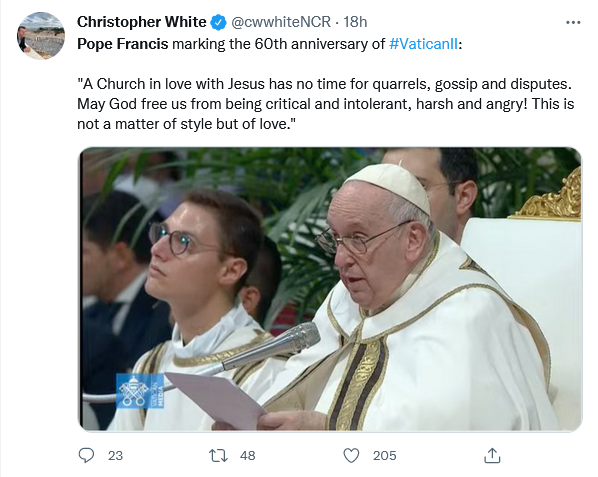
 Translation: Do as I say, sometimes, and not as I do, always. And the beatings will continue until you all feel the Love!



Translation: Do as I say, sometimes, and not as I do, always. And the beatings will continue until you all feel the Love!
There are some excellent essays over at Crisis Magazine’s site which provide a somewhat less effusive view of Vatican II 60 years later, especially the ones by editor Eric Sammons and by Fr. Perricone. Highly recommended.
As someone who felt great hope when Vatican II was announced, I now have great disappointment how it was implemented. I do not blame just this Pope but also an atmosphere that developed among our more adventurous clerics that amounted to a do it yourself as you go along mentality. To many in the pews, the rock of Peter is less and less a firm base on which to cling.
Reform was needed, but it did not have to look like what was served up.
The physician definitely did not heal himself.
Which is fine–if you look at the second millennium of Catholicism, councils were very hit and miss when it came to stated goals. I daresay that Trent was the outlier, really. And that was likely the case because it was a death-struggle for survival, which concentrates the mind wonderfully.
Vatican II has clearly failed of its stated goal, at least outside of Africa and parts of Asia. The smart money would be to move on, instead of indulging in self-serving, ahistorical catchphrases like “it takes a century for a council to take hold.”
The problem is that the cabal in charge wants to triple down on a more-of-the-disease cure. If we’re lucky, the Church will divest itself of such compromised churchmen and their thinking.
But we haven’t been lucky for a while now.
[…] Links: Papal Beatings Will Continue Until You All Feel the Love – D McClarey JD/The American Catholic Castration for Boys, Hysterectomies for Girls without […]
Reform was needed
Reform is always ‘needed’. In regard to Vatican II, did the Council actually address any problem which required an oecumenical council to address it and did it actually improve matters in any realm.
Many years ago Dom Bettinelli rented a room in a local rectory. He got to hear priests’ table talk and it was something of an education in how the sausage is made. The clergymen did bring up some issues in their table talk that identified one post-Vatican reform that had been beneficial. It had to do with standards and practices in handling money. Parishes had formerly been personal benefices of the pastor, and the priests recalled situations they’d known of where the curates did the work and the crooked absentee pastor showed up to collect a wad of cash, disappearing until the following week. Did we need an ecumenical council to address that?
One positive clarification VII made was in respect to the actual authority of bishops, which I think was a much needed clarification. Unfortunately, many events following in the intervening decades up until and including the present have all but occluded that and practically made the bishops into franchisees of the Vatican, as if the church is now some form of Chik-Fil-A except for being open on Sundays (well, except during the last couple years…). So while I think the clarification was good, unfortunately the result has been less than satisfactory.
Unfortunately, many events following in the intervening decades up until and including the present have all but occluded that and practically made the bishops into franchisees of the Vatican, as if the church is now some form of Chik-Fil-A except for being open on Sundays (well, except during the last couple years…). So while I think the clarification was good, unfortunately the result has been less than satisfactory.
Huh? There are 3,000 ordinaries worldwide. The Holy See can provide prudent and faithful guidance or it can make embarrassing messes that faithful clergymen have to figure out how to explain. It does not have the manpower to actually supervise diocesan operations (though it can make decisions which disrupt them episodically. See Paul VI running interference for the priests disciplined by Cdl. O’Boyle in Washington in 1971).
There are a lot of faggots in the kitchen.