
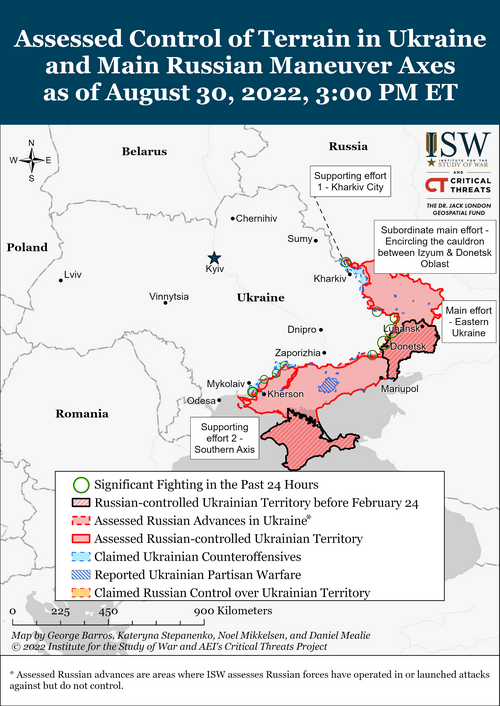
From The Institute For The Study of War:
Russian Offensive Campaign Assessment, August 30
Kateryna Stepanenko, Karolina Hird, George Barros, Grace Mappes, and Frederick W. Kagan
August 30, 10:30 pm ET
Click here to see ISW’s interactive map of the Russian invasion of Ukraine. This map is updated daily alongside the static maps present in this report.
Ukrainian forces began striking Russian pontoon ferries across the Dnipro River on August 29, which is consistent with the start of the Ukrainian counteroffensive. The effects of destroying ferries will likely be more ephemeral than those of putting bridges out of commission, so attacking them makes sense in conjunction with active ground operations. Ukrainian military officials confirmed that Ukrainian forces destroyed a Russian pontoon-ferry crossing in Lvove, approximately 16km west of Nova Kakhovka on the right bank of the Dnipro River on August 29.[1] Ukrainian and Russian sources have also reported that Ukrainian forces struck a pontoon crossing constructed out of barges near the Antonivsky Road Bridge.[2]
Ukrainian forces have long undertaken efforts to destroy Russian ground lines of communication (GLOCs) prior to the announcement of the counteroffensive operation, which likely indicates that Ukrainian forces are committed to a long-term effort – composed of both strikes and ground assaults. Ukrainian strikes on Russian GLOCs disrupt the Russians’ ability to supply and reinforce their positions with manpower and equipment, which will assist Ukrainian ground counteroffensives. Satellite imagery shows that Russian forces are continuing to use ferries to transfer a limited amount of military equipment daily via the Dnipro River.[3]
The Ukrainian counteroffensive is thus a cohesive process that will require some time to correctly execute. The Kremlin will likely exploit the lack of immediate victory over Kherson City or Ukrainian operational silence on the progress of the Ukrainian counteroffensive to misrepresent Ukrainian efforts as failing and to undermine public confidence in its prospects.
Russian forces are continuing to react and adjust their positions throughout southern Ukraine, likely both as a response to the ongoing Ukrainian counteroffensive and in preparation for broader Ukrainian counter-offensives further east. Russian forces are continuing to transfer large convoys of military equipment from Crimea and Melitopol.[4] Melitopol Mayor Ivan Fedorov also noted that Russian forces have opened up around five military bases and barracks in Melitopol and will likely continue to prepare defenses around Melitopol given its strategically vital GLOCs between Rostov Oblast and southern Ukraine.[5] The Ukrainian Southern Operational Command reported that Russian forces in Kherson Oblast are attempting to conduct rotations of troops, likely in an effort to reinforce some vulnerable positions.[6]
The Ukrainian counteroffensive is likely driving Russian redeployment and reprioritization throughout the theater. The Ukrainian General Staff reported that Russian forces are reinforcing the grouping of forces operating west of Donetsk City area with elements of the Central Military District (CMD).[7] ISW has previously identified that CMD units, under the command of the CMD Commander Colonel General Aleksandr Lapin, operated in the Lysychansk-Siversk area and recently concluded an operational pause in mid-August.[8] The movement of CMD units to Donetsk City area further suggests that Russian forces are deprioritizing the Siversk advance in favor of attempting to sustain momentum around the Donetsk City area. ISW has previously reported that Russian advances around Avdiivka and the western Donetsk City area have effectively culminated following Russian limited breakthroughs around the Butivka Coal Mine ventilation shaft.[9] The redeployment suggests that the Russian command has recognized that it cannot pursue more than one offensive operation at a time.
The Ukrainian General Staff also reported that Russian forces are deploying elements of the newly-formed 3rd Army Corps, which is at least in part composed of inexperienced volunteers, to reinforce neglected Russian positions in Kharkiv and Zaporizhia Oblasts.[10] The deployment of the 3rd Army Corps may indicate that Russian forces seek to recoup combat power for use in offensive operations around Donetsk City or defensive operations in Kherson by replacing experienced troops with raw and poorly trained volunteer units.
Russian President Vladimir Putin is likely setting conditions for the coerced cultural assimilation of displaced Ukrainians in Russia to erase their Ukrainian cultural identity. Head of the Russian Federal Agency for Ethnic Affairs, Igor Barinov, spoke about the creation of “adaptation centers” for “migrants” living in Russia with Putin on August 29. [11] Barinov stated that with Putin’s permission and support, the Federal Agency for Ethnic Affairs is working on programs in unspecified pilot regions to ensure that “migrants” to Russia know and respect Russian traditions, customs, and laws to prevent “migrants” from experiencing “social isolation” in Russia.[12] Barinov claimed that there is a risk of ethnic minorities in Russia forming enclaves that will exacerbate ethnic crime within Russia, and that “adaptation centers” would be an effective tool in maintaining the stability of migrant communities.[13] Russian outlet Vot Tak amplified statements made by Russian migration expert Alexander Verkhovsky that such programs should structure themselves as something between refugee camps and vocational training centers for migrants.[14] Verkhovsky also noted that over 3.5 million displaced Ukrainians have entered Russia since the full-scale invasion began on February 24.[15] Many displaced Ukrainians in Russia are not in Russia voluntarily, and the Russian government has forcefully transferred at least 1,000 children from Mariupol to Russia.[16] The forcible transfer of children of one group to another “with intent to destroy, in whole or in part, a national, ethnical, racial or religious group” is a violation of the Convention on the Prevention and Punishment of the Crime of Genocide.[17]
The creation of so-called social adaptation programs in Russia would add a social dimension to the legal frameworks through which Putin likely seeks to forcibly culturally assimilate Ukrainians into the Russian Federation. As ISW previously reported on August 29, Putin signed two decrees on August 27 in a purported effort to assist stateless peoples and migrants from Ukraine to indefinitely live and work in the Russian Federation with certain social payments allocated to those who left Ukraine following February 18.[18] Russian Security Council Chairman Dmitry Medvedev also stated that Russia will begin working on a bill in September for the condition of entry, exit, and stay in Russia for foreigners.[19] Putin’s decrees and the bill alluded to by Medvedev are likely meant to set conditions for migrants from Ukraine to remain in Russia permanently, thus essentially forming the backbone of an extended campaign to at population transfer between Ukraine and Russia with the purpose of Russifying Ukraine. Programs at so-called adaptation centers would likely serve as a form of cultural reprogramming to erase Ukrainian cultural identity from displaced Ukrainian who either fled to Russia or were deported by Russian authorities.
Key Takeaways
- Ukrainian forces continued counteroffensive operations with ground assaults and strikes against Russian GLOCs across the Dnipro River. Ukrainian forces made gains on the ground and have begun striking pontoon ferries across the river.
- Russian President Vladimir Putin is likely setting legal and social conditions for the coerced cultural assimilation of displaced Ukrainians in Russia to erase their Ukrainian cultural identity.
- Russian forces conducted a limited ground attack north of Kharkiv City.
- Russian forces conducted limited ground attacks southwest of Izyum, south of Bakhmut, and near the western outskirts of Donetsk City.
- Russian forces conducted a limited ground attack in northern Kherson Oblast.
- An anonymous senior US military official stated that the US believes that Russia is firing artillery from positions around and in the vicinity of the Zaporizhzhia Nuclear Power Plant.
- Russian occupation authorities are continuing efforts to forcibly-integrate schools in occupied Ukraine into the Russian educational system and extending methods of social control.
- Russian forces are continuing to move military equipment into Crimea.
- Russian federal subjects (regions) are continuing to recruit and deploy volunteer battalions.
- Russian occupation authorities are taking measures to forcibly-integrate Ukrainian schools into the Russian education space in preparation for the approaching school year.
Go here to read the rest.
From Strategy Page:
August 29, 2022: Russia is losing control of the 20 percent of Ukrainian territory they occupy. Even in areas (Crimea and Donbas) occupied since 2014) the inhabitants are refusing to support the Russian war effort. Currently, few Ukrainians or Russians living in Crimea or Donbas are willing to join the military or police. This is the result of the populations in Crimea and Donbas realizing that Russia could lose control of these areas to Ukrainian forces, which does not work out well for “collaborators.” Returning to post-war Russia is not an attractive prospect either. One thing both Ukrainian residents and Russian immigrants of these occupied territories have learned since 2014 is that living standards are higher in Ukraine than in Russia. When Ukraine became independent of Russia in 1991, living standards were equal. Russian soldiers invading Ukraine since then were surprised at how much better Ukrainian living standards had become than Russia’s. Russian propaganda had implied that Ukrainians were repressed and impoverished, not better off and willing to fight and defeat their Russian “liberators”.
Local security forces in Crimea and Donbas have been there since 2014 but the high casualties suffered by front line troops meant a lot the troops occupying Crimea and Donbas were sent to the front, where most became casualties. Russia needs fewer troops in Crimea now that they have withdrawn most of their warships, aircraft and shipyard workers to Russia. Ukrainian partisans have been more active in Crimea, destroying military aircraft with seeming impunity. Similar attacks are made on prominent Russians in Crimea and Ukrainian collaborators. In Donbas ethnic Russians and their Ukrainian collaborators are also under attack and departing for Russia or, if Ukrainian, quietly switching sides. Donbas used to be a good source of Russian troops but the heavy casualties and Ukrainian offensive and partisan activity in Donbas has put an end to Russian recruiting efforts there.
Russia did manage to occupy most of Kherson province north of Crimea but holding on to it is another matter. The Russians were never able to establish full control over Kherson and now the province is a major target for Ukrainian offensive operations. Russian troops are being forced back in Kherson and partisan activity is growing. Kherson must be liberated before the Ukrainians can go after Crimea. Russia does not have enough troops to prevent that. The Ukrainians are patient and not attempting a reckless and costly offensive. Time is on their side and, while Ukrainian troops get better, Russian troops get worse.
Despite all these efforts Russia cannot obtain enough troops to win in Ukraine, much less stop the Ukrainian offensive. As a result, Russian occupation forces in Kherson are on the defensive and taking heavy losses. Using the nuclear power plant complex in Kherson to cause a nuclear accident has the rest of the countries in the region protesting Russian threats to release a lot of radioactivity that will cause problems for Russia and other nearby countries. This threat has created a lot of international criticism of Russian tactics in Ukraine.
Ukrainian forces can bypass the power plant complex and give the Russian forces there a chance to surrender and avoid war crime prosecutions (or death from radiation sickness). Russian forces occupying the nuclear complex appear aware of this and are preparing to evacuate before being surrounded. Failing that the Russians appear unwilling to cause a nuclear accident.
Go here to read the rest. The Ukrainian counter offensive will eventually be judged by how much territory it takes and holds.

