
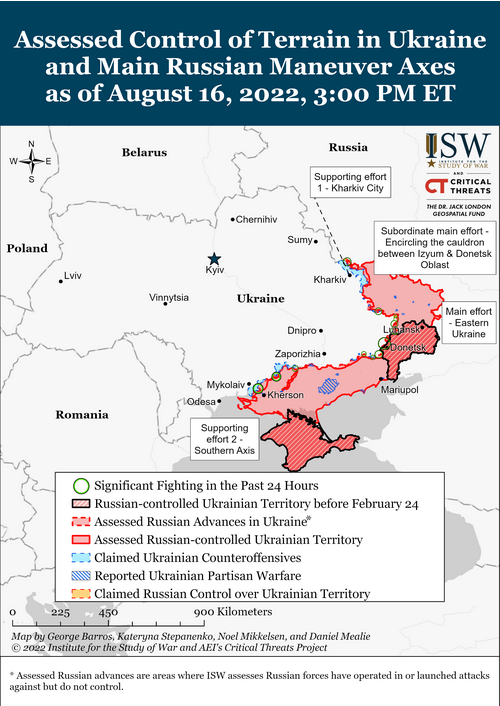
From The Institute For The Study of War:
Kateryna Stepanenko, Grace Mappes, Angela Howard, George Barros, and Frederick W. Kagan
August 16, 9 pm ET
Click here to see ISW’s interactive map of the Russian invasion of Ukraine. This map is updated daily alongside the static maps present in this report.
Russian and Ukrainian sources reported explosions at an airfield and a critical Russian supply nexus in Crimea on August 16. Local reports and videos show a series of explosions at a Russian ammunition depot and a transformer substation in Dzhankoiskyi District and an airfield near Hvardiiske, Crimea.[1] These explosions both caused significant damage to Russian resources and seriously disrupted Russian logistics. Russian forces have used Dzhankoi as a railway hub for transporting troops and equipment to occupied settlements in southern Zaporizhia Oblast, including Melitopol.[2] Russian authorities temporarily suspended passenger rail service from Russia into Crimea following the attack.[3]
Ukrainian forces have not officially claimed responsibility for these explosions. The New York Times reported that an anonymous senior Ukrainian official attributed the explosions in Dzhankoiskyi District to “an elite Ukrainian military unit operating behind enemy lines,” but no Ukrainian official has publicly come forward to claim responsibility.[4] The Russian Ministry of Defense released a statement calling the explosions “a result of sabotage.”[5]
A Ukrainian strike on logistical targets in Crimea, which is the sovereign territory of Ukraine, would not violate Ukrainian commitments to Western partners regarding Ukraine’s use of Western-supplied weapons within Ukrainian territory or stated US policy regarding Ukraine’s right to use force to regain control of all its territory including areas seized by Russia in 2014.[6] There are no indications that Ukrainian forces used US-supplied weapons in recent strikes on Crimea, and it is unlikely that they did since the targets are well beyond the range of the US-provided systems.
Attacks on Russian positions in and around Crimea are likely part of a coherent Ukrainian counter-offensive to regain control of the west bank of the Dnipro River. Russian supply lines from Crimea directly support Russian forces in mainland Ukraine including those in western Kherson Oblast. Ukraine’s targeting of Russian ground lines of communication and logistic and support assets in Crimea is consistent with the Ukrainian counteroffensive effort that has also targeted bridges over the Dnipro River and Russian logistical support elements in occupied Kherson Oblast.[7] The net effects of this campaign will likely be to disrupt the ability of Russian forces to sustain mechanized forces on the west bank of the Dnipro River and to defend them with air and artillery assets on the east bank from Ukrainian counterattacks.
The Kremlin continues efforts to misrepresent its likely maximalist goals in Ukraine. ISW assesses that Russian strategic objectives remain unchanged: changing the regime change in Kyiv and securing territorial control over most of Ukraine. Russian President Vladimir Putin omitted mention of territory outside of Donbas while describing the goals of Russia’s war in Ukraine on August 15. Putin closed his preliminary remarks to the Army-2022 forum on August 15 with the claim that Russian and Donbas forces are “doing their duty” to fight for Russia and “liberate” Donbas.[8] Such a limited statement of Russian goals sharply contrasts with previously articulated Russian war goals to “denazify” and “demilitarize” all of Ukraine. Putin‘s relatively limited statement additionally is incompatible with Russian actions to integrate occupied parts of Kherson and Zaporizhia Oblasts into the Russian Federation.
Key Takeaways
- Russian forces conducted ground attacks across the Eastern Axis but failed to advance northwest of Slovyansk and east of Siversk.
- Russian forces are launching offensive operations around Bakhmut, southwest of Avdiivka, and southwest of Donetsk City.
- Russian forces conducted unsuccessful offensive operations in northern and northwestern Kherson Oblast.
- The Russian Defense Ministry claimed that Ukrainian forces in Nikopol are preparing to conduct provocations at the Zaporizhia Nuclear Power Plant, possibly setting information conditions for further shelling of Nikopol or provocations of its own.
- Chechen units are reportedly relocating to Kherson Oblast to police Russian military deserters.
- Russian forces struggle to recruit soldiers even for safe, prestigious jobs.
Go here to read the rest.
From Strategy Page:
August 16, 2022: President-for-Life Vladimir Putin is trying to enforce a law he had had enacted a month ago that allows the government to impose wartime conditions on military suppliers who are not fulfilling their contracts. Sanctions on Russia from its invasions of Ukraine have cut off supplies of key components. The new law is vague on what the government can do other than order changes to working conditions and how managers operate. These are Soviet-era rules. Putin is thinking World War II while the rest of the world sees the 1980s.
Putin is seeking to find $10 billion to augment the current defense budget, which so far this year is about $6.6 billion a month. For all of 2021 Russia spent $5.42 billion a month. Russia claims its economy is doing well. Foreign economists studying the matter come to a different conclusion. It is believed that Russian GDP will shrink more than fifteen percent in 2022. It’s worse in Ukraine, where deliberate Russian attacks on economic targets are causing long-term economic damage. In Russian-occupied Ukraine there is no effort to repair economic damage and useful economic assets are shipped back to Russia. This is the ancient strategy of “creating a desert and calling it peace”. Russian attempts to mobilize its economy for wartime production continue despite senior government economic officials pointing out that Western sanctions emphasize crippling weapons production. Putin insists Russia will find a solution, as it did during World War II. This assessment ignores how Russia lost the Cold War when its empire literally fell apart because of economic mismanagement while its World War II victory was due in large part to essential Western economic and military aid.
Ukraine Attacks
Ukraine has, without much fanfare, started its offensive to expel Russian forces from all occupied areas of the country. This comes months after the Russian invasion that everyone, including the U.S., other NATO nations and Russia believed would be over in a few weeks. Ukraine knew better, as did American and other NATO troops who had worked with the Ukrainians since the first Russian land grab in 2014. By late 2021 NATO nations were already supplying Ukraine with modern weapons requested by the Ukrainians.
The Ukrainians were winning because they had superior planning, tactics, equipment, morale, Information War capabilities, intel and logistics.
Planning And Tactics
Ukraine had learned a lot about Russian tactics and equipment capabilities since 2015. The ceasefire line in Donbas was always active, with Russian forces constantly violating the truce but not getting much to show for it. Ukraine learned from the Donbas experience, Russia did not. Since 2014 Ukraine has had support from NATO countries, including military observers, advisers and technical specialists. Between Donbas and Syria, much was learned about what Russian equipment could and could not do in a combat situation. As a result, Russia found its forces and weapons far less effective than expected. In contrast Ukrainian forces preparations were far more effective. Russian soldiers, most with no combat experience and many not even aware they were invading Ukraine, were prepared for what they faced. As the fighting continued the Ukrainian adapted to change far more quickly than the Russians, who had suffered very heavy losses, not just from being on the attack against a superior defender, but because of desertion, refusal to fight and acute shortage of replacements and new recruits.
Equipment
After 2014 Ukraine kept its military equipment in better shape than the Russians. Since Ukraine used to be part of the Soviet Union, much of its military equipment was similar to what the Russians had. The difference was that Ukraine maintained the equipment and kept track of its status accurately. The Russians had problems in both these areas and that became obvious once the fighting began. Since 2014 Ukraine received more and more Western weapons and equipment and deliveries accelerated in the months before the Russians invaded. Since February Ukraine has been receiving larger quantities of weapons and equipment. Much of it is new but a lot of it is from NATO neighbors that still have some of their Soviet era equipment and are sending most of it to Ukraine.
The disparity in equipment quality and quantity widened as the war went on. This is a major embarrassment for Russia, which has not fired senior officials responsible, like the Minister of Defense, because that would draw attention to the poor pre-war preparations. Unlike Ukraine, Russia has few foreign sources of new equipment. One exception is Iran, which has provided UAVs in a trade deal that involved Iranian access to modern Russian warplanes.
Morale
Russian political and military leaders seem surprised at the extent to which Russian soldiers are refusing to fight in Ukraine. Perhaps someday these leaders will realize that this should not have been a surprise. While Russian leaders earlier made much of reforming the military and upgrading its equipment, they ignored fundamentals like willingness to fight. In modern war the infantry is a minority (10 to 25 percent of troops) but takes over 80 percent of the casualties and are essential in any war or battle.
Vladimir Putin realized there might be problems if his troops did not win a quick victory. There was no victory, quick or otherwise. The Ukrainians fought back and forced the Russian troops trying to quickly take the Ukrainian capital to withdraw to Russia and redeploy to eastern Ukraine and Crimea, areas Russia had seized in 2014 but were stopped in by unexpected Ukrainian resistance. These setbacks hurt Russian troop morale and inspired more Ukrainians to volunteer for military service to preserve their national independence if the Russians attacked again.
In 2022 the defeated Russian forces reacted differently to their defeat. Russian combat troops accused their government of sending them up against a formidable enemy that they were told would not resist. Many Russian troops were angry over the fact that they were not told they were invading Ukraine, leaving them to discover that only when they came under heavy fire after crossing the border they were not told about. After a few months of fighting Putin acted surprised as many Russian soldiers refused to go to Ukraine and many of those in Ukraine refused to fight.
As word spread inside Russia about what was going on in Ukraine, parents of conscripts backed their sons who were trying to stay out of the army and most definitely out of Ukraine. Putin apparently did not appreciate the fact that he was facing over a century of heavy losses and bad leadership that had killed millions of Russians, in addition to those killed by enemy troops. The Rodina (the Russian people) had not forgotten because it was the Rodina that died, not their leaders. The bill for over a century of such attitudes came due on Putin’s watch.
After more than a century of lies, deceit, poor leadership and heavy losses, the young Russian men headed for the infantry, as well as their families, are refusing to be killed in another unnecessary war in Ukraine. Defending Russia is another matter, but Putin’s attempt to call the invasion an internal problem with a wayward region, did not work.
Before the war Ukrainian military and information analysts predicted that the Russians would run out of soldiers because of low morale and that got worse once the magnitude of the Russian defeat became known to the Russian public. That news took longer to reach most Russians because of censorship. By May the Russian army was visibly shrinking from losses that amounted to nearly 100,000 Russian soldiers killed, wounded, captured or deserted. That’s nearly 40 percent of the Russian ground forces and few Russians were willing to join the army, either as a conscript or volunteer.
Desperate measures were required and the Russian government has employed most of them. They lowered the standards for conscripts and volunteers, encouraging unfit Russians to join. That did not work out well. Russia loosened the qualifications for volunteers, allowing men up to 60 years old to join. It was easier to find recruits in rural areas, where there was more poverty and less access to outside (of Russia) news. Most of the active (and passive) opposition to the war was in the cities. That’s where most of the anti-war demonstrations and physical attacks on recruiting stations take place. Despite that the government ordered urban recruiters to call in older (40s) veterans for an interview. If that fails the recruiters must ask the veteran if they would sign an affidavit affirming that they spoke to the recruiter and refused to join. Most of the reluctant vets sign, if only to annoy the government. Back in Soviet days such defiant behavior could get you in trouble. Despite the current authoritarian government, times have changed in Russia.
Russia also spent a lot of scarce cash on a program to form battalions in dozens of regions where bonuses and high pay were offered to volunteers, especially veterans, who would join the local battalion and enter combat alongside other locals. This program had some success, especially in poor rural areas. These new volunteers still required at least two months of training to prepare them for what they would face in Ukraine. Russia also had to supply armored vehicles and artillery for these battalions, most of them to be organized as BTGs (Battalion Task Groups). None of these new regional units has been in combat and those sent to Ukraine are placed in dormant areas where they can gain some exposure to the combat zone without taking heavy losses during their initial battles. Most of the regional volunteers were never suitable for combat because the program was crippled by corruption, mismanagement and a shortage of useful volunteers. Desperate to get something out of this, some individuals were sent to Ukraine without much training to replace combat losses. This included a lot of the older volunteers who had served in the military decades ago. Many were attracted by the relatively high pay and even higher signing bonuses, which the volunteers were told they would receive once they reached Ukraine. The federal government was supposed to help pay the volunteers but sometimes did not.
Another mobilization effort relied on the Wagner Group PMC (private military contractors) and several similar but smaller PMCs. The Wagner Group was created by Putin and works for him. Wagner is selective about who they accept and pay the highest rates any Russian military personnel in Ukraine get. To help with the troop shortage in Ukraine Wagner created an economy grade contractor that was cheaper because there were lower qualifications for the job that paid less, but enough to make it attractive. An additional source of cheap contractors was recruiting prison inmates who were offered contracts which, if completed, included cancellation of remaining prison time. Wagner Group personnel are now often the only ones available to make crucial attacks and even that is often not enough.
Ukrainian forces have proved to be far more resourceful, skilled and determined than the Russians expected and Wagner personnel were ordered to ignore the rules that soldiers are bound by. That made the PMC forces more effective but also a prime target for Ukrainian guided missiles or airstrikes. Despite that, Russian military contractors suffer lower casualties because of better leadership and morale. The contractors are also better at assessing a combat situation and declining to make attacks with little chance of success. Some veteran PMC men are not renewing their contracts or simply quitting and accepting the financial penalties for doing so.
Manpower shortages remain a major problem for the Russians. Their many improvisations have not solved the problem while contributing to continued high casualties because Russia has been sending anyone willing to serve in Ukraine, even if such volunteers are too old, unstable or inexperienced to be of any use. For experienced Russian troops, low-quality replacements like this are worse than no replacements at all. So far, nothing Russia has tried has generated enough additional troops to increase their troop numbers inside Ukraine. Currently Ukraine has about twice as many troops available but cannot fully use that advantage because most of them have little formal training. NATO nations help with this by establishing training centers in NATO countries bordering Ukraine. This is in addition to training programs inside Ukraine. Despite these efforts, it will be six months or more before most of the recent volunteers get their basic military training. The training includes the use of some combat veterans, who also update the training curriculum to include the latest lessons learned. Not enough combat vets are available for the training programs because there is a severe shortage of NCOs and junior officers in many units. This is because the army expansion was so large and fast, there were not enough NCOs and junior officers available in February 2022 to deal with combat and training needs. Unlike the Russians, Ukraine considers it a priority to keep their combat casualties as low as possible.
Go here to read the rest. Russia is clearly ceding initiative in the War to Ukraine. This is sizing up to be the biggest Russian defeat since the Russo-Japan War of 1904-1905. Losing wars and revolutions are a significant twinned feature in Russian history.


There is a rather contradictory dichotomy developing in the Russian homeland with a majority of the people believing that Putin had a valid reason to invade Ukraine but the same majority wished to have nothing to do with the operation.. Memories of the failed Afghanistan adventure still linger in the mind.
Putin does not seem to be going “full Stalin” on his opposition at this point. Is it because he doesn’t want to or because he can’t?
Putin began the war with inadequate forces, and I think he fears domestic unrest if he really tries to put Russia on a war footing.