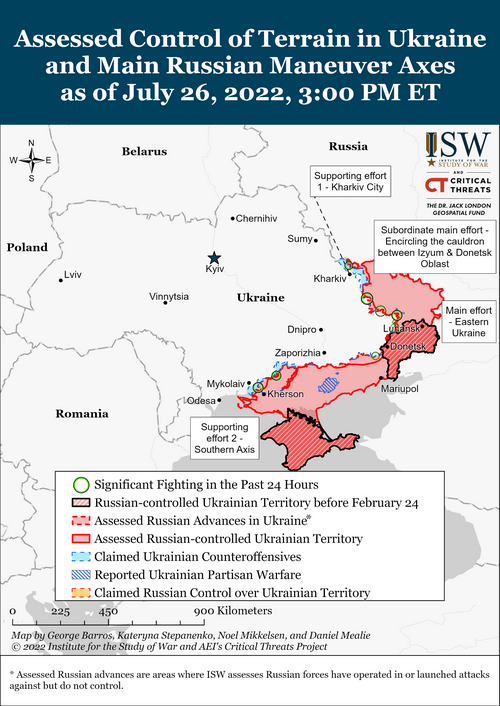
From The Institute For The Study of War:
Karolina Hird, Kateryna Stepanenko, Katherine Lawlor, Layne Philipson, and Frederick W. Kagan
July 26, 7:15 pm ET
Click here to see ISW’s interactive map of the Russian invasion of Ukraine. This map is updated daily alongside the static maps present in this report.
Russian-backed proxy leadership continues to enunciate deadlines for the capture of additional Ukrainian territory, likely to support ongoing preparations for referenda on the annexation of these territories to the Russian Federation. Donetsk People’s Republic (DNR) Deputy Minister of Information Daniil Bezsonov stated on July 25 that the DNR expects to capture the entirety of Donetsk Oblast by the end of August.[1] Various Russian and Western sources have previously reported that Russia intends to hold referenda in occupied areas by the first half of September, likely sometime around September 11, which is the unified voting day in the Russian Federation.[2] Proxy leadership and Russian-backed occupation authorities are likely pushing for deadlines for military objectives to support condition setting for expedited annexation objectives, although Russian forces remain unlikely to occupy significant additional territory in Ukraine before the early autumn annexation timeline.
Key Takeaways
- Russian proxy and occupation leadership is enunciating expedited deadlines for the capture of Ukrainian territory to align with the Kremlin’s efforts to prepare for the annexation of occupied territories into the Russian Federation.
- Russian forces gained marginal ground northeast of Bakhmut and are continuing to fight east and south of Bakhmut.
- Russian forces conducted a limited attack northwest of Izyum, likely to secure Russian rear areas on the Izyum-Slovyansk line.
- Russian forces conducted limited attacks southwest of Donetsk City near the Zaporizhia Oblast border.
- Russian forces focused on defending occupied lines and conducted a limited ground assault in northwestern Kherson Oblast.
- Ukrainian forces continued to strike Russian logistics nodes in Kherson Oblast.
- The Kremlin is continuing to constitute regional volunteer battalions for deployment into Ukraine.
- Ukrainian intelligence leaks continue to reveal the Kremlin’s annexation agendas for occupied Ukraine by way of falsified referenda.
Go here to read the rest.
From Strategy Page:
July 26, 2022: The Czech Republic and other East European NATO members are quietly donating hundreds of Russian helicopters, tanks, rocket launchers, rockets, artillery shells and other items of military equipment to Ukraine without providing many details. This forces Russia to guess who gave what and when, which is fine with Ukraine, where Western systems get most of the detailed publicity.
The Czech are apparently unloading their entire inventory of Russian Mi-35/24V armed transports as well as older Mi-8 and Mi-17 transports. All of these are basically the Mi-8, the Russian answer to the American UH-1, and both helicopters are still in production. The Czech Mi-8s are being replaced by eight newly built UH-1Y transports and four AH-1Z gunships. The AH-1 was the first helicopter gunship, which was basically a reconfigured UH-1. The Russians also used their Mi8 as the basis for their early gunships, but did so by just adding a lot of weapons and a fire control system to an M-8 and calling it an Mi-24 gunship. By the end of the 20th century, it was possible to simply add lots of weapons and a fire control system to an Mi-8 to create a really formidable “armed transport” while retaining much of the transport capability. This worked on the Mi-8 because it was larger and heavier than the UH-1. There were always a lot of AH-1 gunships, and in the 1980s, AH-64 gunships. In the American military the larger and more capable UH-60 began replacing UH-1s in the 1980s. That process was only completed in the last few years because there were a lot of jobs the elderly UH-1 were still quite capable of handling. For many countries the cheaper but updated UH-1 and AH-1 remain cost-effective.
The Mi-8 took on a number of different names over the years. The export model of the Mi-8 was the Mi-17 while the gunship version was the Mi-24 with the export model called the Mi-35. All of these were regularly upgraded over the decades and the latest gunship versions are Mi-24V and Mi-35M. which sell for $10 to15 million each. The Czechs received at least fourteen of the later Mi-24/35 models two decades ago from Russia to repay debts for non-military Czech exports to Russia. Some of these Mi-24/35s are still in service with the rest in storage. At least two active-duty Czech Mi-24Vs were spotted in Ukraine with the Czech air force markings painted over with Ukrainian identification.
The Ukrainians use most of the Czech-donated Russian Mi-8 type helicopters as transports. Helicopter gunships face a lot of hostile fire in combat zones and the Ukrainian need transports more than gunships. These helicopters can carry up to three tons of cargo or 24 passengers.
The Mi-24/35 gunship models still retain a lot of cargo/passenger space that can hold up to eight people, or four stretchers. The basic Mi-8 is a 12-ton helicopter with a reputation for reliability. Most have an availability rate of at least 70 percent. Without all the space and weight taken up by weapons and other accessories, the ability to carry up to three tons of cargo or 24 passengers on missions lasting up to two hours at speeds of up to 335 kilometers an hour is a valuable air transport asset.
Go here to read the rest. More of the same as the Russian war effort seems stuck in Neutral.