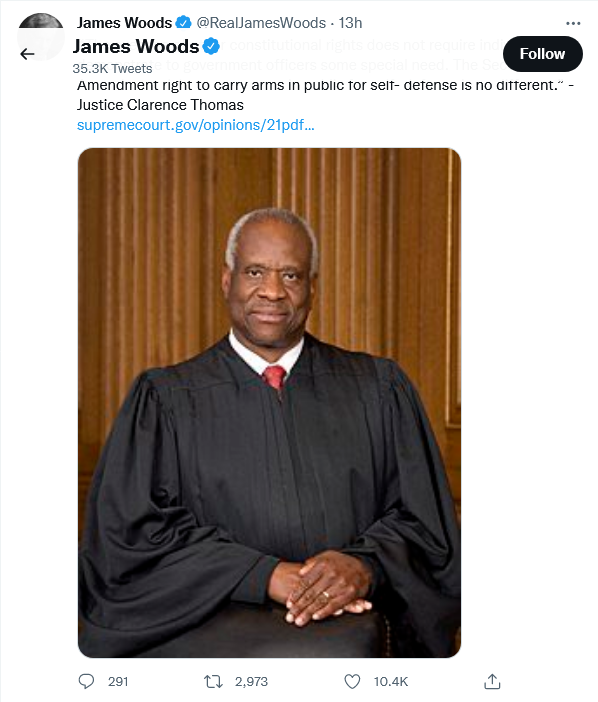
News that I missed, courtesy of The Babylon Bee:
WASHINGTON, D.C.—Justice Clarence Thomas has been rushed to a burn ward in Washington after he scorched his hands writing another “absolutely fire” Supreme Court opinion this morning in the case of New York State Rifle & Pistol Association Inc. v. Bruen, sources at SCOTUS confirmed today.
Thomas suffered the injuries after finalizing his opinion on the Second Amendment gun rights case and submitting it for publication.
“Hmmm, let’s see – why don’t I write a paragraph pointing out how gun control has been used by racists to keep black people unarmed,” the justice muttered to himself, causing his keyboard to begin to glow orange like a hot bed of coals. “Now, I’m just going to absolutely wreck Democrats’ argument that the Second Amendment isn’t necessary in the 21st century.”
Fire then erupted from his computer, according to witnesses.
“Oh no – I’ve done it again,” he said as his hands burst into flames, igniting his desk, carpet, and Trump bobblehead. “I hate it when this happens! Clerks! Get the fire extinguisher!” Clerks rushed into the room and broke the glass reading, “Break in case of fire opinion” and tried to put him out, but they couldn’t, as “the opinion was just too fire.”
Ambulances quickly arrived on scene and carted Thomas to his private burn ward, reserved for just such an occasion.
“He comes in here three or four times a week,” said his doctor. “We keep telling him to keep it easy and hold back on his absolutely scorching opinions, but he just doesn’t listen. He’s been diagnosed with a condition known as ‘being totally based.'”
“It’s incurable, sadly.”
Go here to read the rest. Since the death of Scalia this has been the Thomas Court:
A short prologue is in order. Even before the Civil War
commenced in 1861, this Court indirectly affirmed the im–
portance of the right to keep and bear arms in public. Writ–
ing for the Court in Dred Scott v. Sandford, 19 How. 393
(1857), Chief Justice Taney offered what he thought was a
parade of horribles that would result from recognizing that
free blacks were citizens of the United States. If blacks
were citizens, Taney fretted, they would be entitled to the
privileges and immunities of citizens, including the right
“to keep and carry arms wherever they went.” Id., at 417
(emphasis added). Thus, even Chief Justice Taney recog–
nized (albeit unenthusiastically in the case of blacks) that
public carry was a component of the right to keep and bear
arms—a right free blacks were often denied in antebellum
America.
After the Civil War, of course, the exercise of this funda–
mental right by freed slaves was systematically thwarted.
This Court has already recounted some of the Southern
abuses violating blacks’ right to keep and bear arms. See
McDonald, 561 U. S., at 771 (noting the “systematic efforts
made to disarm blacks); id., at 845–847 (THOMAS, J., con–
curring in part and concurring in judgment); see also S.
Exec. Doc. No. 43, 39th Cong., 1st Sess., 8 (1866) (“Pistols,
old muskets, and shotguns were taken away from [freed
slaves] as such weapons would be wrested from the hands
of lunatics”).
In the years before the 39th Congress proposed the Four–
teenth Amendment, the Freedmen’s Bureau regularly kept
it abreast of the dangers to blacks and Union men in the
postbellum South. The reports described how blacks used
publicly carried weapons to defend themselves and their
communities. For example, the Bureau reported that a
teacher from a Freedmen’s school in Maryland had written
to say that, because of attacks on the school, “[b]oth the
mayor and sheriff have warned the colored people to go
armed to school, (which they do,)” and that the “[t]he super–
intendent of schools came down and brought [the teacher]
a revolver” for his protection. Cong. Globe, 39th Cong., 1st
Sess., 658 (1866); see also H. R. Exec. Doc. No. 68, 39th
Cong., 2d Sess., 91 (1867) (noting how, during the New Or–
leans riots, blacks under attack “defended themselves . . .
with such pistols as they had”).
Witnesses before the Joint Committee on Reconstruction
also described the depredations visited on Southern blacks,
and the efforts they made to defend themselves. One Vir–
ginia music professor related that when “[t]wo Union men
were attacked . . . they drew their revolvers and held their
assailants at bay.” H. R. Rep. No. 30, 39th Cong., 1st Sess.,
pt. 2, p. 110 (1866). An assistant commissioner to the Bu–
reau from Alabama similarly reported that men were “rob–
bing and disarming negroes upon the highway,” H. R. Exec.
Doc. No. 70, 39th Cong., 1st Sess., 297 (1866), indicating
that blacks indeed carried arms publicly for their self-
protection, even if not always with success. See also H. R.
Exec. Doc. No. 329, 40th Cong., 2d Sess., 41 (1868) (describ–
ing a Ku Klux Klan outfit that rode “through the country
. . . robbing every one they come across of money, pistols,
papers, &c.”); id., at 36 (noting how a black man in Tennes–
see had been murdered on his way to get book subscrip–
tions, with the murderer taking, among other things, the
man’s pistol).
Blacks had “procured great numbers of old army muskets
and revolvers, particularly in Texas,” and “employed them
to protect themselves” with “vigor and audacity.” S. Exec.
Doc. No. 43, 39th Cong., 1st Sess., at 8. Seeing that govern–
ment was inadequately protecting them, “there [was] the
strongest desire on the part of the freedmen to secure arms,
revolvers particularly.” H. R. Rep. No. 30, 39th Cong., 1st
Sess., pt. 3, at 102.
On July 6, 1868, Congress extended the 1866 Freedmen’s
Bureau Act, see 15 Stat. 83, and reaffirmed that freedmen
were entitled to the “full and equal benefit of all laws and
proceedings concerning personal liberty [and] personal se–
curity . . . including the constitutional right to keep and bear
arms.” §14, 14 Stat. 176 (1866) (emphasis added). That
same day, a Bureau official reported that freedmen in Ken–
tucky and Tennessee were still constantly under threat:
“No Union man or negro who attempts to take any active
part in politics, or the improvement of his race, is safe a
single day; and nearly all sleep upon their arms at night,
and carry concealed weapons during the day.” H. R. Exec.
Doc. No. 329, 40th Cong., 2d Sess., at 40.
Of course, even during Reconstruction the right to keep
and bear arms had limits. But those limits were consistent
with a right of the public to peaceably carry handguns for
self-defense. For instance, when General D. E. Sickles is–
sued a decree in 1866 pre-empting South Carolina’s Black
Codes—which prohibited firearm possession by blacks—he
stated: “The constitutional rights of all loyal and well-
disposed inhabitants to bear arms will not be infringed;
nevertheless this shall not be construed to sanction the un–
lawful practice of carrying concealed weapons. . . . And no
disorderly person, vagrant, or disturber of the peace, shall
be allowed to bear arms.” Cong. Globe, 39th Cong., 1st
Sess., at 908–909; see also McDonald, 561 U. S., at 847–848
(opinion of THOMAS, J.).26 Around the same time, the edi–
tors of The Loyal Georgian, a prominent black-owned news–
paper, were asked by “A Colored Citizen” whether “colored
persons [have] a right to own and carry fire arms.” The ed–
itors responded that blacks had “the same right to own and
carry fire arms that other citizens have.” The Loyal Geor–
gian, Feb. 3, 1866, p. 3, col. 4. And, borrowing language
from a Freedmen’s Bureau circular, the editors maintained
that “[a]ny person, white or black, may be disarmed if con–
victed of making an improper or dangerous use of weapons,”
even though “no military or civil officer has the right or au–
thority to disarm any class of people, thereby placing them
at the mercy of others.” Ibid. (quoting Circular No. 5,
Freedmen’s Bureau, Dec. 22, 1865); see also McDonald, 561
U. S., at 848–849 (opinion of THOMAS, J.).27
##########################
At the end of this long journey through the Anglo-American
history of public carry, we conclude that respondents have
not met their burden to identify an American tradition jus–
tifying the State’s proper-cause requirement. The Second
Amendment guaranteed to “all Americans” the right to bear
commonly used arms in public subject to certain reasona–
ble, well-defined restrictions. Heller, 554 U. S., at 581.
Those restrictions, for example, limited the intent for which
one could carry arms, the manner by which one carried
arms, or the exceptional circumstances under which one
could not carry arms, such as before justices of the peace
and other government officials. Apart from a few late-19th–
century outlier jurisdictions, American governments simply
have not broadly prohibited the public carry of commonly
used firearms for personal defense. Nor, subject to a few
late-in-time outliers, have American governments required
law-abiding, responsible citizens to “demonstrate a special
need for self-protection distinguishable from that of the
general community” in order to carry arms in public.
Klenosky, 75 App. Div., at 793, 428 N. Y. S. 2d, at 257
Go here to read the rest.