
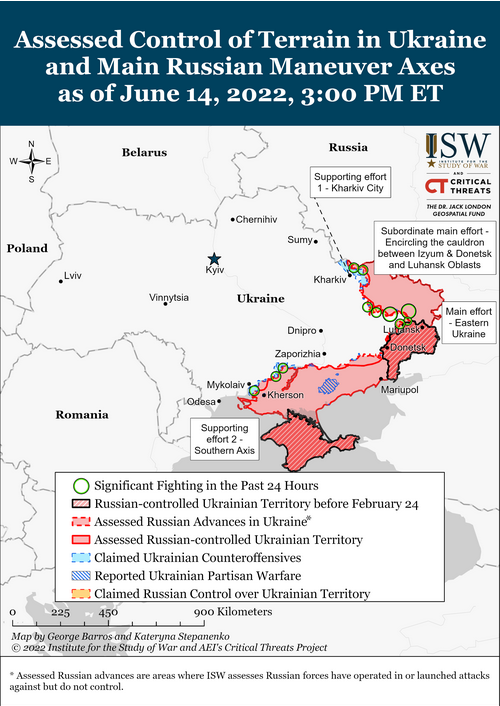
From The Institute For The Study of War:
Karolina Hird, Mason Clark, George Barros, and Grace Mappes
June 14, 5:00 pm ET
Click here to see ISW’s interactive map of the Russian invasion of Ukraine. This map is updated daily alongside the static maps present in this report.
The Belarusian Armed Forces began a command-staff exercise focused on testing command and control capabilities on June 14. However, Belarus remains unlikely to join the war in Ukraine on behalf of Russia. Head of Logistics for the Belarusian Armed Forces Major General Andrei Burdyko announced that the exercise will involve military authorities, unspecified military units, and logistics organizations and is intended to improve the coherency of command-and-control and logistics support to increase the overall level of training and practical skills of personnel in a “dynamically changing environment.”[1] Despite the launch of this exercise, Belarus remains unlikely to join the war in Ukraine due to the threat of domestic unrest that President Alexander Lukashenko faces if he involves already-limited Belarusian military assets in combat.[2] Any Belarusian entrance into the war would also likely provoke further crippling sanctions on Belarus. Any unsupported Belarusian attack against northern Ukraine would likely be highly ineffective, and the quality of Belarusian troops remains low. ISW will continue to monitor Belarusian movements but does not forecast a Belarusian entrance into the war at this time.
Russian authorities may be accelerating plans to annex occupied areas of Ukraine and are arranging political and administrative contingencies for control of annexed territories. Russian military correspondent Sasha Kots posted an image of a map that was displayed at the St. Petersburg Economic Forum depicting a proposed scheme for the “administrative-territorial” division of Ukraine following the war on a three-to-five-year transition scale.[3] The proposed scheme divides Ukrainian oblasts into Russian “territorial districts” and suggests the manner in which Russian authorities hope to incorporate Ukrainian territory directly into Russia. Advisor to the Mayor of Mariupol Petro Andryushchenko additionally outlined a series of indicators that he claimed suggest that Russian authorities are planning to annex occupied Donetsk Oblast as soon as September 1, 2022.[4] Andryushchenko stated that the leadership of occupied Donetsk has entirely passed from authorities of the Donetsk People’s Republic (DNR) to Russian officials and that Russian educational authorities are already referring to Donetsk, Luhansk, Zaporizhia, and Kherson as regions of Russia. Andryushchenko additionally stated that the financial and legal systems in occupied Donetsk have already transitioned to Russian systems. Despite the apparent lack of a Kremlin-backed mandate concerning the condition of occupied areas, Russian authorities are likely pushing to expedite a comprehensive annexation process in order to consolidate control over Ukrainian territories and integrate them into Russia’s political and economic environment. However, the Kremlin retains several options in occupied Ukrainian territory and is not bound to any single annexation plan.
The Russian military leadership continues to expand its pool of eligible recruits by manipulating service requirements. Russian milblogger Yuri Kotyenok suggested that Russian authorities are preparing to increase the age limit for military service from 40 to 49 and to drop the existing requirement for past military service to serve in tank and motorized infantry units.[5] If true, the shift demonstrates the Kremlin’s increasing desperation for recruits to fill frontline units, regardless of their poor skills. Kotyenok echoed calls made by other milbloggers to reduce the health requirements for those serving in rear and support roles.[6] Kotyenok additionally noted that while Russian recruits must have clean criminal records to serve, private military companies such as the Wagner Group will allow those with “mild misdemeanors” into service and that many of these low-level offenders have been mobilized into combat with Wagner in Donetsk and Luhansk. The Russian military leadership will likely continue efforts to expand the pool of eligible recruits, even at the cost of high-quality military personnel.
Key Takeaways
- Russian military authorities are pursuing options to increase the available pool of eligible recruits to account for continued personnel losses in Ukraine.
- Russian forces are continuing to fight for control of the Azot industrial plant and have destroyed all bridges between Severodonetsk and Lysychansk, likely to isolate the remaining Ukrainian defenders within the city from critical lines of communication.
- Russian forces continue to prepare for offensive operations southeast of Izyum and west of Lyman toward Slovyansk.
- Russian forces are continuing offensive operations to the east of Bakhmut near the T1302 highway to cut Ukrainian lines of communication to Severodonetsk-Lysychansk.
- Russian forces continued offensive operations to push Ukrainian troops away from frontlines northeast of Kharkiv City.
- Ukrainian counterattacks have forced Russian troops on the Southern Axis to take up and strengthen defensive positions.
Go here to read the rest. From Strategy Page:
June 14, 2022: In Ukraine the most reliable source of information is photographic, especially commercial satellite photos. These photos don’t reveal everything because both sides present mostly identical (from the air) combat vehicles, uniforms and other equipment. Ukraine allows foreign reporters access to the combat zones while Russia does not. The best sources of information about conditions in Russian occupied territory comes from those who risked escape. The front lines are over a thousand kilometers long and many areas are lightly controlled and guarded. This often consists of checkpoints on main roads that cross the “front line.” The Russian occupation is brutal by any standard, especially in areas taken during the first weeks of the invasion. These are mainly in the south and east. Areas Russia took in the north were retaken after about a month. This left behind very visible evidence of Russian looting, murder, wanton destruction and a hasty retreat that left behind many dead Russians. There were also a lot of captured (or surrendering) Russian soldiers who were willing to provide video testimony of what it was like from the invader’s perspective.
This forced the Russians to fall back on disinformation. This is something Russia has used successfully for centuries. This has become more difficult in the age of cellphones and commercial satellite images. Russia earlier developed an Internet based disinformation capability that can plant fake news all over the Internet where journalists outside Russia look for newsworthy (contrarian) items they use for an essentially pro-Russia article. Get enough of these online or in print and the authors can cite each other if sources are demanded. This disinformation effort is mainly about Ukrainians actually losing the war and suffering large but unverifiable, losses.
The verifiable facts are that the major Russian offensives in the south and east have failed and in some cases Ukrainian counter-attacks have regained ground. Russian forces have made some gains and held onto them, but at great cost. Russia is running out of troops and officers willing and able to fight effectively. This is something Russia officially denies. There is plenty of proof from Russians back home and troops in combat units. Ukrainians getting out of occupied territory bring with them videos documenting the armed resistance against the Russians and their inability to provide food, medical care or repairs to infrastructure that Russian firepower destroyed. This has caused cholera outbreaks in some areas. Russia gives their troops priority when it comes to supplies and other resources that get past the guerillas or Ukrainian artillery in occupied areas.
Russia has also learned from Israeli tactics used in Syria. There Israel has eliminated the risk of losing warplanes during airstrikes on Syrian targets by using cruise and ballistic missiles launched from aircraft over Lebanese, Jordanian or Israeli airspace. Russia uses its bombers as well as some fighter-bombers to do this and reduce its aircraft losses. This means the only losses are among ground attack aircraft (the Su-25), helicopters and UAVs. Russia also has lots of artillery, especially long-range guided and unguided rockets that can fire from the Russian side of the border. Many of the guided rockets are used against Ukrainian weapons storage sites or convoys/freight trains making deliveries from NATO countries. Russia still has a network of paid informers inside Ukraine who now concentrate on locating such targets. The number of such agents has declined since February, mainly because many agents disagreed with the invasion and quit or defected. Russia also has access to satellite photos, both commercial and from their own photo satellites and those of China.
Ukraine admits that it needs more artillery ammo well as guided rockets. Russia pretends that such shortages do not exist with their troops. The ones that end up in Ukrainian custody tell another story, as do Ukrainian civilians who get out of Russian occupied territory alive. When Ukrainian troops do withdraw from territory, most Ukrainian civilians go with them. Living under Russian occupation is seen as a potentially fatal decision.
Ukrainian commanders also discovered that offensive warfare is more costly in terms of casualties and morale than they expected. Armored vehicles, especially tanks as well as ammo along with more rocket launchers and big guns promised by NATO have been slow in arriving. The major suppliers, like the U.S. and Germany, don’t seem to appreciate the need for speedy delivery. The Americans are again suggesting a negotiated peace. Ukraine points out that such an approach failed several times because Russia always comes up with an excuse for ignoring their promises, and this is making East European nations nervous. Russians are now openly discussing canceling the agreements that made it possible for East European NATO members to leave the collapsing Soviet Union in 1991 without a civil war.
Americans underestimate the degree of fear East European nations have of more Russian invasions. The sanctions are hurting Russia but not discouraging the Russians from seeking to get their empire back. American leaders don’t believe Putin could be another homicidal maniac like Stalin, Hitler, Mao or Pol Pot who collectively killed over a hundred million people in the last century. Most of this carnage took place in eastern Europe where these catastrophes are still vivid local history. It’s not paranoia if someone is really after you. That’s why Poland, Belarus, the Baltic States and Ukraine are collectively and unofficially known as the Bloodlands because millions were killed there by Hitler and Stalin.
Russian leaders, especially president-for-life Vladimir Putin, make matters worse by insisting that fighting in Ukraine is not an invasion but liberation of territory unfairly taken from Russia in the past. Recently Putin put these claims in context by saying he was emulating 18th century tsar Peter the Great who conquered large parts of the empire the communists inherited a century ago. The communists were unable to hold onto it and lost control of the government and then, in 1991, half the population of the empire and over a third of the territory to defections by portions of the empire that had lost their independence to Russia invaders, often several times, over the last few centuries. Many of the new nations founded by former members of the empire joined NATO as an additional defense against the next Russian conqueror.
Putin claims to be the next conqueror and uses that to call for more sacrifice from Russians to support continued fighting. Putin believes the threat of nuclear war, to halt a “NATO invasion” will keep aid to Ukraine limited or slow enough to demoralize Ukrainians and at least cause a stalemate and time to turn occupied Ukrainian territory into submissive subjects of the empire. This is a brutal process that kills a lot of Ukrainians and destroys the local economy.
While the Russian invasion of Ukraine in 2022 united NATO in ways few NATO members, many Ukrainians or the Russians, expected, it did expose divisions within NATO on how to end the fighting and the war. There were some exceptions initially. Hungary had elected a pro-Russian president who was reluctant to get involved with what could become outright war between NATO and Russia. France and to a lesser extent Italy, urged Ukraine to negotiate a peace deal with Russia, even if it meant ceding some territory to Russia. The Russian invasion was justified by Russian using claims that Ukraine wanted to join NATO and become part of the NATO effort to destroy Russia. This was an absurd concept to any Russian who had visited NATO countries or did business with them. What Hitler and Stalin did was seen as impossible until the evidence was revealed during and after World War II.
Support for Ukraine was always strongest in nations that lived closest to Russia suffered because of that over the last century. That included the nations that freed themselves from Russian domination between 1989 and 1991. The new eastern members kept reminding the older NATO members that Russia could not be trusted and would eventually go after their lost territories. And it came to pass even though not everyone in Western Europe appreciated the seriousness of the threat.
A major difference between the present and past Russian efforts is that Russians in general are less willing to go along and resisting in ways not possible during the Soviet period. There were exceptions. During the 1980s war in Afghanistan there were lots of complaints and some open protests by families that had lost conscript sons in Afghanistan. Most of the 15,000 Russians who died in Afghanistan were conscripts or reservists called up for a very unpopular war. As a result, the new democratic Russian government formed after 1991 had to reduce the size of the Soviet-era military by 80 percent in terms of personnel and pass laws limiting, to one year, the time a conscript served. Later laws prohibited the use of conscripts in any combat outside Russia. The memories of a large and expensive military Russia could not afford, and its onerous conscription laws that mandated three years of service, have not been forgotten. That did not stop Russian leaders from invading Ukraine with a poorly armed, led and supplied force that included conscripts who were told they were still in Russia until it was obvious that they were in Ukraine and the Ukrainians were not welcoming them. There is violent resistance to conscription in Crimea and the portions of Donbas Russia has occupied since 2014 and now considers part of Russia.
Ukrainians are realizing that they might be better off emulating an ancient tactic made famous over 2,000 years ago by Roman general Fabius the Delayer, who defeated a larger Carthaginian force commanded by Hannibal. The Carthaginians had inflicted several massive defeats on Roman forces during their invasion of Italy and appeared unstoppable. Fabius believed his less effective Roman and Allied forces could defeat Hannibal by attacking supply lines and fighting only when a portion of Hannibal’s forces attacked Romans who were in good defensive terrain and likely to win. Over a decade of Fabian tactics eventually forced Hannibal to leave Italy.
Using the Fabian approach in Ukraine won’t take that long because 2,000 years later bad news travels faster and in more vivid detail. Ukraine has already used Fabian tactics successfully during the first month of the invasion where Russia lost more troops than they had in nearly a decade of Afghanistan operations. In Russia these losses were declared a state secret. That simply slowed down the bad news reaching most Russians. Fabian tactics work if consciously adopted. The U.S. won its independence because George Washington, the rebel commander, was aware of the Fabian approach and used it throughout the war. That lesson is more vivid to Ukrainians than the Americans who are an ocean away from the bloodlands.
Go here to read the rest. During our War of Independence Washington adopted the strategy of the Fox. The Continental Army represented a hard corps of regular troops supported by huge amounts of militia. Set piece battles were normally avoided, while Washington engaged in raids and quick strikes against British outpost forces as he did at Trenton. British supply lines were under constant threat from bands of American partisans, and any isolated British force could never be sure that in the dawn they might not find an American force preparing to attack. The British at one time or another occupied every major American city, but to no avail as long as Washington and his army remained in the field. The Ukrainians would be well advised to adopt a variant of this strategy.

