A far superior film is The Highwaymen (2019) on how Bonnie and Clyde were stopped permanently. The clip below from that film demonstrates that Woody Harrelson, left wing loon that he is, has few peers as an actor:
Bonus:
Donald R. McClarey
Cradle Catholic. Active in the pro-life movement since 1973. Father of three, one in Heaven, and happily married for 43 years. Small town lawyer and amateur historian. Former president of the board of directors of the local crisis pregnancy center for a decade.
It’s The Highwaymen, not The Highway Men. And I completely disagree. Bonnie and Clyde is easily one of the most groundbreaking American films of the 1960s, and the blunt brutality of its conclusion hasn’t lost any of its power since then. And few actresses have looked as beautiful as Faye Dunaway does in that film.
The entire film is a tissue of lies, about par for the Sixties. It’s depiction of Frank Hamer for example was completely fictional, and its glorification of the two criminals as youthful rebels is nihilism incarnate. As opposed to The Highwaymen, thank you for that correction, the 67 film is an evocation of the Sixties rather than Depression Era America. As a work of Art the 67 film has merit, but if you want to learn anything about the actual Bonnie and Clyde and their times, it is a waste of time.
Completely agree as to Fay Dunaway who was far more glamorous than Bonnie Parker. Dunaway is 81 this year which illustrates that we are far more removed in time from 1967 than 1967 was from 1934.
Art Deco
Tuesday, May 24, AD 2022 5:32am
The entire film is a tissue of lies, about par for the Sixties. It’s depiction of Frank Hamer for example was completely fictional, and its glorification of the two criminals as youthful rebels is nihilism incarnate.
Blanche Barrow was irritated that the film depicted her as ‘a screaming horse’s ass’.
The two of them were subject to an extrajudicial execution. Not sure anyone at the time objected.
One curio about the whole affair that the film largely omits is the degree to which their families countenanced what they were doing. They were so welcome in the homes of their relatives that relatives of each were subject to criminal charges. Also omitted was that Bonnie Parker had a husband in the state prison.
Completely agree as to Fay Dunaway who was far more glamorous than Bonnie Parker.
Well, ordinary people do not have make-up artists working them over. Also not depicted is that due to bullet wounds not properly attended to, Bonnie Parker was quite lame at the end of her life.
Art Deco
Tuesday, May 24, AD 2022 5:38am
Another thing omitted from the film was the character of the neighborhood in which both were reared. The unincorporated area to the west of the City of Dallas was what the Brazilians call a favela. For all they did not have two nickels, Bonnie Parker had attended high school and was an above-average student; regrettably, she had an attraction to bad boys.
“Years from now it is quite possible that “Bonnie and Clyde” will be seen as the definitive film of the 1960s, showing with sadness, humor and unforgiving detail what one society had come to. The fact that the story is set 35 years ago doesn’t mean a thing. It had to be set sometime. But it was made now and it’s about us.”
Art Deco
Tuesday, May 24, AD 2022 8:23am
But it was made now and it’s about us.
Words like this uttered by journalists are almost never authentically self-critical.
Robert
Tuesday, May 24, AD 2022 6:53pm
Donald: I think that’s a big part of the film’s brilliance. Arthur Penn uses Bonnie and Clyde to comment on the amorality of the 1960s and its hedonistic counterculture. It definitely takes a lot of artistic liberties, but I don’t think Penn ever set out to make a documentary. If somebody wants to learn about Bonnie and Clyde, then The Highwaymen is probably a better educational tool. But as a movie (and as a thematic statement), Bonnie and Clyde offers a mesmerizing portrait of the era during which it was released, which is why I believe that it’s the better film.
Art Deco
Tuesday, May 24, AD 2022 7:36pm
According to IMDB, they began filming on 4 October 1966 and finished on 1 January 1967. They’d have had drafts of the script, film treatment, shooting script, storyboard before 4 October 1966 if I understand how it’s done. I don’t think there was a ‘hedonistic counterculture’ in 1966 outside of the East Village and Haight Ashbury.

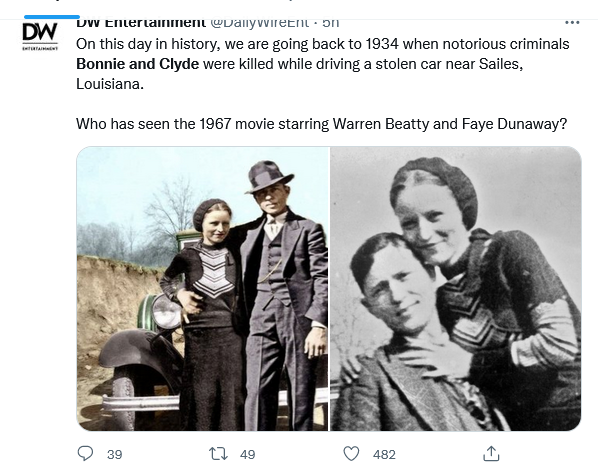


It’s The Highwaymen, not The Highway Men. And I completely disagree. Bonnie and Clyde is easily one of the most groundbreaking American films of the 1960s, and the blunt brutality of its conclusion hasn’t lost any of its power since then. And few actresses have looked as beautiful as Faye Dunaway does in that film.
The entire film is a tissue of lies, about par for the Sixties. It’s depiction of Frank Hamer for example was completely fictional, and its glorification of the two criminals as youthful rebels is nihilism incarnate. As opposed to The Highwaymen, thank you for that correction, the 67 film is an evocation of the Sixties rather than Depression Era America. As a work of Art the 67 film has merit, but if you want to learn anything about the actual Bonnie and Clyde and their times, it is a waste of time.
Completely agree as to Fay Dunaway who was far more glamorous than Bonnie Parker. Dunaway is 81 this year which illustrates that we are far more removed in time from 1967 than 1967 was from 1934.
The entire film is a tissue of lies, about par for the Sixties. It’s depiction of Frank Hamer for example was completely fictional, and its glorification of the two criminals as youthful rebels is nihilism incarnate.
Blanche Barrow was irritated that the film depicted her as ‘a screaming horse’s ass’.
The two of them were subject to an extrajudicial execution. Not sure anyone at the time objected.
One curio about the whole affair that the film largely omits is the degree to which their families countenanced what they were doing. They were so welcome in the homes of their relatives that relatives of each were subject to criminal charges. Also omitted was that Bonnie Parker had a husband in the state prison.
Completely agree as to Fay Dunaway who was far more glamorous than Bonnie Parker.
Well, ordinary people do not have make-up artists working them over. Also not depicted is that due to bullet wounds not properly attended to, Bonnie Parker was quite lame at the end of her life.
Another thing omitted from the film was the character of the neighborhood in which both were reared. The unincorporated area to the west of the City of Dallas was what the Brazilians call a favela. For all they did not have two nickels, Bonnie Parker had attended high school and was an above-average student; regrettably, she had an attraction to bad boys.
Well, ordinary people do not have make-up artists working them over.
My point Art is that like the rest of the film Dunaway’s appearance had little to do with Bonnie Parker.
The ending of Roger Ebert’s review in 67:
“Years from now it is quite possible that “Bonnie and Clyde” will be seen as the definitive film of the 1960s, showing with sadness, humor and unforgiving detail what one society had come to. The fact that the story is set 35 years ago doesn’t mean a thing. It had to be set sometime. But it was made now and it’s about us.”
But it was made now and it’s about us.
Words like this uttered by journalists are almost never authentically self-critical.
Donald: I think that’s a big part of the film’s brilliance. Arthur Penn uses Bonnie and Clyde to comment on the amorality of the 1960s and its hedonistic counterculture. It definitely takes a lot of artistic liberties, but I don’t think Penn ever set out to make a documentary. If somebody wants to learn about Bonnie and Clyde, then The Highwaymen is probably a better educational tool. But as a movie (and as a thematic statement), Bonnie and Clyde offers a mesmerizing portrait of the era during which it was released, which is why I believe that it’s the better film.
According to IMDB, they began filming on 4 October 1966 and finished on 1 January 1967. They’d have had drafts of the script, film treatment, shooting script, storyboard before 4 October 1966 if I understand how it’s done. I don’t think there was a ‘hedonistic counterculture’ in 1966 outside of the East Village and Haight Ashbury.
OT, did you catch this?
https://jonathanturley.org/2022/05/25/fbi-agent-comey-and-other-leadership-were-fired-up-to-pursue-the-false-alfa-bank-claims/#more-189132
Good catch Art. No matter how little we think of the FBI we underestimate how deeply the corruption runs.