
If you take a flat map
And move wooden blocks upon it strategically,
The thing looks well, the blocks behave as they should.
The science of war is moving live men like blocks.
And getting the blocks into place at a fixed moment.
But it takes time to mold your men into blocks
And flat maps turn into country where creeks and gullies
Hamper your wooden squares. They stick in the brush,
They are tired and rest, they straggle after ripe blackberries,
And you cannot lift them up in your hand and move them.
–A string of blocks curling smoothly around the left
Of another string of blocks and crunching it up–
It is all so clear in the maps, so clear in the mind,
But the orders are slow, the men in the blocks are slow
To move, when they start they take too long on the way–
The General loses his stars and the block-men die
In unstrategic defiance of martial law
Because still used to just being men, not block-parts.
Stephen Vincent Benet, John Brown’s Body
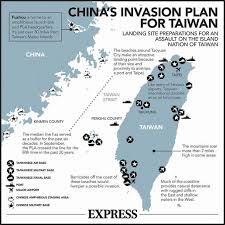
A very good look of the likely problems encountered by Red China if they sought to invade Taiwan:
The two airports near Taipei – which are the ones you have to use for an air assault assuming you want to conquer the capital city – have nice little mountains overlooking them.
The downtown one (Songshan) is so obviously going to be a deathtrap, you aren’t going to land troops there. Even if you land a couple of commercial airliners like A380s full of troops ready to go as a surprise attack, you won’t get any more assuming the Taiwanese have any kind of AA fire nearby. And even then, if there’s any artillery at all in those hills they can take out anything in or around the airport with one ranging shot, an easy visual confirmation of hit and then full battery fire. Seriously go look at google maps with the topo view, and feel free to zoom in to the bit near the google pin in the image above. You will note that there’s a hill to the north that is over 300ft/100m high and less than 2miles/3km from the airport. Plus the same hypothetical artillery in those hills can also shell anywhere in Taipei because pretty much the entire city is within 5 miles of them so even if you break out from the airport you can’t escape the artillery. And no you can’t land some paratroopers in those hills to take out the defenses. Well, you can land them, but most of them are going to end up dangling from the tops of trees with broken limbs so they won’t be doing a great deal of fighting because those hills are forested (see google maps satellite view and street view of some of the small roads). The British SAS tried parachuting into the jungle during the Malayan Emergency and it didn’t work for precisely those reasons, and the SAS didn’t have to face people shooting at them as they floated down. PLA paratroopers are likely to be shot at, presuming they make it out of the plane before it is shot down. You also can’t get some of your first wave of airborne assault to charge up the hillside – there’s a 400ft/120m wide river in the way with 1 (one) bridge. If the hypothetical artillery don’t already have that bridge locked down with precise ranges etc. (and/or the bridge has not been wired for demolition) they are demonstrating practically Russian levels of incompetence and that seems improbable. Also once your troops have got across the river they have to climb the hillside, which is (see above) forested and not notably filled with pathways and trails once you get past the built up lower parts.
So taking Songshan and trying a decapitation strike on the Taiwanese government from it is pretty much doomed to failure. It will make the Russian adventures in Hostomel look successful.
It is way more sensible try for the further one, Taoyuan, which also has hills a couple or three miles away but isn’t quite so obviously a death trap. It also makes a tad more sense, since it’s right by the coast so potentially it can function as part of the beachhead for the naval invasion force. As the missile flies, Taoyuan airport to the middle of Taipei is about 30km/19 miles so that seems doable in principle, even though you probably can’t get there using the same route as a missile but have to go south to the Tamsui river and then follow that downstream. The coast, as illustrated in google streetview, is flattish muddy beach with no obvious mine fields, tank traps, or other obstructions so a logical invasion would have an airborne force land at the airport, hold it for air support and have part of the force head to the coast taking out any resistance so that shortly afterwards the main invasion force can make a landing there.
In order to do this you need air superiority so you need to have taken out all the Taiwanese airfields, static radars and SAM batteries. A large missile barrage should suffice and the PRC almost certainly has enough working missiles for this – unlike Russia. Now if you’re lucky that’s going to be sufficient. If the Taiwanese have been paying attention to Ukraine (and if they haven’t then they deserve whatever they get) then they will have lots of mobile SAM batteries, radars etc. stashed in useful locations that won’t be taken out by the missile strike. Those will then pop up to take out your airborne assault unless you are able to confuse the issue with lots of other aircraft. This is, as with the missile strike, almost certainly doable. It will be expensive in pilots as well as in aircraft and missiles but it should be possible to keep a corridor over the strait of Taiwan and around Taoyuan generally open to aircraft if enough fighters, missiles and the like are thrown at the problem.
Go here to read the rest. The Russians have demonstrated in Ukraine how easily military operations can go badly awry. Planning military operations is not that hard; carrying out the plans is never so simple.
Words for every military man to live by: Maybe somebody just forgot what it was like.


Having lived in Southeast Asia for over a decade and been to Taiwan a number of times, I can say that the attacker would have even more difficulty than what is cited here. Of course the population difference would probably insure eventual victory for the mainland, but the cost in men and materials would be prohibitive. Taiwan has a skilled and well equipted modern military and access to even more technology from their own assets. Also, it is by no means assured that there would be popular support for such an action by the Chinese people. The number of functionaries at the top in control of the country is quite small and the rest of the population very large. Chinese history is replete with rulers who have been deposed when conditions for the masses have become too onerous, a fact not lost on President Xi who is seeking a third term in office.
“Everyone’s got a plan, until the 1st punch is thrown”. – Mike Tyson.
Every military war college in the US has war gamed this scenario over and over. I would imagine the western Pacific nations have also. There were papers on possible surprise attacks by the Japanese written by Naval War College students in the 1920s but Pearl Harbor did happen DEC 7, 1941.
Donald Link’s observations are quite interesting.
I passed through Taiwan in February 1973. Even then the airport had artillery placements along the runways. Inside the commercial airport (I forget which one) there were armed soldiers everywhere.
I suppose coordinated ChiCom SEAL landings in advance of an invasion could take out Taiwanese command and control. The Chinese have landed a military aircraft at an airport on a a partially manmade island in the disputed S China Sea Spratly Islands https://www.reuters.com/article/us-southchinasea-china-idUSKCN0XF0AZ. Satellites would pick up any unusual activity there.
Lastly the National Chinese Taiwanese after so many years have little in common with the mainlanders.
Stephen Vincent Benet’s little poem has enormous military wisdom encapsulated in a very few words.
What Chris Cappy says at “Task and Purpose,” the US military tactical motto is to “Get there fast, and get there first..” — something the Russian army has completely failed to do from the very beginning—and now has completely failed yet again apparently in the last 24 hours in Kharkiv, exposing the north side of their flank as they try to take Severodonetsk: Oh wow apparently suffering once again even more horrific casualties from the very recent modern weaponry that has flowed into Ukraine at last the past few weeks.
Not a good time to be a Russian conscript.
In an interview on “Military History Visualized” D.M. Giangreco said that logistics is very important, but that people are not very interested in the subject.
I have read a number of war games involving an attack by the PROC horses on Taiwan. The PROC lacks sufficient amphibious landing and support vessels, at least at the present time, and there is doubt their navy could screen vs. US submarine attacks (assuming the US will immediately step in) and aircraft carrier units. Also, the Taiwanese Air Force has about 60 or so upgraded US F-16 C/D’s as of 2019 due to Trump (Obama repeatedly refused to give the updated F 16 to Taiwan) and about 50 or so Dassault Mirage 2000’s (Although there is a question about Taiwanese Air Force training because they’ve had a number of crashes over the years with the Mirage units). Taiwan is supposed to have nine military airfields with all of them having underground and/or bomb/missile resistant protected hangars. Most morning outcomes show the Taiwanese holding on successfully through the first wave and potentially infecting extremely heavy losses on any invading China fleet.
At that point it’s a matter of resolve on both sides particularly the US to support Taiwan.
It should be pointed out that the poem works both ways, that is to say, both sides will experience the difference between plans and reality. History is full of daring and surprising attacks that nullified carefully prepared defenses. Let’s remember the Romans, Hannibal and the Alps; the great disappointment that was the Maginot Line; or Mussolini’s rescue by German gliders in the Gran Sasso.
Being sympathetic towards Taiwan should not blind us to the uncertainties of war.
True Bruno but note the examples you raise. Hannibal surmounted the Alps but lost a fair amount of his army doing so. If had not been a Great Captain it would all have been for nought. In reference to the Maginot Lince, an argument could be made that it was not extended far enough. Once again we had foolish generals on one side of the Maginot Line up against Guderian. Skorzeny’s rescue of Mussolini was a tour de force with not an ounce of strategic impact on the war.
Military genius can overcome obstacles, but it is rash to assume that your side will have the military geniuses and the otehr side will have none. I completely agree with you as to the uncertainty of everything when the iron dice of war are rolled.
Certainly, those kinds of operations almost always come with a steep price, and on top of that many just don’t work as expected (think of Gallipoli or Market Gardens, among hundreds of others).
The problem with Taiwan is that, due to the geographical location and the disparity in size, China only has to have one major success to win, so Taiwan cannot afford any big mistake. They have to be Hannibals all the time. As long as China is powerful, Taiwan’s independence will be what we physicists call an unstable equilibrium.