
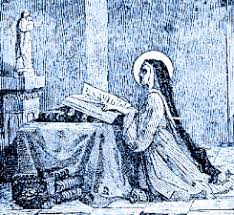
Bertha of Val d’Or (birth unknown, death c. 690), was an abbess, virgin, and martyr, and is venerated in the Roman Catholic Church as a saint.[1] Her husband was Gombert, Lord of Champenois, who was a nobleman and member of the royal family of France, with whom she lived “a celibate life”.[1] The legend of Bertha’s life is “very late and unreliable.[2] Laurent Majoret wrote a vita that was first published in Toul in 1650 and reissued in Rheims in 1700 and in 1743.[3][4][5]
Gombert built a convent for Bertha and her maidens at Avenay, and then retired to a monastery on the coast.[6][2] After Gombert was killed by “idolaters”[6] and “pagan marauders”,[2] she was directed by a vision to move her nuns to Val d’Or, near Avenay, in the Champagne region of northeastern France.[6] It is uncertain if the convent followed the Dominican Rule.[2] There was a drought in the area; according to hagiographer Agnes Dunbar, Peter the Apostle appeared to her and guided her to a garden with a good spring.[6][2] She created, with her distaff, a stream she called “Libra” because she bought the spring with a pound of silver. The stream flowed in front of her convent and supplied water for both her nuns and for the town; Dunbar reported that “there it flows to this day, an abundant supply of beautiful, clear water, curing many infirmities, and witnessing the truth of the legend of the distaff”.[6]
In 690, the relatives of Bertha’s husband became angry with her because they were indignant that she distributed her husband’s money to the poor[2] and because she “gave to the poor a great deal that they hoped to get for themselves”.[6] so they killed her.
Go here to read the rest.

