
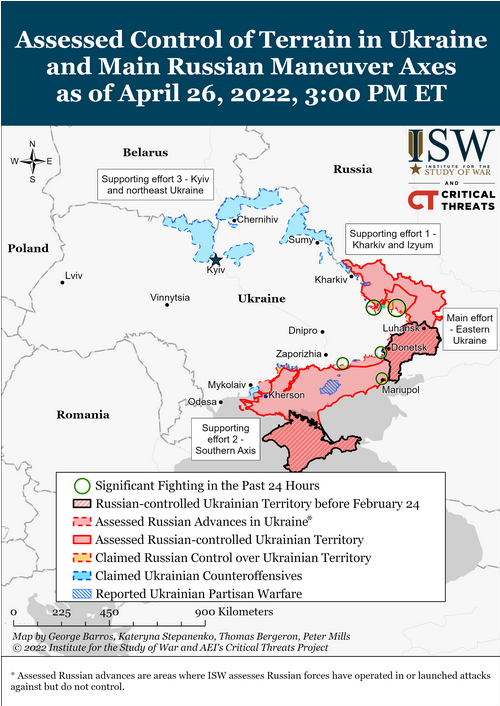
From The Institute For The Study of War:
Frederick W. Kagan, Kateryna Stepanenko, and Karolina Hird
April 26, 6:30 pm ET
Russian forces have adopted a sounder pattern of operational movement in eastern Ukraine, at least along the line from Izyum to Rubizhne. Russian troops are pushing down multiple roughly parallel roads within supporting distance of one another, allowing them to bring more combat power to bear than their previous practice had supported. Russian troops on this line are making better progress than any other Russian advances in this phase of the war. They are pushing from Izyum southwest toward Barvinkove and southeast toward Slovyansk. They are also pushing several columns west and south of Rubizhne, likely intending to encircle it and complete its capture. The Russian advances even in this area are proceeding methodically rather than rapidly, however, and it is not clear how far they will be able to drive or whether they will be able to encircle Ukrainian forces in large numbers.
Russian forces on the Izyum axis likely benefit from the absence of prepared Ukrainian defensive positions against attacks from the Kharkiv direction toward Donbas. Ukraine has prepared to defend the line of contact with Russian-occupied Donbas since 2014, and Russian troops continue to struggle to penetrate those prepared defenses—as shown by repeated Russian efforts to take Avdiivka, just north of Donetsk City, or to advance through Popasna, just beyond the original line of contact.
Russian troops continued to attack Ukrainian defenders in Mariupol, including in the Azovstal Plant, despite Russian President Vladimir Putin’s claims that there is no more fighting in the city. Ukrainian forces likely still hold important positions beyond the plant itself, and Russian forces continue to fight outside the plant, bomb the plant, and assault positions near the plant. Putin’s order not to chase Ukrainian defenders into the tunnels and catacombs of the facility evidently did not preclude continued efforts to secure at least the entire perimeter of the plant and likely also the important M14 highway that runs along it to the north and northwest.
Russia is staging false-flag attacks in Transnistria, Moldova, likely setting conditions for further actions on that front. The two motorized rifle battalions Russia has illegally maintained in Transnistria since the end of the Cold War are not likely sufficient to mount a credible attack on Odesa by themselves, nor are the Russians likely to be able to reinforce them enough to allow them to do so. They could support more limited attacks to the northwest of Odesa, possibly causing panic and creating psychological effects to benefit Russian operations in the south of Ukraine.
Russia may also seek to destabilize Moldova itself, however. Comments by the head of the Donetsk People’s Republic and other Russian officials and proxies raise the possibility that Putin might recognize the self-styled Pridnestrovian Moldavian Republic (PMR) in Transnistria as he recognized the Donetsk and Luhansk People’s Republics. The PMR could then ask for additional Russian protection, and Putin could attempt to send some additional forces or capabilities to Transnistria. Any such activities would greatly raise tensions and fears in Moldova and neighboring Romania, putting additional pressure on NATO, possibly giving Putin a cheap “win,” and distracting from Russia’s slog in eastern Ukraine.
Continued indications that Russian forces intend to hold referenda to establish “people’s republics” in occupied areas of southern Ukraine raise the possibility that Putin intends to unveil an array of new “independent” “people’s republics” as part of a Victory Day celebration. The forecast cone is wide, and there is as yet no solid basis to assess one path as much more likely than another. But the false-flag attacks and Russian and Russian proxy reactions to them are alarming, and it behooves NATO and the West to consider the most dangerous courses of action and prepare to meet them.
Key Takeaways
- Russian forces continue to make slow but steady progress south from Izyum and northwest of Rubizhne, but Russian offensive operations elsewhere along the line in eastern Ukraine remain unsuccessful.
- Fighting continues in Mariupol, where Ukrainian defenders apparently still hold positions beyond the Azovstal Plant.
- Russia and/or Russian proxies have staged false-flag attacks in Russian-occupied Transnistria, possibly to threaten a (very likely unsuccessful) attack on Odesa, possibly to destabilize Moldova.
Go here to read the rest. From Strategy Page:
April 26, 2017: As part of the latest U.S. military aid for Ukraine, the Americans are sending combat-tested artillery spotting radars as well as Sentinel air surveillance radars that detect helicopters, UAVs and cruise missiles up to 75 kilometers distant and alert ground units within range via encrypted military radio. Sentinel is particularly useful for ground troops armed with American Stinger or other manpads (Man Portable Air Defense Missile Systems) . Ukraine has a lot of Cold War era Ilga (SA-18) and over a thousand other systems from NATO nations. Ukrainian troops also have better communications than the Russians and could link nearby manpad teams with Sentinel and alert them when a likely target approaches.
In 2017 the AN/TPQ-53 FireFinder artillery spotting radar systems were updated to fix some problems discovered with early models. The TPG-53 was introduced in 2012 as the replacement for the older AN PQ-36/37 FireFinder artillery spotting radar with the new and improved AN/TPQ-53. While the new system was an improvement, the army began getting more and more reports from users in combat zones of false positives; the radar showing something incoming when there wasn’t anything, as well as difficulty distinguishing between artillery shells, rockets and mortar shells. There were also reports that the new system did not handle multiple incoming shells well, being unable to provide data on where it was all coming from. The U.S. Army halted distribution after 38 of the new systems went into service and delayed production of another hundred until the problems could be fixed. A series of tests were conducted in 2015 to document the problems so the manufacturer could fix them. These fixes have been completed and verified by more tests so now manufacturing can continue.
Despite these problems, the new system was seen as an improvement. Troops in Afghanistan continued to call the new version “FireFinder” or “counterfire radar” even though the new TPQ-53 is a visibly new and different looking system, each consisting of two trucks (one for the radar, the other for the control center and backup generator). For the troops in Afghanistan the TPQ-53 was a success because the most common threat was individual mortar shells being fired at a base. The TPQ-53 was faster and more reliable at dealing with that.
AN/TPQ-53 was sent to Afghanistan for final testing in 2010. In early 2012 the army ordered 51 of the AN/TPQ-53 systems. Easier to use and repair, as well as more reliable than its predecessor (the AN/TPQ-36/37), the TPQ-53 could also scan all around (360 degrees), rather than just 90 degrees (as with the older system), and was faster as well. Americans buy TPQ-53s, for about $9 million each. The older FireFinder is cheaper and still gets the job done. This is why some countries (like Iraq) prefer the cheaper older FireFinder. Many Iraqis have seen the older FireFinder in action. They know it works and so do the Ukrainians.
FireFinder would be particularly effective dealing with Russian artillery and unguided rockets, especially if the Ukrainians have the PGK (Projectile Guidance Kit) 155mm fuze. The PGK fuze turns an unguided 155mm shell into a GPS/INS guided one. These were found to be exceptionally useful in Syria and Iraq and, in mid-2017, the U.S. Army ordered another 5,600 PGK fuzes and has been building a large stockpile. The army still uses unguided artillery shells for situations that don’t require precise accuracy for each shell but the PGK provides options that can be implemented quickly to turn any “dumb” shell into a smart one. It is unknown if any of these PGK fuzes have been sent to Ukraine. If PGKs were available, they would work well with the new Zusana-2 8×8 155mm self-propelled artillery systems being purchased by western neighbor Slovakia. Zusana-2 is highly automated with a modern fire control system so it can, in less than a minute, halt, fire one or two PGK equipped shells with the location data provided by FireFinder to destroy Russian artillery and then move on before being targeted itself. Russia too has counterfire radars and guided shells, but no combination of radar and guided shells quick enough to catch Zuzanna-2s employing such “shoot and scoot” tactics. The Zuzanna-2 armor offers some protection from shell fragments and blast effects on equipment and its three-man crew. Ukraine is about to receive Excalibur GPS guided 155mm shells from several NATO countries. Excalibur is more accurate than a shell with a PGK fuze but a lot more expensive.
Go here to read the rest. We have been through a period when not much was happening in the War. That is ending. We should begin to see in the next few days Ukrainian counter moves to the Russian offensive.


Effective counter-battery would be huge.
Hard for the Ukrainians to really be excessively concerned about Russian columns “advancing in a general south/southwest direction from Izium:”. The Ukrainians have played this game before very well, allowing the terminal incapacity of the Russians to maintain logistical supply lines and support with any effectiveness or consistency, and the Ukrainian special units subsequently falling upon these overextended columns in their own friendly territory with hideous nighttime attacks on these convoys with resulting grievous Russian losses. Oryx site says the Russians have lost at least 480 documented tanks, not counting BTG‘s and other mechanized equipment, which must number excess of a thousand or so. NATO estimates Russia has lost between 600 and 700 tanks.
If the Ukrainians break this offensive and exact more expected armor losses on the Russians, who apparently put their best upgraded T72’s & T90’s in the early fight at Kyiv, hopefully it will be curtains for Putin‘s army.
But we shall see. It may be a surprise to the Russians “who encircles who.”