
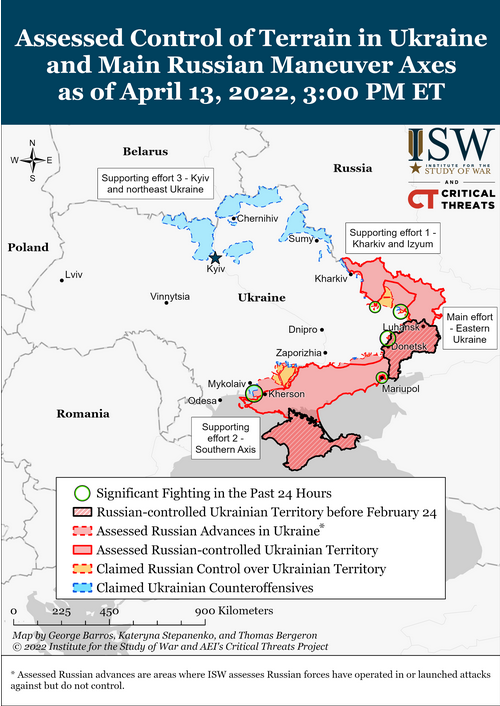
From The Institute For the Study of War:
Mason Clark, Kateryna Stepanenko, and Karolina Hird
April 13, 4:30pm ET
Russian claims of a mass Ukrainian surrender in Mariupol are likely false, but Russian forces forced Ukrainian troops to abandon the Ilyich metal plant in northern Mariupol on April 13, further constricting the two remaining pockets of Ukrainian defenders. Russian forces will likely capture Mariupol in the coming week. Russian forces continued to conduct small-scale limited offensive operations on both the Izyum and Severodonetsk axes and have not yet begun a broader offensive campaign.
Key Takeaways
- Russian forces continued to take ground in Mariupol, but Russian claims of a mass Ukrainian surrender are likely false.
- Russian forces continued unsuccessful local attacks in eastern Ukraine amid continuing preparations for a likely wider offensive.
- Russian forces continued to regroup in Kharkiv Oblast for offensive operations and conducted only minor attacks south of Izyum.
Go here to read the rest. From Strategy Page:
April 13, 2022: Russia has appointed four- star general Aleksandr V. Dvornikov, a veteran of operations in Syria, as the first commander of all operations in Ukraine. Previously all Ukrainian operations were commanded by Stavka (the Russian General Staff) and civilian officials in Moscow. Dvornikov apparently is free to do whatever it takes to turn the defeats in Ukraine into a victory. To do that he is apparently using what he learned in Syria, where he commanded Russian forces from 2015, when Russia committed substantial ground and air forces to save Syrian dictator Basher Assad from a three-year old rebellion which, at that point, after three years of fighting, Basher Assad was losing but he was eager to use the Russian forces to employ tactics that his father Hafez Assad, had used after he gained power in 1971 and retained by emulating the first (in 1547) tsar of Russia, Ivan Grozny, known in the west as Ivan the Terrible. In Russian, “Grozny” means fearsome, menacing or, to many Russians, dreaded. Tsar Ivan spent most of his 37 years in power leading his armies against various enemies, as well as reforming the Russian government. He was largely successful against Turkic enemies that occupied what is now much of southern Russia and Ukraine. Ivan was ruthless and went full Grozny against his Turkic foes. Then he sought to take Livonia (Latvia and Estonia) to provide landlocked Russia with access to the Baltic Sea. At first Ivan was successful, but then Poland and Sweden intervened and turned Russia back into a landlocked empire until 1709 when tsar Peter the Great finally defeated the Swedes and made his new city on the Baltic, Saint Petersburg into the new Russian capital.
Hafez Assad was more an Ivan Grozny than a Peter the Great and maintained his rule of Syria by terrorizing and massacring his foes. That worked until Hafez died in 2000 and his son Basher took over. That was not supposed to happen because Basher was the younger son who graduated from medical school in 1988 and became an army doctor. His older brother Bassel was trained to take over from Hafez. Bassel died in an accident in 1994 leaving the 29-year-old doctor Basher the heir. Basher was quickly prepped as the heir and that appeared to work. At first Basher was successful after Hafez died in 2000.
Then came 2011 when Syria was one of several Arab countries to undergo uprisings against dictatorial rule. The uprising in Syria turned into a civil war and, because the Assads were a Shia minority in a country that was about 70-75 percent Sunni the situation looked grim. Most Syrian Sunnis were Arabs but over ten percent of the Sunnis were Kurdish, Turkomen and other minorities. The largely Sunni Kurds were about nine percent of the population. The Assad clan is Shia, a minority that comprised about 13 percent of the population. Various Christian groups totaled about ten percent of the population. Another religious minority were somewhat Islamic groups like Druze and Yazidis who are considered heretics by conservative Moslems but tolerated in many Moslem majority nations.
The Assads had long maintained power by turning the other minorities into loyal allies who could be relied on to serve in key government jobs. Some of the Sunni minorities were more reliable than others. The half million Palestinian refugees were well educated Sunni Arabs and willing to serve a Shia government. Some minorities didn’t want to be Syrians and the chief among these was the Kurds, who yearned to unite with Turkish, Iraqi and Iranian Kurds to create an independent Kurdistan. The four nations these Kurds lived in cooperated in blocking and suppressing these Kurdistan ambitions.
After a decade of fighting, the civil war changed the ethnic profile of Syria in a big way. Since 2011 about two percent of the population has died from the fighting while over six million Syrians have been forced to leave Syria because of the war. Nearly all of those who fled the country, and won’t be coming back, are Sunni. That means the Sunni majority of the Syrian population went from over 70 percent in 2011 to 58 percent in 2020. To make matters worse Assad ally Iran encouraged Shia from other countries (Lebanon, Afghanistan and Iraq) to settle in Syria and take over the homes and property of the departed Sunnis. Not many foreign Shia were willing to settle in a war zone. While the Assads deliberately attacked Sunni civilians and encouraged them to flee the country, an autonomy deal was possible with the Kurds. One reason for this is that the Kurds are almost all Sunni and, like their fellow Sunni Kurds in Iraq, not fanatic about their religion. In 2020 Syria the Kurds comprise about 17 percent of the Sunni majority. But if the Kurds are allies of the Assads the remaining Sunni Arabs are no longer a majority. The Sunni Arabs also had factions and some were more inclined to work with and for the Assads than others. This is how the Assads have ruled Syria for two generations and they will have an easier time doing so because of the war.
A major obstacle to continued Assad rule is the destruction of the Syrian economy and the lack of economic assistance for rebuilding. GDP is less than half of what it was in 2011. Over half the pre-war population of 23 million are refugees. Half are displaced inside Syria and half outside the country. While most of the country is now controlled by the Assad government, most of that territory is shared with foreign troops; Iranian, Turkish, Russian and American, in that order. Syrian forces have to be wary of these allies, as well as the Islamic terrorist groups. ISIL (Islamic State in Iraq and the Levant) is particularly active in attacking Syrian troops.
The damage done to Syria by ten years of war is worse than realized when you take into account expected (normal) growth in the economy (GDP) and the population if the war had not happened. This data assumes a decade of some post-war reconstruction for the real Syria. In contrast, Syria without the war would have a population of 32 million by 2030. Because so many (over six million) Syrians fled the country and fewer were born and more died, the most likely population of war-ravaged by 2030 is 22 million. Most of the refugees (Sunni Arabs) do not want to return to a homeland dominated by a Shia government and occupied by Iranian (and Shia) forces. In these “war/no-war” comparisons the economic projections show the country even worse off. Currently GDP is less than half, perhaps just a third of what it was in 2011. No one is sure because the economic damage is so extensive. Even with a decade of post-war reconstruction 2030 GDP would only be about 74 percent of what it was in 2011 and about 35 percent of what it would have been in 2030 without a war. Without the war GDP would have doubled by 2030. It is possible that Syria will grow (in terms of GDP and population) at a faster rate but that is unlikely since not a lot of nations are lining up to donate to or invest in reconstruction. In part that is due to the expected long-term presence of Iran or, even without that, the Assads would probably remain in power and still be accused of war crimes during the war. There is no statute of limitations on that sort of thing. Meanwhile the years of war have destroyed structures, infrastructure and businesses that would cost several hundred billion dollars to replace. That will be hard to do for a nation that had a 2011 GDP of about $60 billion and not a lot of natural resources other than its people and their many skills.
Go here to read the rest. No Ukraine War Analysis until after Easter on Tuesday April 19 as I am taking a mini-Easter vacation. I wish the combatants in Ukraine could also take a Easter vacation from the War.


By now, most readers of TAC have learned of the (at least) severe damage suffered by the Russian guided missile cruiser “Moskva” (an omen? “Moscow”), a fairly large vessel (over 600’ length) that supposedly had been outfitted with the most recent version of the S300 anti-aircraft and anti-missile systems. Are photograph taken by Ukrainian drones show it is apparently beached in a Russian-controlled port, with severe damage evident amidships, and the Russians claiming “all 500 crew were evacuated.” However, anyone who is even a casual reader of naval history knows a cruise-missile direct hit (by apparently 2 Ukrainian-made “Neptune“ missiles), that such evident massive damage, means a very large loss of life to the crew on board. Also, a British military expert, Sir Christopher Deverell, noted on BBC News, more importantly this indicates the effective closure of the Straits of the Sea of Azov, and perhaps roughly half the Black Sea to Russian naval vessels (The estimated range of this type of Ukrainian cruise missiles supposed to be 300 to 400 km).
But as Solzhenitsyn noted in “August 1914,” the Russian dictatorship will continue to force this doomed war “because of the limitless capacity of the Russian soul to suffer (verbatim).”
Also, I would be very doubtful about the alleged report by the official Russian news agency of a “mass surrender of 1000 Ukrainian Marines in Mariupol.”
Almost 2 weeks ago (Apr. 4th), you may remember the Russians staged a surrender of supposedly 100 Ukrainians in Mariupol, but former Navy SEAL Chuck Pfarrer observed that the uniforms of all these supposedly battle-weary Ukrainian military were all clean, no tatters, no apparent wounded, and especially no one had any beards— which after fighting for four weeks without much water supply, shaving is going to be out the door. Also only 2 of the “soldiers” had Ukrainian ID tags, the rest had no tags at all on their uniforms— pretty sure evidence this was faked, obviously as propaganda to demotivate the Ukrainians and their western allies. That video of two weeks ago is now considered highly doubtful. For another thing, no Ukrainians allegedly captured have had their names given out by the Russians.
If you look at the recent “surrender” video released by the last 24 hours, same thing: none of these alleged soldiers are gaunt, thin, suffering from malnutrition; no massive beards on everyone, mostly clean-shaven; and they don’t have that vacant exhaustion look typical of soldiers fighting to their death. Also, knowing the high-level capacity of the Ukrainians to disinform their enemies, I don’t believe the Ukrainian Marines allegedly are “out of ammunition” and especially that they would announce that to the Russians – – – unless it is to motivate the West—but more likely it is to sucker the Russians, any remaining, into “an easy mop-up campaign,” in which the Ukrainians can absolutely devastate the already demotivated and highly degraded Russian forces in Mariupol.
We shall see.
So now, approx 11pm Moscow time, the Russian Ministry of Defense has admitted the guided missile cruiser “Moskva” has\d sunk while being towed after being hit by the 2 Ukrainian cruise missiles earlier today. Apparently it sank in the open sea, meaning it is not likely to be raised and to be salvageable.
No pun intended, but let that sink in.
Tick tock. Military history is something about which I know nothing. Still, cannot help but notice that 15 weeks after D-Day, the German forces held Alsace, Lorraine, and some Atlantic ports; they’d been run out of the rest of France. Russia nicked 12 of the Ukraine’s 60 largest cities in 2014. At the rate they’re proceeding, they’ll hold 4 of the other 48 by time they reach the 15 week mark.
From above, “because of the limitless capacity of the Russian soul to suffer (verbatim).” Evidently, the same applies to its limitless evil.
Of course, all this was previously coordinated in Beijing, Moscow, and the CCP-controlled junta in the White House.
Latest. Putin intimating he’ll start nuclear WWIII if Sweden and Finland join NATO.
Putin wouldn’t be pushing USA around if they hadn’t stolen the elections in 2020.
T. Shaw is correct: “Putin wouldn’t be pushing USA around if they hadn’t stolen the elections in 2020.”
Professor Michael Clarke (UK, Director of Royal United Service Institute or RUSI, formerly of Kings College, London, professor of defense studies) was interviewed on SKY News and commented on the sinking of the guided missile cruiser Moskva by Ukraine: He noted, although the Russians still have naval assets in the Black Sea, Turkey will not allow additional Russian vessels into the Black Sea, since they control the Bosporus based on the 1936 Montreux Convention, which gives Turkey the right to restrict warships into that body of water. Perhaps admitting Turkey into NATO membership was not such a bad move after all.
He also noted that “…the last time the Russians lost a flagship was in the (1905) Russo-Japanese War..”, a fact I had not considered.
He says heavy rains are forecast for the next two weeks and doubts that the Russians will be able to effectively launch an attack, as they appear to be planning, from Izium toward Pahvlohrad, southwesterly across the Ukrainian plans, until the rains cease and the watercourses drain off.
The odd crew of 3 Croatian ex-Soviet military who write up “Binkov’s Battleground” say the same thing, that the Russians will have “mud until May”, and that may be a relief for the long overdue Jake Sullivan-delayed US military armaments to reach the Ukrainians. “Binkov” generally has been pro-Russian in their past YouTube videos going back several years, but clearly they have been shocked by Russian miliary incompetence. They say that they believe there are 50,000 Russian troops (of questionable caliber) are being grouped near Izium. However, Pahvlohrad has a very important missile facility, the Pahvlohrad Mechanical Plant, and clearly that is an objective to neutralize Ukrainian missile production.
However, a positive sign: the Binkov people dont sound optimistic about Russian prospects.
One other note: The Russian Defense Ministry claimed initially that “all crew had been evacuated” from the fatally struck “Moskva”.
However, one report yesterday admitted “50 killed” including the ship’s captain, Anton Kuprin, although the RDM hasnt yet acknowledge the 50 number. One should suspect it is even higher, since the 2ndary explosions of armaments within a ship’s hull are known to effect a massively fatal concussive effect on the crew. I will not be surprised to eventually hear several hundred were killed.
So tonight, April 15, an exiled Russian politician named Ilya Ponomarev stated to the UK Daily Mail that 452 of the ill-fated cruiser “Moskva” crew were killed in the cruise missile attack, according to high level Russian gov contacts with whom he has spoken.
It had to be several hundred were killed, if there was a secondary shipboard explosion of armament with a corresponding massive concussive effect contained within the ship’s hull.