
From The Institute For The Study of War:
Frederick W. Kagan, George Barros, and Karolina Hird
April 5, 4:30 pm ET
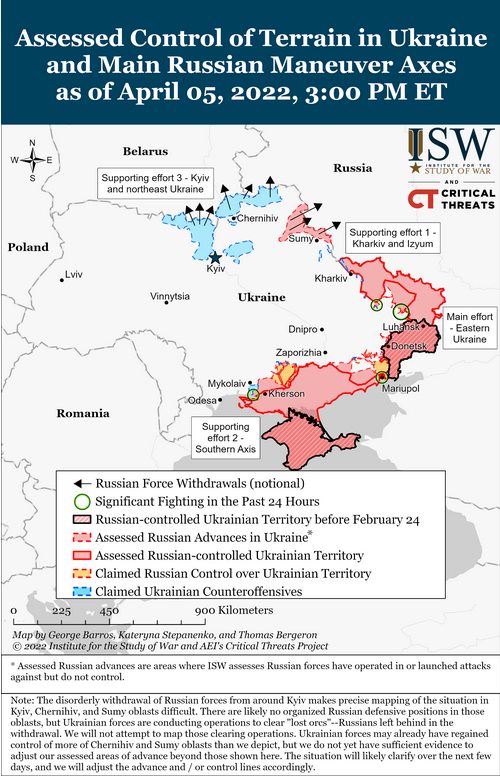
Russian forces continued to reposition to continue their invasion in eastern and southern Ukraine, having abandoned the attack on Kyiv. They have largely completed their withdrawal from the Kyiv area and are reportedly redeploying some of the withdrawn combat forces from Belarus to Russia. Ukrainian forces are moving to regain control over segments of the state border in Chernihiv, having already done so in Kyiv and Zhytomyr Oblasts. Russian troops are pulling back toward Russia along the Sumy axis as well, but it is not yet clear if they intend to retreat all the way back to the border or will try to hold some forward positions on the Sumy axis.
Russia has not yet committed forces withdrawn from the Battle of Kyiv back into the fighting in eastern Ukraine. Russian reinforcements continuing the drive southeast from Izyum toward Slovyansk are from elements of 1st Guards Tank Army units that had been in the Kharkiv-Sumy area. Russian units that retreated from Kyiv will not likely regain combat effectiveness for some time, and it is not clear that the Russians intend to return them to the fight soon. That said, an unconfirmed Ukrainian military intelligence report suggests that Moscow could soon send the 64th Motorized Rifle Brigade of the 35th Combined Arms Army, a unit that reportedly committed war crimes in Bucha, into the fight in eastern Ukraine in the hopes that guilty members of that brigade and witnesses of its war crimes are killed in combat with Ukrainian forces.[1]
Belgorod continues to emerge as the primary concentration area for Russian forces regrouping and refitting after their retreat from Kyiv and in preparation for onward movement to their home stations or to join the fighting in the east. Elements of the Central Military District pulling back from Chernihiv Oblast are reportedly on their way to Belgorod.[2] Their final destination is not yet known.
The Battle of Mariupol continues, with Russian forces continuing to pound the city using artillery and airpower. The constrained information environment in Mariupol prevents us from assessing concrete changes in control of terrain, but Ukrainian forces appear to be sustaining organized resistance in parts of the city.
Russian offensive operations southeast from Izyum toward Slovyansk continued on a small scale and made limited progress. Russia has not yet attempted to mass large concentrations of forces on this axis but continues instead to send individual battalion tactical groups to advance on their own.
Key Takeaways
- The withdrawal of Russian forces from around Kyiv is nearing completion.
- Russia has not yet introduced forces withdrawn from western Ukraine into the fight in the east.
- Ukrainian forces continued to put up organized resistance in parts of Mariupol.
- Russian forces conducted limited offensive operations on the Izyum-Slovyansk axis.
Go here to read the rest. From Strategy Page:
President Vladimir Putin finds himself facing major economic, political, diplomatic crises he never expected at the beginning of the year. Explanations for the decision to invade Ukraine are still absent. There is general agreement that it was the decision of one man, Vladimir Putin, that made it happen. That led to several senior Putin associates quitting the government and some even leaving the country. These Russians report that Putin was shocked at the poor performance of his troops and the rapid and widespread mobilization of the Ukrainian population to resist what Putin described as liberation of Ukrainians that were suffering under the neo-Nazi rule of their unpopular government. You would not expect such delusional behavior from a man who managed to turn Russia back into a centralized state ruled by a man who can ignore elections and rule for life. One plausible, or at least popular explanation refers back to rumors of his health problems. These have been getting more attention, especially from Russian reporters with better access to Putin’s activities and appearance over the last few years. It’s no surprise that the 69-year-old Putin is often accompanied by doctors as he moves around. But one particular doctor who is often present is a thyroid cancer specialist. Putin has disappeared from public appearances several times in the last two years, sometimes for up to six weeks. Some Russians speculated that he had plastic surgery since a comparison of photos show differences, which are described as bloated. The state of Putin’s health and mental clarity is still unclear but even many Russians are embracing these rumors to explain the problems Russia is having internally and externally.
A Change Of Plan
The initial invasion plan failed. It was not over in 15 days with a new pro-Russian government in Ukraine and minimal losses to the 150,000 Russian troops who invaded. Instead, most of the Russian forces have retreated from the outskirts of Kyiv leaving behind a hellish landscape featuring hundreds of burned-out armored vehicles and the bodies of some Russian troops. There were bodies of hundreds of Ukrainian civilians, many of them obviously executed and some of the victims well-known. Russia denied it all but there were all those satellite photos saying otherwise. Russians were less vocal in talking about the low morale of Russian troops and growing incidents of troops and officers refusing to go back into Ukraine, even after a few weeks of rebuilding shattered battalions. Russian troops feel betrayed because many were told there would be no resistance and not even told they were crossing the border. The battalions retuning to Russian in the last two weeks enabled troops from different units to compare experienced and all remembered the same thing; massive and effective Ukrainian resistance and incompetence by their military and civilian leaders. They learned that the families of many of their dead comrades had been contacted by the Ukrainians about what happened to sons and husbands. The Russian government refused to do the same. Soldiers and officers are inclined to believe the Ukrainian claims of a third of the Russian troops becoming casualties (dead, wounded, captured or missing). Officers asked around once back in Russia and discovered that some of the battalions that went in had apparently ceased to exist. Russia hasn’t suffered losses like that since World War II. The troops, and a growing number of their officers are angry. So are young men being conscripted. A larger than usual percentage are evading the draft, some by just “disappearing” for a while until the military situation becomes less potentially lethal for them.
The Russian strategy has obviously changed, with most of the troops pulled out of northern Ukraine and those still capable being sent to the Donbas, where another offensive is being planned. The new Russian troops arriving there are not confident or eager to take on the numerous, determined and effective Ukrainian defenders. Russia launched an offensive in Donbas at the same time troops were moving towards Kyiv and hit a solid wall of defenses. The Ukrainians have been preparing since 2014 to stop another Russian advance. When that came in 2022, Russian gains were minimal and the Ukrainians often regained lost ground. One area where the Russians were more successful was the advance from Crimea, where the Russians had stationed a lot of troops. The Russian plan was to quickly take control of the entire Ukrainian Black Sea coast, cutting Ukraine off from access to the sea. That failed but Russia sees reinforcing and reviving this offensive ss their best chance at salvaging some kind of victory from their looming defeat. Ukrainian leaders have made it clear that nothing less than the expulsion of all Russian troops from Ukraine, including Crimea and Donbas, will do. Most NATO nations, especially those closer to Russia, agree because if Ukraine does not win, the east European nations are next.
One Man Blunder
Putin has spent two decades achieving a form of one-man rule that was supposed to have disappeared as Russia turned to democracy after the Soviet Union went bankrupt and dissolved in 1991. The Russian democracy was messy and corrupt and Putin got elected to fix that. He did, but in the process, he made the central government and the presidency more powerful. Senior officials, civilian and military, who disagreed, for whatever reason, were replaced. The Ukrainian invasion was generally believed to be too risky, even by Russian generals, diplomats and economists. Many civilian advisors quit after the invasion began and some openly or quietly left Russia, along with several hundred thousand other Russians, many of whom were well educated and better able to find a good job in the West. This talent exodus took place right after 1991 and again after the 2014 attack on Ukraine. Putin still has high approval ratings because he revived the Soviet era “Russia is surrounded by dangerous enemies” propaganda. Most recent Russian exiles see China as the only winner here with the West surviving the loss of many Russian exports, especially natural gas. Even the Chinese see the Ukrainian invasion as a foolish move and more Russians are coming around as well, as many did in the 1980s when the Soviet Union came undone. Most Russians today were not around in the 1980s. In the last decade the “post-Soviet” generation became the majority and generally approved of Putin. This generation has access to a somewhat censored Internet that their Soviet era counterparts lacked. But even during the Soviet era the bad news eventually got through to the majority. That process takes less time today and the reality of the situation in Ukraine and Putin’s mismanagement of the economy is becoming more widely understood.
Several Putin comments about using nuclear weapons in Ukraine caused a commotion in the military high-command and Putin’s senior advisors. Apparently, Putin’s ability to order the use of nukes has been diminished. There is still a lot of popular opposition to Russian forces losing in Ukraine. The attitude of returning soldiers is difficult to control or censor because these young guys regularly use encrypted apps that have not been cracked by the government. The most popular one is Telegram, which was developed by the Russian Durov brothers in 2013 and was so successful that the Durovs had to flee Russia to avoid punishment. Telegram is also popular with gangsters and Islamic terrorists as well as young Russians. That last audience is passing on the comments of Russian soldiers who have fought in Ukraine.
Disaster In Ukraine
Ukraine is winning the battles against the Russian invaders but has not yet won the information war. This is about changing the minds of many Russians who still see the invasion as justified and the Western economic sanctions as unwarranted. As of early March, polls in Russia showed 58 percent of Russians back the invasion of Ukraine while only 23 percent oppose it. The number of Russians opposing the war has increased since then, and the government is considering a secret poll to find out how large the opposition has become. It may not be that great because a recent poll of support for Putin gave him 93 percent approval compared to 69 percent in January.
Ukraine believes more Russians back home would oppose the invasion if they knew what was going on with invading forces and the determined resistance of the Ukrainian population. Westerners do not realize how little most Russians know about the “Ukrainian operation”, as the invasion is called by the Russian government. The fact that 23 percent of Russians oppose the war and that over 10,000 were arrested for demonstrating their opposition in public is unusual.
Ukrainian forces have captured a lot of modern Russian weapons and military equipment and made these discoveries available to Western countries that are supplying Ukraine with modern weapons and economic and diplomatic pressure on Russia.
This loot includes largely intact components of the Iskander short range ballistic missiles, new EW (Electronic Warfare) equipment that had proven effective in Syria and Ukraine, and new Azart combat radios and associated equipment. At least one defective Islander missile was recovered largely intact, which allowed close inspection of the missile design and the countermeasures Russia often spoke of but never provided details of. The countermeasures were, as expected, small decoys deployed as the Iskander came within range of the targets, as well as Western ABM (anti-ballistic missile) systems like Patriot, Thaad or the naval Standard missile defense system. Now that there were undamaged examples of these decoys available, Western ABM systems can be modified to defeat them.
NATO intel specialists were surprised at the poor performance of Russian commanders, troops and equipment. Part of this is due to overestimating the value of combat experience Russian pilots and commanders gained in Syria and Libya against Ukrainian forces. Before the invasion (2021) Russian openly boasted of the experience gained in Syria. Russia believed time spent in the Syrian fighting would prove invaluable in any future war. That was because 90 percent of Russian military pilots now had combat experience. Since 2015 many pilots have flown over a hundred combat sorties in Syria and a few of them over 400. This would account for so many Russian aircraft types showing up in Syria, sometimes in small numbers for short periods. Russia had earlier revealed that they combat tested a lot of new equipment and weapons in Syria, enabling the new gear to use a sales inducement of “combat tested”.
Russian aircraft have flown over 40,000 sorties in Syria so far, providing lots of opportunities for Russian pilots to get some combat experience. There was one catch, most of the sorties did not involve engaging the enemy. In Syria that meant lots of reconnaissance sorties and combat sorties where there was no combat, as in nothing to bomb or weather that prevented such attacks. The combat experience of the pilots wasn’t all that dangerous because there were no enemy aircraft while the Islamic terrorists and irregulars below only had short range anti-aircraft weapons like heavy machine-guns and some portable heat-seeking surface-to-air missiles that were out of date compared to the missile defenses in Russian helicopters and fixed wing aircraft. Many of the targets in Syria consisted of pro-rebel civilians Russia was trying to force out of Syria. Most of the combat experience came in the form of finding designated targets and bombing them, often with unguided bombs that had to be dropped from low altitudes.
As of late 2021, nearly 70,000 Russian troops had served in Syria, many more than once. Both pilots and ground troops served in Syria for short periods, like three to six months at a time. Since Russia had been in Syria for six years, a growing number of Russian pilots and ground forces officers have served more than one tour.
Russia also confirmed that promising ground forces officers were also sent to Syria for some combat experience and currently most of the commanders and chiefs of staff of units from battalion size up to the divisions, armies and military districts have had some experience in Syria. For the ground force officers the experience often meant going into action as advisors to Syrian officers. This was often in the form of Russian officers leading by example because most Syrian officers had become reluctant to lead their troops into combat due to heavy casualties the Syrian army has suffered since 2011. Russia special operations officers got the most combat experience because they led Russia spetsnaz commandos on combat missions and took a few casualties.
This combat experience was either wasted or irrelevant or not passed on to Russians troops sent into Ukraine. Russians captured by the Ukrainians, as well as email and social media postings of Russian troops, revealed that most of the Russian troops were either told they were going on a training exercise near the Ukrainian border or were going into Ukraine where most of the population supported Russia replacing recently (2019) elected president Volodymyr Zelenskyy. Russian media portrayed as a popular comic and actor who was not qualified to run a country. The Russian troops were supposed to meet little or no resistance. There were some Ukrainians that shared the official Russian assessment of Zelenskyy but that disappeared the moment Russian troops entered Ukraine. Zelenskyy also turned out to be a charismatic and resourceful leader. Before 2022 Russian media played down the fact that Zelenskyy was also a lawyer and producer of successful TV shows. Zelenskyy knew how to use the media to rally the nation and understood the need to delegate authority to local military commanders. Zelenskyy concentrated on convincing foreign nations to aid Ukraine and made the case that, if Ukraine fell, the rest of eastern Europe was next. Many European analysts had already come to that conclusion so support from the west was massive and quick in arriving. Zelenskyy also outsmarted and outmaneuvered Russian propaganda efforts to demoralize Ukrainians. Zelenskyy was very media savvy and had recruited many like-minded Ukrainians into his government after he became president. Ukrainian claims that Russia quickly grasped the importance of Zelenskyy and made several attempts to assassinate him were largely true. So far, those Russian efforts have failed but they continue because Russia established a lot of intelligence operatives inside Ukraine. Many of these operatives have been arrested or killed since the invasion but many remain active.
Another advantage Ukraine had was efforts since 2014 to expand the military and prepare for a Russian invasion. Ukraine increased its ground forces to 250,000, with 20 percent of them civilian support staff. The government also ordered the formation of territorial defense units in each of the 22 provinces. By the end of 2014 these amounted to 32 battalions and were part of the armed forces. While the military supplied weapons, the 10,000 volunteers for the 32 battalions depended on themselves or donations for other equipment. This was a mistake because other nations threatened by Russia spent money on organizing and equipping local defense units. The Ukrainian territorial defense battalions varied in terms of quality and leadership. By the time Russia invaded in 2022 many of the local defense units had already attracted more volunteers and when the fighting began on February 24th, the local defense battalions continued to be a rallying point for civilian volunteers. While there were not as many volunteers for the local defense units before the invasion, the existence of these defense units made it easier to quickly absorb over 100,000 volunteers, train them quickly and arm them with modern weapons that proved to be much more effective against Russian tanks and armored vehicles than expected.
As of late 2021, nearly 70,000 Russian troops had served in Syria, many more than once. Both pilots and ground troops served in Syria for short periods, like three to six months at a time. Since Russia had been in Syria for six years, a growing number of Russian pilots and ground forces officers have served more than one tour.
Russia also confirmed that promising ground forces officers were also sent to Syria for some combat experience and currently most of the commanders and chiefs of staff of units from battalion size up to the divisions, armies and military districts have had some experience in Syria. For the ground force officers the experience often meant going into action as advisors to Syrian officers. This was often in the form of Russian officers leading by example because most Syrian officers had become reluctant to lead their troops into combat due to heavy casualties the Syrian army has suffered since 2011. Russia special operations officers got the most combat experience because they led Russia spetsnaz commandos on combat missions and took a few casualties.
This combat experience was either wasted or irrelevant or not passed on to Russians troops sent into Ukraine. Russians captured by the Ukrainians, as well as email and social media postings of Russian troops, revealed that most of the Russian troops were either told they were going on a training exercise near the Ukrainian border or were going into Ukraine where most of the population supported Russia replacing recently (2019) elected president Volodymyr Zelenskyy. Russian media portrayed as a popular comic and actor who was not qualified to run a country. The Russian troops were supposed to meet little or no resistance. There were some Ukrainians that shared the official Russian assessment of Zelenskyy but that disappeared the moment Russian troops entered Ukraine. Zelenskyy also turned out to be a charismatic and resourceful leader. Before 2022 Russian media played down the fact that Zelenskyy was also a lawyer and producer of successful TV shows. Zelenskyy knew how to use the media to rally the nation and understood the need to delegate authority to local military commanders. Zelenskyy concentrated on convincing foreign nations to aid Ukraine and made the case that, if Ukraine fell, the rest of eastern Europe was next. Many European analysts had already come to that conclusion so support from the west was massive and quick in arriving. Zelenskyy also outsmarted and outmaneuvered Russian propaganda efforts to demoralize Ukrainians. Zelenskyy was very media savvy and had recruited many like-minded Ukrainians into his government after he became president. Ukrainian claims that Russia quickly grasped the importance of Zelenskyy and made several attempts to assassinate him were largely true. So far, those Russian efforts have failed but they continue because Russia established a lot of intelligence operatives inside Ukraine. Many of these operatives have been arrested or killed since the invasion but many remain active.
Another advantage Ukraine had was efforts since 2014 to expand the military and prepare for a Russian invasion. Ukraine increased its ground forces to 250,000, with 20 percent of them civilian support staff. The government also ordered the formation of territorial defense units in each of the 22 provinces. By the end of 2014 these amounted to 32 battalions and were part of the armed forces. While the military supplied weapons, the 10,000 volunteers for the 32 battalions depended on themselves or donations for other equipment. This was a mistake because other nations threatened by Russia spent money on organizing and equipping local defense units. The Ukrainian territorial defense battalions varied in terms of quality and leadership. By the time Russia invaded in 2022 many of the local defense units had already attracted more volunteers and when the fighting began on February 24th, the local defense battalions continued to be a rallying point for civilian volunteers. While there were not as many volunteers for the local defense units before the invasion, the existence of these defense units made it easier to quickly absorb over 100,000 volunteers, train them quickly and arm them with modern weapons that proved to be much more effective against Russian tanks and armored vehicles than expected.
Go here to read the rest. The key question now is whether the Russians will continue to fight a war that is clearly now a losing proposition for them. Putin will continue to fight. He knows that if he admits defeat his days as the autocrat of Russia are numbered and perhaps his days of personal survival. This is a rare opportunity for someone who wishes to replace him, and ultimately it may be that type of ambition which frees Russia from a war that she does not want and cannot win.


Offered for consideration, seen this morning on Instapundit:
Members of the Board of Directors of the ISW
Dr. Kimberly Kagan, Founder & President, Institute for the Study of War
The Honorable Kelly Craft, Former US Ambassador to UN and Canada
Dr. William Kristol, Director, Defending Democracy Together
The Honorable Joseph I. Lieberman, Senior Council, Kasowitz Benson Torres & Friedman, LLP
Kevin Mandia, Chief Executive Officer & Board Director, Mandiant
Jack D. McCarthy, Jr., Senior Managing Director & Founder, A&M Capital
Bruce Mosler, Chairman, Global Brokerage, Cushman & Wakefield, Inc.
General David H. Petraeus (US Army, Retired), Member, KKR & Chairman, KKR Global Institute
Dr. Warren Phillips, Lead Director, CACI International
Colonel William Roberti (US Army, Retired), Managing Director, Alvarez & Marshal
Lots of “Hmmm” generated by that list, for me at least. The presence of Kristol and Lieberman alone is enough to put a big question mark next to the ISW. And FWIW, according to Wikipedia, ISW is funded by the big defense contractors. Several big brokerage/investment banking houses represented. Also, founder Kimberly Kagan’s husband is a bigshot at the American Enterprise Institute, a/k/a Neocon Central. There are more interesting tidbits to be found online for each of these individuals.
None of this is to contend that the ISW’s information isn’t worthy of review here. But let’s be realistic and filter it through the knowledge that the ISW is run by neocons and investment bankers, and funded by the firms who profit from wars. (Honestly, I’m surprised Bush 43 isn’t on their Board.) It’s Ike’s “military-industrial complex” all the way. I suspect their goals, and the goals of people who would like not to go to war with Russia, may not be congruent.
@ Frank: Outstanding info: Thought exactly the same thoughts.
ISW seems awfully bellicose about Ukraine’s chances. I would say in baseball terms Ukraine is in the 5th inning and leads by 2 runs, but there is a lot of game to play.
I believe their info is completely accurate Frank as to the war or I would not be posting it. They have the most accurate coverage and analysis I have yet read.
Lots of “Hmmm” generated by that list, for me at least. The presence of Kristol and Lieberman alone is enough to put a big question mark next to the ISW. And FWIW, according to Wikipedia, ISW is funded by the big defense contractors. Several big brokerage/investment banking houses represented. Also, founder Kimberly Kagan’s husband is a bigshot at the American Enterprise Institute, a/k/a Neocon Central. There are more interesting tidbits to be found online for each of these individuals.
AEI was founded in 1944. Among its earliest employees was Phyllis Schlafly. Over the years, there likely have been some over-lapping personnel on the board or the staff of AEI with certain letterhead organizations (the Coalition for a Democratic Majority, the Committee on the Present Danger, the Committee for the Free World, and the mastheads of Commentary and The Public Interest). AEI long pre-dated and has for 30 years post-dated the discrete collection of officials, academics, and publicists properly called ‘neo-conservative’.
Thanks for the good information Frank, and for the reminder to do the homework and of our responsibility for due diligence 🙂
Don, I did not mean to suggest you chose poorly. It never occurred to me to check out the organization as the poster on IP did. It was surprising. I assumed they were some kind of academic organization.
Art, thanks for the background on AEI. I have been a financial supporter of AEI in the past. I suppose you and I may disagree slightly as to what constitutes a proper example of “neo-conservative.” The AEI’s list of scholars (their term) includes some people I greatly admire, such as Robert P. George and Charles Murray, but also characters such as Paul Ryan and Jonah Goldberg, as well as other veterans of the once-respectable National Review. So they have some weak points, at the very least.
Stated slightly differently from before, my point is just that everyone in Washington, D.C. has an agenda, and now that I understand a bit more about them, I presume the ISW to be non-exempt from that characterization.
They’re pissing away salaries on a menu of opinion journalists who lack policy chops. That’s a tic I’ve never cared for and indulged in by a number of these outfits. I think Hoover generally abstains from that.
You have a handful of people who I recognize who were once associated with the organizations and publications I named, and two of them (Charles Murray and Leon Kass) have little or no history of writing on foreign affairs (apart from Murray’s accounts of his time as an international development official).
I think we’ve reached a point where we have massive threats to our security. One is external (China), and the others are internal. One is the chronic indifference of our politicians to the task of balancing ends and means. You can see the result in the national debt figures. Another is the penetrability of the government by sectoral interests. Have a gander at the tax code or Dodd-Frank. A third is the insistence of institutional elites and professional activists in acting as parasitoid wasps with every sort of institution. (The military included).