
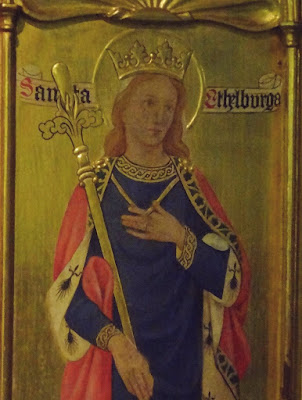
One of many Christian ladies throughout history who have held the door to the Faith open to their husband. She was a daughter of King Ethelbert of Kent, the first of the Christian Saxon Kings. She was married to King Edwin of Northumbria a pagan, who promised to respect her religion and embrace it if it seemed to him holy and right. The Venerable Bede tells us what happened next:
At this time the nation of the Northumbrians, that is, the nation of the Angles who live on the north side of the river Humber, with their king, Edwin, received the faith through the preaching of Paulinus… The occasion of this nation’s embracing the faith was their aforesaid king being allied to the kings of Kent, having taken to wife Ethelburga, otherwise called Tate, daughter to King Ethelbert. He having by his ambassadors asked for her in marriage from her brother Eadbald, who then reigned in Kent, was answered, “It was not lawful to marry a Christian virgin to a pagan husband, lest the faith and the mysteries of the heavenly King should be profaned by her cohabiting with a king who was altogether a stranger to the worship of the true God.” This answer being brought to Edwin by his messengers, he promised in no manner to act in opposition to the Christian faith, which the virgin professed; but would give leave to her, and all that went with her, men or women, priests or ministers, to follow their faith and worship after the custom of the Christians. Nor did he deny but that he would embrace the same religion, if, being examined by wise persons, it should be found more holy and more worthy of God.
Hereupon the virgin was promised, and sent to Edwin, and pursuant to what had been agreed on, Paulinus, a man beloved of God, was ordained bishop, to go with her, and by daily exhortations, and celebrating the heavenly mysteries, to confirm her and her company… But his mind was wholly bent upon reducing the nation to which he was sent to the knowledge of truth; according to the words of the apostle, “To espouse her to one husband, that he might present her as a chaste virgin to Christ.” Being come into that province, he laboured much, not only to retain those that went with him, by the help of God, that they should not revolt from the faith, but, if he could, to convert some of the pagans to a state of grace by his preaching.
The next year there came into the province a certain assassin, called Eumer, sent by the king of the West Saxons, whose name was Cuichelm, in hopes at once to deprive King Edwin of his kingdom and his life. He had a two-edged dagger, dipped in poison, to the end that if the wound were not sufficient to kill the king, it might be performed by the venom. He came to the king on the first day of Easter, at the river Derwent, where then stood the regal city, and being admitted as if to deliver a message from his master, whilst he was in an artful manner delivering his pretended embassy, he started suddenly, and drawing the dagger from under his garment assaulted the king. Lilla, the king’s beloved minister, observed this, and having no buckler at hand to secure the king from death, interposed his own body to receive the stroke; but the wretch struck so home, that he wounded the king through the knight’s body. Being then attacked on all sides with swords, he in that confusion also slew another soldier, whose name was Forthhere.
On that same holy night of Easter Sunday, the queen had brought forth to the king a daughter, called Eanfled. The king, in the presence of Bishop Paulinus, gave thanks to his gods for the birth of his daughter; and the bishop, on the other hand, returned thanks to Christ, and endeavoured to persuade the king, that by his prayers to Him he had obtained that the queen should bring forth the child in safety and without much pain. The king, delighted with his words, promised that if God would grant him life and victory over the king by whom the assassin had been sent, he would cast off his idols and serve Christ; and as a pledge that he would perform his promise, he delivered up that same daughter to Paulinus, to be consecrated to Christ. She was the first baptized of the nation of the Northumbrians, on Whitsunday, with twelve others of her family.
Edwin was victorious and did get rid of his idols but still hesitated to be baptized. One of his counselors gave him this wise advice:
Another of the king’s chief men, approving of his words and exhortations, presently added: “The present life of man, O king, seems to me, in comparison of that time which is unknown to us, like the swift flight of a sparrow through the room wherein you sit at supper in winter, with your commanders and ministers, and a good fire in the midst, whilst the storms of rain and snow prevail abroad. The sparrow, I say, flying in at one door, and immediately out at another, whilst he is within, is safe from the wintry storm; but after a short space of fair weather, he immediately vanishes out of your sight, into the dark winter from which he had emerged. So this life of man appears for a short space, but of what went before, or what is to follow, we are utterly ignorant. If, therefore, this new doctrine contains something more certain, it seems justly to deserve to be followed.” The other elders and king’s counsellors, by divine inspiration, spoke to the same effect.

