
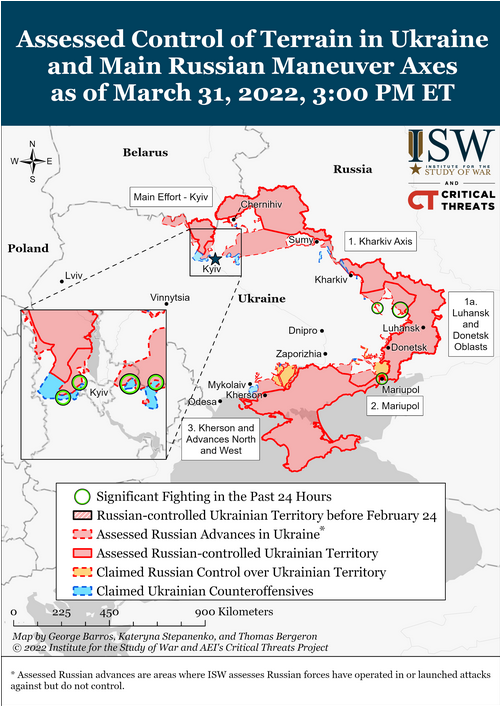
From The Institute For The Study of War:
Mason Clark, George Barros, and Karolina Hird
March 31, 6:00 pm ET
Ukrainian forces conducted several local counterattacks around Kyiv, in northeastern Ukraine, and toward Kherson on March 31, successfully pressuring Russian forces and seeking to disrupt ongoing Russian troop rotations. Ukrainian forces northwest of Kyiv pushed Russian forces north of the E-40 highway and will likely assault Russian-held Bucha and Hostomel in the coming days. Ukrainian forces exploited limited Russian withdrawals east of Brovary to retake territory across Kyiv and Chernihiv Oblasts. Ukrainian forces likely conducted counterattacks toward Sumy in the past 24 hours as well, though ISW cannot independently confirm these reports. Finally, Ukrainian forces conducted limited counterattacks in northern Kherson Oblast. Russian forces only conducted offensive operations in Donbas and against Mariupol in the last 24 hours and did not make any major advances.
Russian efforts to redeploy damaged units from the Kyiv and Sumy axes to eastern Ukraine are unlikely to enable Russian forces to conduct major gains. Russia continued to withdraw elements of the 35th and 36th Combined Arms Armies and 76 Air Assault Division from their positions northwest of Kyiv into Belarus for refit and likely further redeployment to eastern Ukraine. However, these units are likely heavily damaged and demoralized. Feeding damaged Eastern Military District units directly into operations in eastern Ukraine—predominantly conducted by the Southern Military District—will likely prove ineffective and additionally introduce further command-and-control challenges for the Russian military. Russian forces will likely attempt to retain their current front lines around Kyiv and in northeastern Ukraine and will continue to dig in on these fronts; ISW has not seen any indicators of Russian forces fully relinquishing captured territory. However, Ukrainian counterattacks are likely disrupting Russian efforts to redeploy and refit their forces and will continue in the coming days.
Key Takeaways
- Ukrainian forces successfully conducted local counterattacks around Kyiv, towards Sumy, and in Kherson Oblast and will likely take further territory—particularly northwest and east of Kyiv—in the coming days.
- Russia is withdrawing elements of its damaged forces around Kyiv, Chernihiv, and Sumy for redeployment to eastern Ukraine, but these units are unlikely to provide a decisive shift in Russian combat power.
- Ukrainian forces continued to repel Russian assaults throughout Donetsk and Luhansk Oblasts, and Russian forces failed to take territory in the past 24 hours.
- Russian forces continue to steadily advance in Mariupol.
- Russia’s preplanned spring draft will begin on April 1 and does not appear abnormal from Russia’s typical conscription cycle. Newly drafted conscripts will not provide Russia with additional combat power for many months.
- The Kremlin is likely accelerating efforts to establish quasi-state entities to govern occupied Ukrainian territory.
Putin signed a decree on March 31 beginning Russia’s preplanned spring draft, conscripting 134,500 Russians.[1] Russia conducts two prescheduled drafts a year, typically running from April 1 to July 15 and October 1 to December 31.[2] The number of Russian conscripts called up is relatively consistent, including 127,000 in fall 2021 and 134,000 in Spring 2021.[3] New conscripts typically undergo one or two months of basic training followed by three to sixth months of advanced training prior to assignment to specific units, and are precluded by law from deploying to combat with less than four months of training—though the Kremlin could bypass this restriction by announcing a general mobilization.[4] Russia’s Spring 2022 draft does not as of yet appear abnormal from Russia’s typical conscription cycle, but ISW will closely monitor any developments throughout the April 1-July 15 call-up period. Newly drafted conscripts will not provide Russia additional combat power for many months.
The Ukrainian General Staff reported on March 31 that 200 “mercenaries from the Middle East,” likely Syrian troops, arrived at the Gomel military airfield in Belarus on March 29.[5] ISW published an assessment of Russia’s mobilization of reinforcements from Syria and elsewhere to Ukraine earlier on March 31.[6]
The Kremlin is likely accelerating efforts to establish quasi-state entities to govern occupied Ukrainian territory. The Ukrainian General Staff reported on March 30 that Russia is attempting to set up military-civilian administrations and is preparing to create a “Kherson’s Peoples Republic” to administer occupied southern Ukraine. The General Staff later reported on March 31 that Russia’s FSB, the 652nd Group of Information and Psychological Operations, and officers of the 12th Main Directorate of the General Staff of the Russian Federation are currently overseeing the occupation around Kherson, and the Kremlin is “curating” Russian law enforcement personnel and court officials for deployment to Ukraine at an unspecified future date.[7]
Go here to read the rest. From Strategy Page:
Ukrainian forces have captured a lot of modern Russian weapons and military equipment and made these discoveries available to Western countries that are supplying Ukraine with modern weapons and economic and diplomatic pressure on Russia.
This loot includes largely intact Iskander short range ballistic missiles, new EW (Electronic Warfare) equipment that had proven effective in Syria and Ukraine and new Azart combat radios and associated equipment. Some defective Islander missiles were recovered largely intact, which allowed close inspection of the missile design and the countermeasures Russia often spoke of but never provided details of. The countermeasures were, as expected, small decoys deployed as the Iskander came within range of the targets, as well as Western ABM (anti-ballistic missile) systems like Patriot, Thaad or the naval Standard missile defense system. Now that there were undamaged examples of these decoys available, Western ABM systems can be modified to defeat them.
The situation is much the same with captured EW and communications equipment. Another valuable item captured on the battlefield was the state of Russian training and the ability to maintain modern equipment. The most modern Russian vehicles and weapons were used in Ukraine and the Ukrainians and NATO experts had been jointly studying them intently since 2014, but from a distance. Once the Russian equipment was captured you could reach some useful conclusions about their operation. This was enhanced when Russians who used this equipment were also captured. The findings so far presented painful, for the Russians, revelations about how ineffective their expensive military reform and modernization efforts were. Examining Russian vehicles, both tanks and other armored vehicles as well as military trucks, revealed design defects and the traditional Russian inability to perform regular maintenance during peacetime or even when preparing for large scale exercises or combat. Some largely intact Russian helicopters were also examined as well as the wreckage of Russian fighters and transports. Some of these were designed and built in Ukraine before the Soviet Union dissolved in 1991. The Ukrainians learned from these bad Cold War habits and offered to refurbish older Russian aircraft and other equipment to eliminate some of these design flaws. Russia thought they had done the same, but they had not.
Go here to read the rest. Ukraine is becoming Putin’s version of Hitler’s Eastern Front on a miniature scale. It recalls this maxim of Marx, almost the only true thing he ever wrote:


Well, the latest off the battlefield is that there is reason to believe that two of the four planes which breached Swedish air space a few weeks back were carrying nuclear weapons. Now Russian state television’s had a broadcast on which a pro-Putin academician babbled about dropping nuclear weapons on Warsaw, Berlin, and the Baltic states. John Mearsheimer will no doubt have a Rube Goldberg argument to the effect that Russia just has to do this to secure their security, or whatever.