
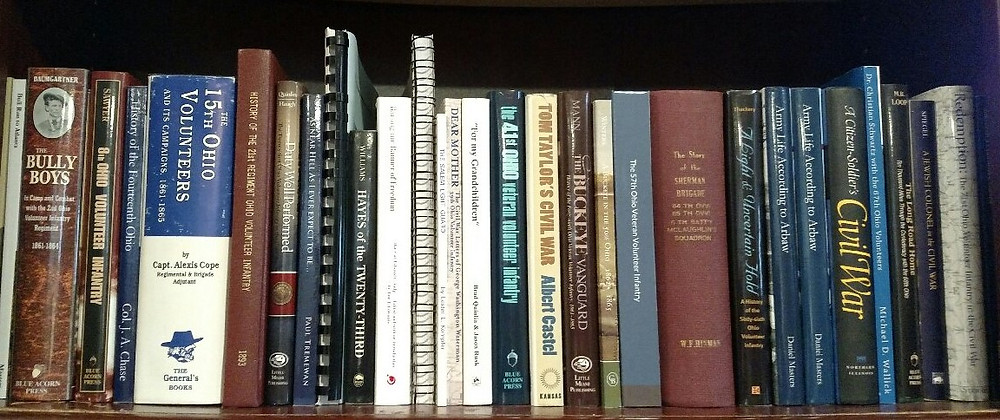
It seems shockingly counter-intuitive to suggest that the Civil War is under studied. Beginning while the War was being waged, and continuing to the present day, there has been an avalanche of books about that conflict. However, certain aspects of the War have been understudied. With the advent of almost cost free e-publishing, the legions of amateur Civil War scholars can help rectify this situation. I expect to partially retire from the law mines in approximately half a decade. If God grants me a long life and good health after retirement I will attempt to aid in shedding light and analysis on facets of the War which have received comparatively little scholarship. Here are ten such areas. I would note that the inclusion of an area for further work does not mean that books and articles have not been written on the subject, but that they are comparatively sparse, especially in reference to topics that receive endless treatment. (Looking at you Gettysburg!)
The Trans Mississippi– Both the Union and the Confederacy frequently used the conflict beyond the Mississippi as a dumping ground for failed and/or troublesome Generals and that perceived taint has apparently descended down the years to make this the most ignored theater of the War. This has helped give a false impression of the War overall. In the far West the War was fought to the knife and the knife to the hilt, engendering hatreds that lingered for generations after the last shot was fired. The conflict was important with the Union dedicating manpower and resources against local Confederate forces that could have been better spent elsewhere. If the Union had lost the War, the conflict in the Trans Mississippi might well have been blamed for being a drain on Union military and naval resources.
Jefferson Davis-Unsurprisingly, the scholarship on Davis is infinitesimal when compared to the mountain of studies on Lincoln. That imbalance will never be addressed, nor should it be. However, the day to day activities of Jefferson as commander in chief do need a serious and comprehensive study and many, many myths about the man also need puncturing.
United States Colored Troops-Some 180,000 blacks fought for the Union, most in the United States Colored Troops. The scholarship on this organization is limited, weak and much of it dated. Time for a good serious study of their role in the war, how the regiments were recruited and their long term impact on the nation they helped preserve.
Regimental histories-In the decades immediately following the Civil War, many regimental histories were written, most by former members of the regiments. Although there is valuable history contained in these tomes, the scholarship usually ranged from non-existent to shoddy. Modern regimental histories, in the mode of the pioneering history of the 20th Maine, are needed. Here, especially, amateur scholars could be quite helpful.
Alcohol and the Civil War-Alcohol tends to be mentioned in most Civil War histories only in reference to General Grant. It was a hard-drinking time and drunkenness was a common problem among officers and men. Alcohol and its impact on the Civil War awaits good, and detailed, studies.
Artillery-Compared to the infantry and cavalry, books on Civil War artillery have been relatively few in numbers. The men who served the king of battle deserve better.
Logistics-Serious consideration of logistics and its impact on Civil War operations tends to be scarce in most histories. A logistical history of the Civil War needs to be written.
Foreign Volunteers-For decades after the Civil War Heroes von Borcke proudly flew the Stars and Bars from the battlements of his Prussian estate, a memento of his service under Jeb Stuart. Considering how many of them there were, the foreign volunteers who fought for the Union and the Confederacy have received little attention in most histories.
Staff work-Ah, the Remfs, always unloved by the frontline soldiers in every conflict. Nonetheless, staff work often determines the success or failure of most military operations, and the scholarship devoted to this important topic during the Civil War is minuscule.
War Governors-Considering the key role they played, the war governors, Union and Confederate, have received, the majority of them, relatively little scholarly attention.
In regard to America’s greatest war, much work remains to be done. Scholars, to your keyboards!


That will definitely have to be done by independent scholars. In the end-stage American academy, the subject will be ritually-unclean–save as to depict him as Worse Than Hitler to students who have the faintest idea who Hitler was.
But the subject you highlight is definitely fascinating. Davis had the best possible training to be a Commander in Chief, looking at his background. And yet, the man who was an elected militia captain for 30 days in the Blackhawk War was far superior.
I think Davis’ problem was that he was too well prepared for the job, whereas he needed an outsider’s perspective to be a truly great war leader.
I think Davis’ problem was that he was too well prepared for the job, whereas he needed an outsider’s perspective to be a truly great war leader.
Davis always said he wanted a field command and never wanted to be President and I think he was being completely honest. Lincoln was fortunate that he had Grant. I can think of no other Union commander who would have had the fortitude to incur 50,000 casualties in a month, as he ground away at The Army of Northern Virginia, with cries of Grant the Butcher, and Mrs. Lincoln privately agreeing, ringing in the Spring of 1864 throughout the war weary North. Lincoln standing by Grant was the great decision of his as Commander-in-Chief, in spite of his belief that doing so might well cost him the election.
I’d like all of our young who can handle conventional classroom instruction to complete a basic education program which incorporates instruction in reading, writing, and the fundamentals of American history, geography, and civics. I don’t think we have to settle for the situation we have now, when we hand out secondary school diplomas to youths who cannot identify the correct half-century when asked when the Civil War occurred. That having been said, having students learn granular details of the military and political situation of that four-year period strikes me as something appropriate for an elective course for high-school upperclassmen, if there.
Reading, writing, arithmetic, elementary algebra, and the fundamentals of American history, geography, and civics.
That will definitely have to be done by independent scholars. In the end-stage American academy, the subject will be ritually-unclean–save as to depict him as Worse Than Hitler to students who have the faintest idea who Hitler was.
Prof. KC Johnson has remarked that hiring biases in history departments have grown so severe that you have subdisciplines wherein what counts as groundbreaking research is to be found in texts published ca. 1977. Military history, diplomatic history, and conventional political history are consistently slighted.
I haven’t a clue why my comment was not published and instead a mess of text was pulled from the page as if I’d copied and pasted it, which I did not.
Now my comment is there and all that mess is gone. I am not getting what’s going on here.
I have corrected it Art. WordPress sometimes acts in mysterious ways.
Side note: Much of today’s information re the Civil War comes from Public Television and cable specials. They generally lean to the more notable events and leave out a lot of background. Many also tend to reflect current points of view and overlook important nuances to various actions, beliefs and opinions of the times of the events covered. An exception was the film Glory which covered the story of the 54th Mass, the first Black regiment.
Foreign volunteers are an interesting topic in general. I’d love to hear some stories behind the thinking of Confederate volunteers, just because that seems so contrary to our modern thinking. But I can get the appeal of volunteering for freedom-fighting underdogs. The idea of volunteering to fight for an established foreign country is odder. Of course, a paycheck is a paycheck, and before Call of Duty men had to prove themselves somehow.
Alcohol and the Civil War: I had a conversation yesterday with a retired physician who was an MD in the Soviet Red Army. He told me in WWII the Russians soldiers were given a liter of alcohol before a battle. They didn’t get drunk because of the high adrenaline levels and if wounded, especially in the mid-section it helped with the spread of infection.
You provide a great list of suggestions. Another topic deserving of more study (as suggested long ago by DS Freeman) is the “rage militaire” that gripped the deep south in 1860. The combination of fear, fanaticism, and arrogance that led to secession deserves considerably more examination.
The combination of fear, fanaticism, and arrogance that led to secession deserves considerably more examination.
Quite right Bob. I think a lot of it was triggered by the Harper’s Ferry raid of John Brown in 1859 and the celebration by too many in the North of that mad venture. That cut the legs out from many Southern Unionists who contended that sectional differences could be resolved peacefully within the Union. John Brown might as well have been paid by the Fire Eaters.
People who study American history might not study much Haitian history. But a lot of whites from Haiti settled in the US and had horror stories. Without going too far with it, I can understand why the Confederates were scared.
With the way things are going I wonder if you could say that education has gone from the three r’s of reading, ‘riting, and ‘rithmetic to racism, Russia, and reparations? Russia is the new “It’s Aliens.”