
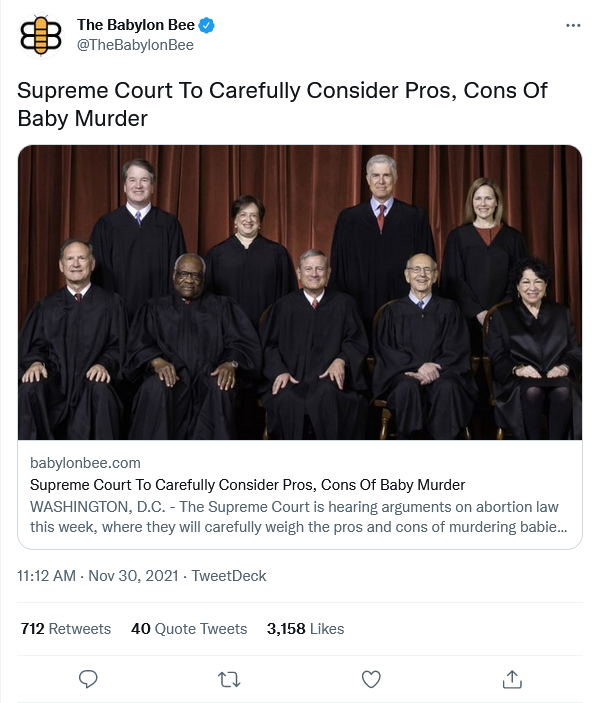
News that I missed, courtesy of The Babylon Bee:
WASHINGTON, D.C.—The Supreme Court is hearing arguments on abortion law this week, where they will carefully weigh the pros and cons of murdering babies with metal tearing instruments and high-powered vacuums.
“Man, this is a tough one! Maybe we should make a list of pros and cons,” said Chief Justice Roberts, according to sources. “Can we end baby murder while staying true to our lofty and convoluted jurisprudence? However we decide this case, we must remember what’s truly important: our political reputations.”
“Um,” said Kavanaugh, “I guess ‘babies not being murdered’ would go in the ‘pro’ column.”
“Yeah, but then CNN might say something bad about us,” said Roberts. “That’s definitely a ‘con’.”
Justices Kagan and Sotomayor disagreed, insisting that ‘babies not being murdered’ should be in the “con” column instead.
The justices went back and forth on the deep complexities of tearing preborn human beings limb from limb, crushing their skulls, and sucking their remains out with a suction device. As they debated, the collected spiritual forces of darkness, such as snarling demons and CNN news crews, descended on the Supreme Court building to voice their opinion that the blood sacrifice of the unborn before the altar of American narcissistic consumerism must be allowed to continue.
Go here to read the rest. I am asking for the intercession of the man who wrote these lines twenty-nine years ago:
What makes all this relevant to the bothersome application of “political pressure” against the Court are the twin facts that the American people love democracy and the American people are not fools. As long as this Court thought (and the people thought) that we Justices were doing essentially lawyers’ work up here–reading text and discerning our society’s traditional understanding of that text–the public pretty much left us alone. Texts and traditions are facts to study, not convictions to demonstrate about. But if in reality our process of constitutional adjudication consists primarily of making value judgments; if we can ignore a long and clear tradition clarifying an ambiguous text, as we did, for example, five days ago in declaring unconstitutional invocations and benedictions at public high school graduation ceremonies, Lee v. Weisman, 505 U. S. ___ (1992); if, as I say, our pronouncement of constitutional law rests primarily on value judgments, then a free and intelligent people’s attitude towards us can be expected to be (ought to be) quite different. The people know that their value judgments are quite as good as those taught in any law school–maybe better. If, indeed, the “liberties” protected by the Constitution are, as the Court says, undefined and unbounded, then the people should demonstrate, to protest that we do not implement their values instead of ours. Not only that, but confirmation hearings for new Justices should deteriorate into question and answer sessions in which Senators go through a list of their constituents’ most favored and most disfavored alleged constitutional rights, and seek the nominee’s commitment to support or oppose them. Value judgments, after all, should be voted on, not dictated; and if our Constitution has somehow accidently committed them to the Supreme Court, at least we can have a sort of plebiscite each time a new nominee to that body is put forward. Justice Blackmun
not only regards this prospect with equanimity, he solicits it, ante, at 22-23.
* * *
There is a poignant aspect to today’s opinion. Its length, and what might be called its epic tone, suggest that its authors believe they are bringing to an end a troublesome era in the history of our Nation and of our Court. “It is the dimension” of authority, they say, to “cal[l] the contending sides of national controversy to end their national division by accepting a common mandate rooted in the Constitution.” Ante, at 24.
There comes vividly to mind a portrait by Emanuel Leutze that hangs in the Harvard Law School: Roger Brooke Taney, painted in 1859, the 82d year of his life, the 24th of his Chief Justiceship, the second after his opinion in Dred Scott. He is all in black, sitting in a shadowed red armchair, left hand resting upon a pad of paper in his lap, right hand hanging limply, almost lifelessly, beside the inner arm of the chair. He sits facing the viewer, and staring straight out. There seems to be on his face, and in his deep set eyes, an expression of profound sadness and disillusionment. Perhaps he always looked that way, even when dwelling upon the happiest of thoughts. But those of us who know how the lustre of his great Chief Justiceship came to be eclipsed by Dred Scott cannot help believing that he had that case–its already apparent consequences for the Court, and its soon to be played out consequences for the Nation–burning on his mind. I expect that two years earlier he, too, had thought himself “call[ing] the contending sides of national controversy to end their national division by accepting a common mandate rooted in the Constitution.”
It is no more realistic for us in this case, than it was for him in that, to think that an issue of the sort they both involved–an issue involving life and death, freedom and subjugation–can be “speedily and finally settled” by the Supreme Court, as President James Buchanan in hisinaugural address said the issue of slavery in the territories would be. See Inaugural Addresses of the Presidents of the United States, S. Doc. No. 101-10, p. 126 (1989). Quite to the contrary, by foreclosing all democratic outlet for the deep passions this issue arouses, by banishing the issue from the political forum that gives all participants, even the losers, the satisfaction of a fair hearing and an honest fight, by continuing the imposition of a rigid national rule instead of allowing for regional differences, the Court merely prolongs and intensifies the anguish.
We should get out of this area, where we have no right to be, and where we do neither ourselves nor the country any good by remaining.
Go here to read the rest. And let’s bring that prince of lawyers, Saint Thomas More, into the lists:
Pray that, for the glory of God and in the pursuit of His justice,
I may be trustworthy with confidences,
keen in study, accurate in analysis,
correct in conclusion, able in argument,
loyal to clients, honest with all,
courteous to adversaries, ever attentive to conscience.
Sit with me at my desk and listen with me to my clients’ tales.
Read with me in my library and stand always beside me
so that today I shall not, to win a point, lose my soul.
Pray that my family may find in me what yours found in you:
friendship and courage, cheerfulness and charity,
diligence in duties, counsel in adversity,
patience in pain—their good servant, and God’s first. Amen


A great post Mr. McClarey.
Your picks are impeccable.
Heading into Mass.
May that courage spoken of by St. Thomas More be found alive and not aborted in the hearts of the Justices today.