
Harvard professor Samuel Eliot Morison, who was about to become the official historian of the Navy during World War II and who would attain Admiral rank, in 1943 came out with his two volume Pulitzer prize winning biography of Columbus, Admiral of the Ocean Sea. The prologue in that book is a standing rebuke of the historical pessimism that infests our own time:
At the end of the year 1492 most men in Western Europe felt exceedingly gloomy about the future. Christian civilization appeared to be shrinking in area and dividing into hostile units as its sphere contracted. For over a century there had been no important advance in natural science, and registration in the universities dwindled as the instruction they offered became increasingly jejune [boring] and lifeless. Institutions were decaying, well-meaning people were growing cynical or desperate, and many intelligent men, for want of something better to do, were endeavoring to escape the present through studying the pagan past.
Islam was now expanding at the expense of Christendom. Every effort to recover the holy Sepulcher at Jerusalem, touchstone of Christian prestige, had been a failure. The Ottoman Turks, after snuffing out all that remained of the Byzantine Empire, had overrun most of Greece, Albania and Serbia; presently they would be hammering at the gates of Vienna….
With the practical dissolution of the Empire and the Church’s loss of moral leadership, Christians had nothing to which they might cling. The great principle of unity represented by emperor and pope was a dream of the past that had not come true. Belief in the institutions of their ancestors was wavering. It seemed as if the devil had adopted as his own the principle “divide and rule.” Throughout Western Europe the general feeling was one of profound disillusion, cynical pessimism and black despair….
Morrison goes on to note that the Nuremburg Chronicle was in preparation in 1492 which purported to be a universal history from the creation of the world.
Lest any reader feel an unjustified optimism, the Nuremberg chroniclers place 1493 in the Sixth or penultimate Age of the world, and leave six blank pages on which to record events from the date of print to the Day or Judgment.
Yet, even as the chroniclers of Nuremberg were correcting their proofs from Koberger’s press, a Spanish caravel named Nina scudded before a winter gale into Lisbon with news of a discovery that was to give old Europe another chance. In a few years we find the mental picture completely changed. Strong monarchs are stamping out privy conspiracy and rebellion; the Church, purged and chastened by the Protestant Reformation, puts her house in order; new ideas flare up throughout Italy, France, Germany and the northern nations; faith in God revives and the human spirit is renewed. The change is complete and startling: “A new envisagement of the world has begun, and men are no longer sighing after the imaginary golden age that lay in the distant past, but speculating as to the golden age that might possibly lie in the oncoming future.”
Christopher Columbus belonged to an age that was past, yet he became the sign and symbol of this new age of hope, glory and accomplishment. His medieval faith impelled him to a modern solution: expansion. If the Turk could not be pried loose from the Holy Sepulcher by ordinary means, let Europe seek new means overseas; and he, Christopher the Christ-bearer, would be the humble yet proud instrument of Europe’s regeneration. So it turned out, although not as he anticipated. The First Voyage to America that he accomplished with a maximum of faith and a minimum of technique, a bare sufficiency of equipment and a superabundance of stout-heartedness, gave Europe new confidence in herself, more than doubled the area of Christianity, enlarged indefinitely the scope for human thought and speculation, and “led the way to those fields of freedom which, planted with great seed, have now sprung up to the fructification of the world.”…
In his faith, his deductive methods of reasoning, his unquestioning acceptance of the current ethics, Columbus was a man of the Middle Ages, and in the best sense. In his readiness to translate thought into action, in lively curiosity and accurate observation of natural phenomena, in his joyous sense of adventure and desire to win wealth and recognition, he was a modern man.
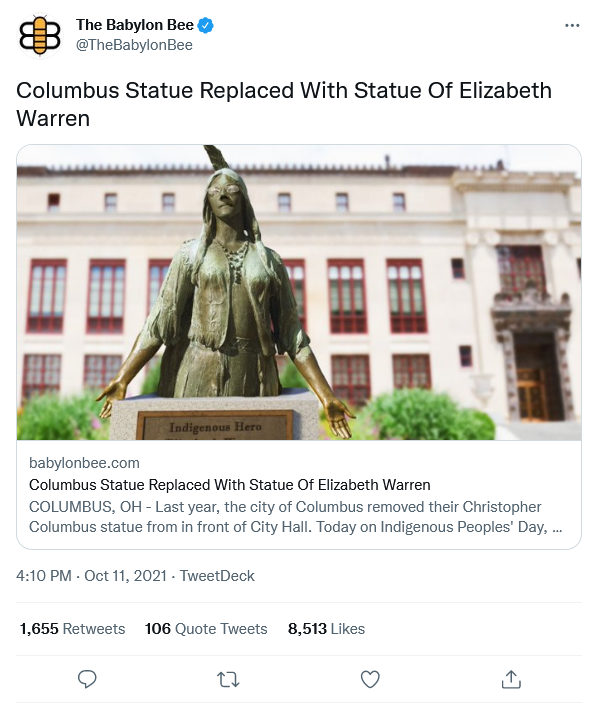
"He discovered America is what he did! He was a brave Italian explorer. And in this house Christopher Columbus is a hero—end of story."pic.twitter.com/rpsyTnlu6V
— Michael Knowles (@michaeljknowles) October 11, 2021


People are ignorant of history. And when confronted with what history actually says, people prefer their ignorance.
.
The same I have found true in science and engineering (especially of the nuclear variety). People are ignorant, and when confronted with what science and engineering actually say, they prefer their ignorance.
.
It is the height of irony that these ignorant people are often the same people who claim they revere the truth in science or history simply because they are materialists, and that persons of faith can never revere the truth in science or history because the eyes of persons of faith are colored (or darkened) by their faith.
.
How did we ever get to this point where the entire repository of all of mankind’s knowledge is at the finger tips of the average smart phone user whose ignorance surpasses that of the most barbaric Scythian of the bygone pagan Roman era?
“many intelligent men, for want of something better to do, were endeavoring to escape the present through studying the pagan past…”
That is exactly right. both the Renaissance and the Protestant Revolt were profundly reactionary movements, seeking a return to a real or imaginary Golden Age.
It was only in the 17th century that we see the slow birth of a new idea, the expectation that the future would be unlike the past, that it would be better, and that the experience of ages may instruct and warn, but cannot guide or control.
Those who say it can’t be done need to move out of the way of those of us who are doing it!! Yes, my friends tell me that I am a bad ass, however I get a lot done. 😀
As I recall, Barbara, Scripture has a whole set of bad asses, some of whom were women. Judith and Deborah come immediately to mind.
Have not seen the word ‘jejune’ used in a sentence since James Joyce’s ULYSSES, with his jejune Jesuits.
Many years ago now, my Uncle Tom [he served under Patton in North Africa and Sicily and was still fighting in the Po Valley when the war ended] gave me that book,. It is wonderful. I will replace it and re-read.
Book recommendation: Admiral Morison’s, The Two Ocean War. It was a close-run thing, i.e., the issue was in doubt, early on.
I have the two ocean war along with eleven of the multi-volume set. His work has never been bettered on the US naval war in World War II.
Why is it so difficult to have even a smidgen of sympathy for the Indigenous who suffered gravely after Columbus landed but instead people complain about the Aztecs and Mayans and a scant few tribes north of present day Mexico as IF all of them were blood thirsty barbarians?
Not to mention especially in South America and the Caribbean as well whose riches of gold, silver, diamonds, cacao and sugar cane were to be reaped sadly at last ( with silver from Potosi being the exception) on the backs and blood of African slaves? I just read that countries like Argentina and Chile for example, changed Columbus Day into a holiday celebration for all contributions not just the Europeans nor just the Indigenous.
Why is it so difficult to have even a smidgen of sympathy
Sympathy always has to be based on accuracy and the people who bash Columbus usually know little about the societies in the New World at the time of the Discovery. Central America and Peru were the homes of vast empires, amazing accomplishments without the wheel and much knowledge of metallurgy. The Aztec devotion to human sacrifice caused many of their subject peoples to view the Spanish as liberators. North America was filled with hosts of tribes and confederations of tribes, usually at war with each other, and not far removed from the stone age. South America, outside of the Incan Empire was similarly populated. Like all peoples at all time, all these cultures had their vices and their virtues, and the study of them is fascinating and rewarding. They are reduced to stick figures by the Left to bash the West for contemporary political battles. The current onslaught against Columbus has very little to do with Columbus or the Age of Exploration and everything to with the Leftist desire to pull down the West and to build some bloody Utopia on the ruins.
… people complain about the Aztecs and Mayans and a scant few tribes north of present day Mexico as IF all of them were blood thirsty barbarians?
As my generation says:
tell me you either view American Indians as sub humans whose lives matter not at all, or know absolutely nothing of the kind of brutality that was normal, without TELLING me that….
Where is your sympathy for those tortured horrifically to death by the “mostly peaceful” locals? Why is the horror at slavery reserved for African slaves– is the routine raiding and enslavement of neighboring tribes just not worthy of note?
Where is the respect for the basic humanity of the women who birthed children in conditions that make a modern pig stall look good, with the best outcome being that the infant was not tortured to death in front of them before they could die?
The Aztecs weren’t noted for BEING brutal, they were noted for being EXCEPTIONALLY among the exceptionally brutal locals.
The folks calling for “sympathy” spent decades claiming the records of what they said they did were slanderous lies– only to find out, every time there is physical evidence, that it was an understatement. If someone lied about how horrific their behavior was, it was the Aztecs bragging.
Funny, same pattern as Carthage, and their infant sacrifice….
Is Morrison right, though? The 1400’s saw the invention of the printing press and subsequent increase in learning. The Portuguese were exploring Africa and India. Europe was just figuring out explosive projectiles. Leonardo da Vinci was working, and granted not all of his inventions were well-known, but it’s hard to think of his era a “decline”.
Like most eras it was a mixture Pinky but overall I think Morrison was right. The Fifteenth Century saw the Great Schism with three popes at one time. The Hussite wars ravaged Central Europe. The Turks were continually expanding in the East with the fall of Constantinople in 1453. The crusading movement was dead. The Renaissance was flowering in Italy, but many were disturbed by the rampant immorality which accompanied it along with, often, a scorn for religion. The West seemed in retreat throughout most of the century with the Iberian peninsula being a rare bright spot. Europe seemed stuck, never having recovered its confidence after the devastation wreaked by the Black Death in the Fourteenth Century. In hindsight we can see technological developments that were soon going to make the West dominant around the globe, but contemporaries in Europe in the 15th century did not view the world with such optimism.
Yeah, I’m with you on a lot of that. I think we underrate just how embarrassing the 1300’s-1400’s were for the papacy, and how much damage that did to the sense of unity of truth. (I know, I’m setting you up with a “bad popes can do a lot of damage” line, but it’s true.)