Donald R. McClarey
Cradle Catholic. Active in the pro-life movement since 1973. Father of three, one in Heaven, and happily married for 43 years. Small town lawyer and amateur historian. Former president of the board of directors of the local crisis pregnancy center for a decade.



I had a naughty book by Judy Bloom at one point. In a moment of moral uprightness, I decided to throw the book away; this horrified my mother (who was aware of what was in the book, and disapproved). She was a Depression/WWII era girl, and the above scene probably explains why treating any book with disrespect with just not done in our house.
.
It took many, many years before I would allow my children to write in their books. I still have trouble doing it myself.
Ray Bradbury was a prophet?
He has an increasing claim to the title Frank with each passing year.
Wow. Growing up, to even think of banning books – much less burning them – was to be two steps away from a Nuremberg rally. I have a gut feeling the ones who taught us that are now the ones burning the books.
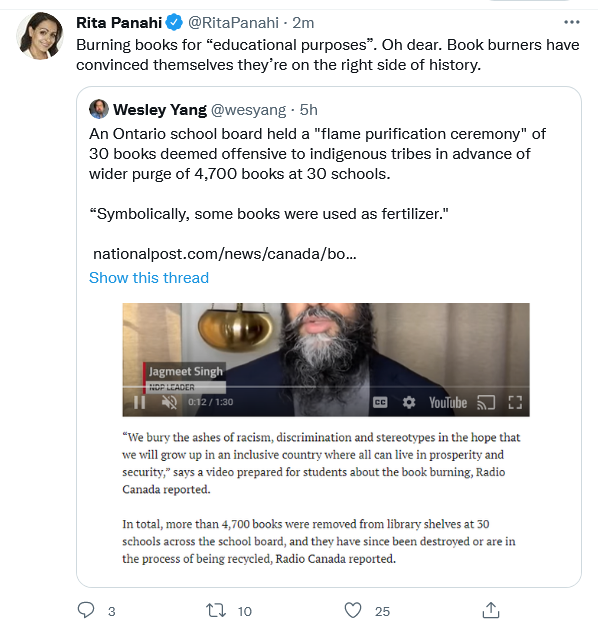
Burning books for “educational purposes.”
Next up, killing children for women’s reproductive health care.
Then it’s, financial penalties for not happily complying to Transgender requests and homosexual pride.
Satanism as a preferred religion is gaining popularity among the baby killing book burning homosexual transgender community.
“What a wonderful world it would be.”
I’ll post a dissent, here. Libraries are great repositories of the world’s mediocre literature. When you’re running out of space, something’s gotta give. So you weed and have a secondhand dealer take what he wants for the price he states. (There was at one time a fine place in Deansboro, NY, near Utica). Then you put the rest on sale for name your price. The secondary market for much is minimal. If you’re anxious, you can check OCLC for who has a copy. . Next stop is the recycle bin.
.It took many, many years before I would allow my children to write in their books. I still have trouble doing it myself.
If the book isn’t decorative and it’s your property, scribble away. Marginalia is one way you absorb, learn, and mark for review. Nothing can beat it.
I have a little confession here – when I was a pastoral minister at a Newman center our small study library was unkempt. I found a preponderance of resources were very liberal. On a summer work project I made for myself, I put all the Schillebeeckx, Rahner, “America” etc on tables with signs to help yourself to any free book of your choice. I didn’t destroy anything but I didn’t want want to give any support or imprimatur of sorts to the fact that our library was full of them.
Most of the books walked one or a few at a time over the summer. I also tried to organize our little library to make really good books and authors easier to find.
The truth is that there is nothing inherently wrong with destroying a truly malicious book or making them harder to access. The Church wasn’t mistaken to have a index of prohibited books, though it can be argued that the list could have been too broad. If you think that it is wrong to ever restrict access to books, imagine a book that describes in great detail how to perform and get away with the most heinous crimes you can imagine. Now imagine that this book is specifically targeted towards children and placed in a children’s museum. Or imagine a book that describes how to do fun science experiments like making rock candy or a model volcano, but which are intentionally set up to make bombs and poisonous gasses to kill anyone who tries the experiments out.
The real issue is that the left is following the old line by Herbert: “When I am weaker than you I ask for freedom, because that is according to your principles. When I am stronger than you I take away your freedom, because that is according to my principles.” The left used the idea that all books should be treasured specifically to fill libraries with their trash. (And note that since there is only finitely much space in libraries, this often lead to classics being put into storage and then destroyed.) Once they were firmly in the curation positions they dropped the facade about wanting to preserve books for the sake of books so that they could destroy what little decent literature remained.
The truth is that there is nothing inherently wrong with destroying a truly malicious book or making them harder to access.
Yes there is because there will never be agreement about what books should be banned and tyrants will always use censorship to crush resistance to them. Something like child porography is easy to agree to ban. Going much beyond that is evil and futile. The index Liborum Prohibitorum did nothing but make the Church look like a laughing stock and an enemy of freedom.
https://en.wikipedia.org/wiki/List_of_authors_and_works_on_the_Index_Librorum_Prohibitorum
Book burning is something that should be abhorrent to anyone having a love of freedom.
I have a little confession here – when I was a pastoral minister at a Newman center our small study library was uncared for . I found a preponderance of resources were very liberal. On a summer work project I made for myself, I cleaned the room literally and organized the shelving system. I put all the Schillebeeckx, Rahner, “America” etc on tables with signs to help yourself to any free book of your choice. I didn’t destroy anything but I didn’t want want to give any support or imprimatur of sorts to the fact that our library was full of them.
Most of the books walked one or a few at a time over the summer. I also tried to organize our little library to make really good books and authors easier to find.
If I was rich or could get it organized it would have been better to just clean and organize and then outnumber the 30th century modernists. Liberals with lots of really good classics
Books are destroyed every day. Literal tons of pulp fiction was just thrown away and either ended up in landfills or incinerators. Libraries routinely destroy books that they they no longer wish to offer and are not sold. None of that is a tragedy in and of itself.
You might as well say that the youtube Channel RedLetterMedia is an enemy of freedom, because they routinely destroy DVD’s and VHS’s containing really crappy movies. It’s just the wrong perspective to view things from.
I am not advocating for the mass destruction of books, or even the abolition of books I don’t like. I have enough of a curator’s instinct that I even get annoyed when crappy shovelware games vanish off the face of the Earth. But does that mean that I refuse to delete anything from my hard drive to free up space? After all, it’s making “art” just that much harder to preserve.
The frame that books are sacred just for being books is how we got duped into allowing filth from the likes of Samuel Delaney into libraries (and the same frame meant that once we allowed it in, we could never get rid of it.)
Start by preserving our own works and works of actual art. If there’s space and time left over to preserving the mediocre and mildly offensive we can get to it then.
20th century
And to tie my discussion into the point about Ray Bradbury, yes indeed Fahrenheit 451 was prophetic. It is a very apt description of our current culture. But it is also a very misunderstood book. In the book it is stressed, on multiple occasions, that the institution of book burning is not what is wrong with society. It is said explicitly, and shown repeatedly through the actions of the “normal” characters, that even if books were not burned no one would read them anyway. The only reason that the government burns them is to assure the public that they aren’t any worse off or missing anything by burning the books.
The tragedy here is not that they are burning books. The tragedy is that they are so divorced from classical western culture. The mere act of burning the books is an afterthought, the real damage had been done long before that. If we obsess over the physical objects of books we are prioritizing the wrong thing. This hurts us in two ways: first, it leads to be satisfied with a society that still has books that lie unread (and which will eventually decay into unreadability while still being unread), and second because it makes it more difficult for us to prevent the enemy from successfully spreading its propaganda (propaganda which will inevitably end with the destruction of our books.) If we prevent some paper from meeting a fire, but we do nothing about those points, it is meaningless. If we preserve our culture, our intellectual curiosity and our discourse but a few books end up destroyed (as they always do) it is a great victory.
that even if books were not burned no one would read them anyway. The only reason that the government burns them is to assure the public that they aren’t any worse off or missing anything by burning the books.
No, the government burns the books to destroy them because an odd minority actually are reading them. The problem with the books is that text within them can promote emotional states whose very power and unfamiliarity causes distress. The foundation for redeploying the fire department was competing complaints from the aggrieved, for which the solution was to burn everything which bothered anyone.
Bradbury emphasizes the degraded character of the sensibilities and interests of the people who are not resisting, including Mrs. Montag, and looks at the problem from various angles.
And, yes, he called it. Not one false note.
I have a little confession here – when I was a pastoral minister at a Newman center our small study library was uncared for . I found a preponderance of resources were very liberal.
Same deal with the Newman Center at my old employer. Subscriptions to Commonweal, America and the like. You have limited space and limited budget. Note, the main library had both publications. What neither had was Crisis, Our Sunday Visitor, National Catholic Register, The Wanderer, or The Latin Mass. The one oddment which had slipped through decades earlier was a subscription to The New Oxford Review, purchased initially when it was an Anglican publication.
Looking back through Fahrenheit 451, we’re both right. In Beatty’s big speech on why the firemen are necessary he does talk quite a bit about the perpetually aggrieved. But he mixes that with a discussion of how entertainment has steadily been dumbed down for the masses (discussing people who think they know Hamlet because they read a one page digest about it.) He then goes into how this stoked feelings of inferiority in the general public towards the “intellectuals” that still read, and that firemen were necessary to maintain a sense that we were all “equal.” (This is in fact the first answer he gives to Montag when Montag explicitly asks about why there are firemen, he talks about the idea that burning is better than being offended later.)