
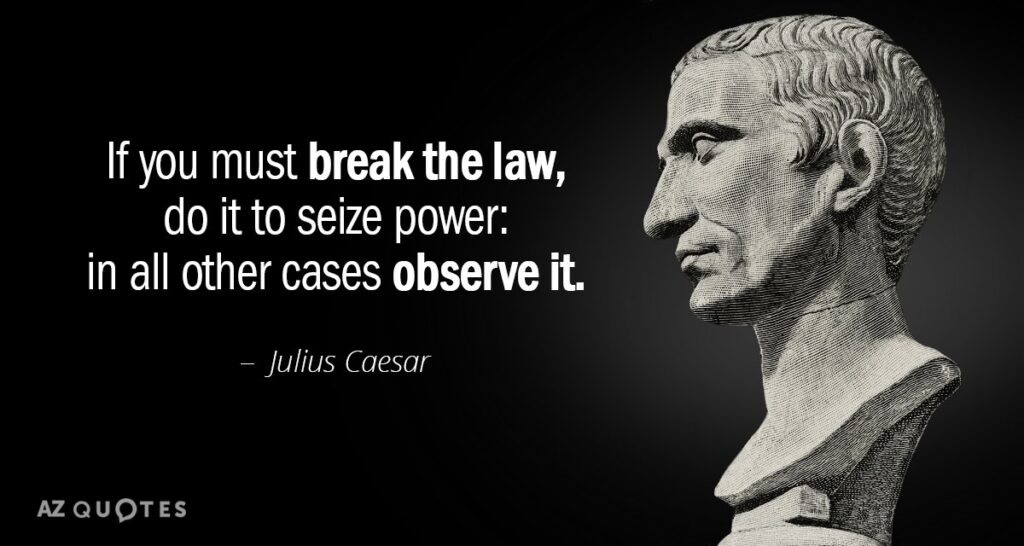
Caesar was and is not lovable. His generosity to defeated opponents, magnanimous though it was, did not win their affection. He won his soldiers’ devotion by the victories that his intellectual ability, applied to warfare, brought them. Yet, though not lovable, Caesar was and is attractive, indeed fascinating. His political achievement required ability, in effect amounting to genius, in several different fields, including administration and generalship, besides the minor arts of wire pulling and propaganda. In all these, Caesar was a supreme virtuoso.
Arnold Toynbee
The shade of Caesar probably would have objected to his portrayal by Shakespeare. Caesar comes off as a stuffy dodo, almost reduced to a plot device, his assassination setting the play in motion. To his contemporaries Caesar was a prodigy of nature. Coming from a largely impoverished aristocratic family of no special note, Caesar rose to the front rank of the Roman political scene largely due to his political daring and his mastery of the intricate Roman political machinations of his time. His military genius, which so fascinates us, he was able to exercise solely because of his political ability and intrigues, his political career in no way resting upon his military career. His military genius did allow him to seize power and to begin the funeral ceremonies for the Republic which had been manifestly dying since the time of the Gracchi brothers decades before the birth of Caesar.
Of all the “bold, bad men” that infest the pages of human history, Caesar has always had a special fascination for me. A man of genius, and so recognized by his contemporaries, he had not a scintilla of sentiment for the political forms that had governed Rome for perhaps five centuries by the time of Caesar but clearly had lived beyond their alloted span by Caesar’s day. It is beyond ironic that he did not live to create the new state that his life was clearly dedicated to bringing into being. That task was left to his great nephew, the colorless Octavius, aka Augustus Caesar, who was devoid of military talent, but who knew how to make good use of men of genius in all spheres, and who, while creating permanent one-man rule in Rome, constantly proclaimed himself a Republican, and actually at one point proclaimed that he had restored the Republic. (He had learned the lesson well of his great uncle’s assassination, that one man rule in Rome needed to be disguised and not flaunted, even if everyone could see through the fig leaf.) Elite opinion in Rome was intensely Republican during Octavian’s life, but almost all realized that a return to the Republic meant a return to endless civil war. Thus Octavian gave to Rome a century of civil peace, and banished from the ancient world the concepts of liberty that inspired “the Glory that was Greece and the Grandeur that was Rome.” Men like Caesar remind us how swiftly political freedom can die an unmourned death.
Republics tend to be fragile things, and often will die unless carefully tended and guarded. The reader may judge how well this is being done currently in our Republic in this year of grace 2021.
SCOTT: I must confess, gentlemen. I’ve always held a sneaking admiration for this one.
KIRK: He was the best of the tyrants and the most dangerous. They were supermen, in a sense. Stronger, braver, certainly more ambitious, more daring.
SPOCK: Gentlemen, this romanticism about a ruthless dictator is
KIRK: Mister Spock, we humans have a streak of barbarism in us. Appalling, but there, nevertheless.
SCOTT: There were no massacres under his rule.
SPOCK: And as little freedom.
MCCOY: No wars until he was attacked.
SPOCK: Gentlemen.
KIRK: Mister Spock, you misunderstand us. We can be against him and admire him all at the same time.
SPOCK: Illogical.
KIRK: Totally. This is the Captain. Put a twenty four hour security on Mister Khan’s quarters, effective immediately.
Star Trek, Space Seed
Fate has a way of picking unlikely material,
Greasy-haired second lieutenants of French artillery,
And bald-headed, dubious, Roman rake-politicians.
Stephen Vincent Benet


IMO America no longer has what it takes to be free as indicated by the Biden “election”. Freedom requires effort, sacrifice, a fighting spirit, moral consciousness and belief in God. It now appears most Americans would rather go along to get along,
Can our dictator be long in coming?
Worth respecting Michael- “Freedom requires effort, sacrifice, a fighting spirit, moral consciousness and belief in God. “
Spiritual warfare “materializes” and becomes all too real- in the real world
We are told many times in the Bible that we need to be contenders
I am stealing that Benet quote.
I admit to more admiration–and more than a little–for Augustus. To be thrown into the viper pit of Roman politics at 18 by his great-uncle’s will, and to die of old age took no small genius.
I think his colorlessness was a deliberate public mask, part of the facade of restoring the Republic as just a regular ol’ consul. He deliberately avoided flamboyance and let the monuments speak for him.
Perhaps. He might also have been eager to avoid trying to appear to ape Julius. One thing to be an heir, another to be an imitation.