
“Already in the first meditation my soul was struck by the following words of the priest: I must not oppose God’s will and God’s designs, whatever they might be [emphasis added]; ” —Diary of St. Faustina, Notebook 3, Entry 1101.
ONE MORE STAGE OF GRIEF
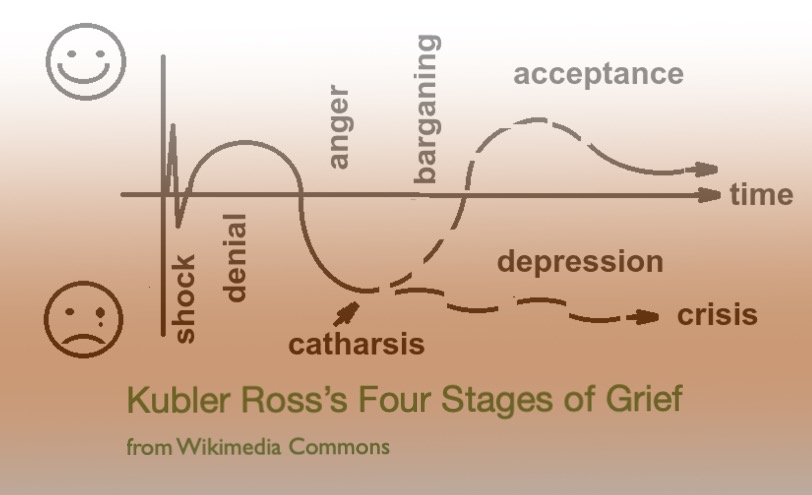
A few days after the November election I wrote an article “The Stages of Grief: A 12 Step Lesson, Post-Election.” In that article I summarized the Kubler-Ross description of the four stages of grief and pointed out the relevancy of the 12 Steps of AA. During the months that followed I have been in the fourth stage, but like Schrodinger’s cat, simultaneously in two contradictory states, reluctant acceptance and profound depression.
As one commentator to the original article wisely noted: “the stages of grief are a very helpful tool– when used as a guidebook, not an instruction manual!” (Foxfier); they are only an analogy. Accordingly, I want to add another stage of grief to those given by Kubler-Ross, one that relies on Catholic theology and on Steps 1-3 of the 12 Steps: Abandonment to Divine Providence. I’ve happily come to that stage through the advice of my good lady, who has given me an historical perspective, and through homilies from three priests: Fr. Eric Bergman (St. Thomas More Parish, Anglican Ordinariate Usage); Fr. Chris Alar, MIC (at the National Shrine of Divine Mercy), and Fr. Joseph Johnson (Holy Family Catholic Church, St. Lous Park, MN). (See here and here for the Youtube videos of the Masses at which the homilies were given by Frs. Alar and Johnson.)
Another source of strength has been the Liturgy of the Hours, Morning Prayer, Evening Prayer, Night Prayer, Office of Readings. The psalms tell the story not only of the tribulations of the Hebrews, but also of our times. And the New Testament tells us to pray for those who persecute us, essential advice, albeit hard to follow.
Let’s try to understand the historical perspective that will help us accept God’s design, His will.
PERSECUTION—A HISTORICAL PERSPECTIVE
It’s quite clear that the new de facto administration is intent on persecuting Catholics who follow the Church’s teaching, despite the presidential press secretary’s avowal that the democrat nominee is “Catholic and goes to Mass.” In his campaign statements, the official presiding over our government, Mr. Biden, said that he would reinstate the persecution of The Sisters of the Poor (require them to supply contraceptives, abortifacients and fund abortions for their employees) and make the “right” to abortion a federal law. And the rest of his agenda with regard to “sexual identity,” “marriage,” is totally in accord with the most radical of his party.
When has such persecution occurred before? We don’t have to go as far back as the later Roman Empire. Let’s look at Elizabethan England, and the martyrs for the faith, Poland under the Nazis and Communists, Mexico in the early 20th Century. In all these cases, the faithful remained strong. Indeed, a great Pope and saint, John Paul II, flowered in the briar patch of Nazi and Communist persecution.
THE LORD LOVES US EVEN IN TIMES OF TRIAL
Should we conclude that the Lord still loves us in this time of trial? Yes!
“For whom the Lord loveth, he chastiseth; and he scourgeth every son whom he receiveth.” Heb 12:6 (Douay-Rheims)
As the homilies cited above make clear, it is not our will that is to be enforced, but God’s. Even though we do not know God’s will, it is necessary that we submit ourselves to His plans. And that way lies peace and acceptance. Which is not to say that we should retreat into a den of quiescence. Rather
“Fight the good fight of faith, lay hold on eternal life, whereunto thou art also called, and hast professed a good profession before many witnesses.” 1 Timothy 6:12


It seems to me that Abandonment to Divine Providence and acceptance are very similar concepts, the former being spiritual and the latter psychological. Certainly, the former is a bigger concept, and a Christian probably can’t attain the psychological state without the spiritual state (or a ton of cognitive dissonance). But I don’t really understand how you can consider it an addition to the stages.
Biden, confronted in the right way, is an opportunity for our personal salvation.
Pinky, thanks for your comment. I don’t think “psychological acceptance” is equivalent to “Abandonment to Divine Providence.” Nor do I think the first 3 steps of the usual 12 Steps (I can’t, a higher power can, I think I’ll let the higher power do it) are equivalent. Which is way I turned to the Calix Society to supplement what was given in AA and Alanon. So that’s why i think this is a different stage from that given in the usual Kubler-Ross scenario. Moreover, one can do an “acceptance” for a particular situation, but “Abandonment to Divine Providence” is for all one’s concerns.