
The Declaration of Independence was formed by the representatives of American liberty from thirteen States of the confederacy—twelve of which were slave holding communities. We need not discuss the way or the reason of their becoming slave holding communities. It is sufficient for our purpose that all of them greatly deplored the evil and that they placed a provision in the Constitution which they supposed would gradually remove the disease by cutting off its source. This was the abolition of the slave trade. So general was conviction—the public determination—to abolish the African slave trade, that the provision which I have referred to as being placed in the Constitution, declared that it should not be abolished prior to the year 1808. A constitutional provision was necessary to prevent the people, through Congress, from putting a stop to the traffic immediately at the close of the war.
Now, if slavery had been a good thing, would the Fathers of the Republic have taken a step calculated to diminish its beneficent influences among themselves, and snatch the boon wholly from their posterity? These communities, by their representatives in old Independence Hall, said to the whole world of men: “We hold these truths to be self evident: that all men are created equal; that they are endowed by their Creator with certain unalienable rights; that among these are life, liberty and the pursuit of happiness.” This was their majestic interpretation of the economy of the Universe. This was their lofty, and wise, and noble understanding of the justice of the Creator to His creatures. Yes, gentlemen, to all His creatures, to the whole great family of man.
In their enlightened belief, nothing stamped with the Divine image and likeness was sent into the world to be trodden on, and degraded, and imbruted by its fellows. They grasped not only the whole race of man then living, but they reached forward and seized upon the farthest posterity. They erected a beacon to guide their children and their children’s children, and the countless myriads who should inhabit the earth in other ages. Wise statesmen as they were, they knew the tendency of prosperity to breed tyrants, and so they established these great self-evident truths, that when in the distant future some man, some faction, some interest, should set up the doctrine that none but rich men, or none but white men, were entitled to life, liberty and the pursuit of happiness, their posterity might look up again to the Declaration of Independence and take courage to renew the battle which their fathers began—so that truth, and justice, and mercy, and all the humane and Christian virtues might not be extinguished from the land; so that no man would hereafter dare to limit and circumscribe the great principles on which the temple of liberty was being built.
Abraham Lincoln, August 17, 1858
In my family each year we have a group reading of the Declaration of Independence. The kids, when they were kids, enjoyed it and so do Mom and Dad. My bride and I keep up the custom. Each year I am struck by a timeless quality of the words.
“We hold these truths to be self-evident, that all men are created equal, that they are endowed by their Creator with certain unalienable Rights, that among these are Life, Liberty and the pursuit of Happiness. — That to secure these rights, Governments are instituted among Men, deriving their just powers from the consent of the governed, — That whenever any Form of Government becomes destructive of these ends, it is the Right of the People to alter or to abolish it, and to institute new Government, laying its foundation on such principles and organizing its powers in such form, as to them shall seem most likely to effect their Safety and Happiness. Prudence, indeed, will dictate that Governments long established should not be changed for light and transient causes; and accordingly all experience hath shewn that mankind are more disposed to suffer, while evils are sufferable than to right themselves by abolishing the forms to which they are accustomed. But when a long train of abuses and usurpations, pursuing invariably the same Object evinces a design to reduce them under absolute Despotism, it is their right, it is their duty, to throw off such Government, and to provide new Guards for their future security.”
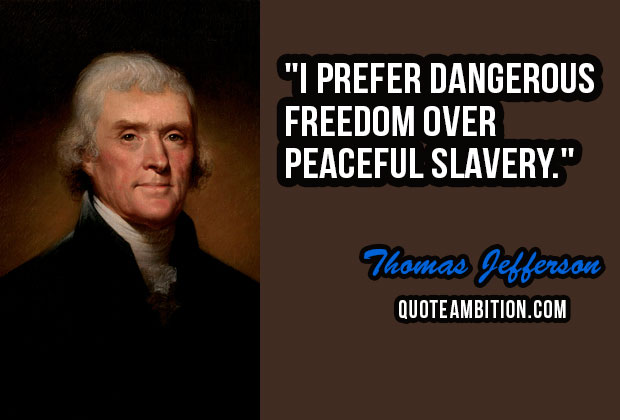
Mr. Jefferson was not just writing to the Americans alive in 1776, but to all Americans for all time to come. His words are not meant to be locked away in unread books, or to be venerated as sacred text, but rather to be thought about and debated. We Americans have a wonderful heritage, but it does us no good if we know little about it and give little thought to it. This Independence Day read the Declaration please, even if you have read it many times before, and think about the meaning of the words. The Declaration is just as radical today as it was in 1776, perhaps more so, and just as important to those who love freedom.

