
A striking scene from the movie Lincoln (2012) in which Lincoln and his Cabinet discuss the legality of the Emancipation Proclamation and the necessity of a Constitutional amendment banning slavery. This was the way Lincoln’s mind worked. He was a shrewd attorney with a vast experience in courts and a hard won understanding as to how most judges reason. What may be allowed in war time would not necessarily be allowed in peace time in the minds of the judges who would decide the question. That this was not an unfounded concern by Lincoln was confirmed by post war events.
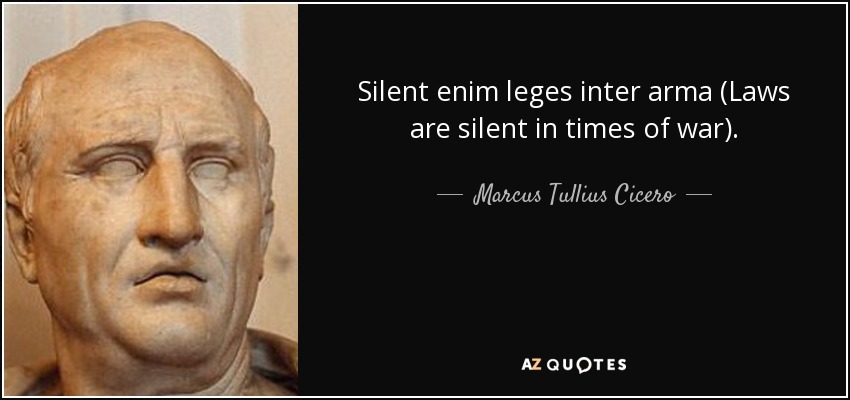
Inter arma enim silent leges was a phrase not uncommon in the North during the Civil War, a time when many cherished laws and safeguards of personal liberty did fall silent. In the aftermath of the War there was a return to peace time norms. This was reflected in the case of Ex parte Milligan, an 1866 Supreme Court case. Lambdin P. Milligan, one of the leaders of the Knights of the Golden Circle, a “secret” Confederate organization in the North that everyone in the North seemed to know about, in Indiana was arrested in 1864, accused of being involved in a plot with others who were also arrested, to free Confederate prisoners from a POW camp and with their aid seek to topple the government of Indiana. Milligan was tried by a military commission and sentenced to death. Showing their neutrality in regard to the Defendant, the military commissioners spoke at Republican party rallies in the fall of 1864.
The case was appealed to the United States Supreme Court. Benjamin Butler, always as competent as an attorney as he was incompetent as a general, argued the case for the government. The Defense had a high-powered team, including Jeremiah Black a former attorney general and Union general and congressman, and future president, James Garfield. The court handed down a unanimous decision as to reversal in 1866 authored by Lincoln’s old friend from Illinois, Justice David Davis, who Lincoln had appointed to the court. This striking passage in the decision indicated that with the ending of the War the court was going to be reasserting its role regarding the law.
Without the Thirteenth Amendment the legality of the Emancipation Proclamation would have been tested in the courts. I think it probably would have been upheld, but I am not confident in that prediction, especially with Lincoln no longer on the scene and with the North growing weary of policing the South. Fortunately, the Thirteenth Amendment rendered the legality of the Emancipation Proclamation purely of academic interest.


Thank you for this. It is always good to learn something new, particularly when it’s presented in a non- polemical way (unusual, that, these days!).
Reguardless of your feeling as to the legality of the result, the emancipation proclamation was a political document which aimed at two objectives: 1) to prevent any European intervention on behalf of the Confederacy by casting the war as one being waged for the abolition of slavery, (a misrepresentation beyond this post)and 2) start a murderous slave rebellion as only women and children, for the most part, remained at home, most males being in the Armies of the Confederacy. The first objective succeeded, the second, to the everlasting credit of those in bondage. It only free certain blacks, those in areas not under control of the Union Army. (Read it for yourself)
The Thirteenth Amendment was certainly necessary to free ALL former slaves. The Corwin Amendment, supported by Lincoln to prevent secession would have enshrined slavery forever in the Constitution where it already existed. I know, the winners write the history books, but the truth is out there if you wish to find it. Finally, as Federal Troops occupied Richmond in 1865, the only legal slave in the Confederate Capital was owned by the wife of Ulysses S. Grant.
2) start a murderous slave rebellion as only women and children, for the most part, remained at home, most males being in the Armies of the Confederacy.
There is no historical support for that contention. The only murder that resulted from the Emancipation Proclamation was the official policy of the Confederacy to murder white Union officers leading black troops, after the capture of such officers, a policy which was sadly often carried out informally by Confederate troops, along with the murder of captured black Union troops.
From the Retaliatory Act passed by the Confederate Congress on May 1, 1863:
That every white person being a commissioned officer or acting as such who during the present was shall command negroes or mulattoes in arms federate States or who shall arm, train, organize or prepare negroes or mulattoes for military service against the Confederate States or who shall voluntarily aid negroes or mulattoes in any military enterprise, attack or conflict in such service shall be deemed as inciting senile insurrection, and shall if captured be put to death or be otherwise punished at the discretion of the court.
So far from seeking a slave rebellion, the Emancipation Proclamation contained this provision:
And I hereby enjoin upon the people so declared to be free to abstain from all violence, unless in necessary self-defence; and I recommend to them that, in all cases when allowed, they labor faithfully for reasonable wages.
Union armies throughout the War continually encountered large bodies of slaves following them as liberators. It would have been a simple task for the Union armies to make use of such slaves in order to start a slave insurrection, but such was not the policy of the Union, except in fevered Confederate fantasies.
The Emancipation Proclamation being a war measure of course could only apply in areas in rebellion. Lincoln the Lawyer understood this, and that total emancipation would require an Amendment to the Constitution. As to the Corwin Amendment, that was passed by Congress in the dying days of the Buchanan administration in an effort to get the seceding states to return to the Union. Lincoln reluctantly supported it, since it merely codified the fact that the Federal government in time of peace lacked the authority to abolish slavery within a state. The proposed Amendment rapidly became a dead letter during the War.
As to Ulysses S. Grant and slavery go here to read all about it:
https://acwm.org/blog/myths-misunderstandings-grant-slaveholder
Mrs. Grant regarded her personal slaves as being freed by the Emancipation Proclamation. That was her understanding even though it was technically incorrect. In any case, her home state of Missouri abolished slavery on January 11, 1865, prior to the fall of Richmond.