United States Navy
The American Revolution at Sea
I wish to have no connection with any ship that does not sail fast; for I intend to go in harm’s way.
Captain John Paul Jones, November 16, 1778
Yesterday was the 237th birthday of the United States Navy. On October 13, 1775 the Continental Congress passed the following resolutions:
“Resolved, That a swift sailing vessel, to carry ten carriage guns, and a proportionable number of swivels, with eighty men, be fitted, with all possible despatch, for a cruise of three months, and that the commander be instructed to cruize eastward, for intercepting such transports as may be laden with warlike stores and other supplies for our enemies, and for such other purposes as the Congress shall direct.
That a Committee of three be appointed to prepare an estimate of the expence, and lay the same before the Congress, and to contract with proper persons to fit out the vessel.
Resolved, that another vessel be fitted out for the same purposes, and that the said committee report their opinion of a proper vessel, and also an estimate of the expence.”
Congress thus threw down the gauntlet against the mightiest sea power in the world. Vastly outnumbered by the Royal Navy, the United States Navy gave a good account of itself, raiding British commerce, bringing desperately needed supplies to Washington’s Continental Army, shipping diplomats like Benjamin Franklin and John Adams to Europe to enlist the aid of France and other sympathetic countries, and demonstrating to an astonished world, again and again, that it was possible to beat a British warship in battle, as John Paul Jones did commanding the USS Bonhomme Richard against HMS Serapis on September 23, 1779:
Padre of Guadalcanal

(This is a post I did in 2009. It seemed appropriate to repost it today. Father Gehring pray for us that we may have the courage to face our challenges in life and win victories over them.)
Frederic Gehring was probably lucky that he was born and reared in Brooklyn. It has always been a tough town and it prepared him for the adventurous life he was to lead. Born on January 20, 1903, he went on to attend and graduated from Saint John’s Prep. Setting his eyes on being a missionary priest, he entered the minor seminary of the Vincentians, Saint Joseph’s, near Princeton, New Jersey. Earning his BA in 1925, he entered the seminary of Saint Vincent’s in Philadelphia.
Ordained as a priest on May 22, 1930, he was unable to immediately go to China due to military activity of the Communists in Kiangsi province. For three years he traveled throughout the US raising funds for the missions in China, and, at long last, in 1933 he was able to pack his bags and sailed for China. Laboring in the Chinese missions from 1933-1939 in the midst of warlordism, civil war and the invasion of China, commencing in 1937, by Japan must have been tough, but Father Gehring was always up to any challenge. For example, in 1938 Japanese planes strafed a mission he was at. Father Gehring ran out waving a large American flag in hopes that the Japanese would not wish to offend a powerful neutral nation and would stop the strafing. The Japanese planes did fly off, and Father Gehring was pleased until someone at the mission pointed out that maybe the Japanese had simply run out of ammo! In 1939 Father Gerhring returned to the States to raise funds for the missions.
Immediately following Pearl Harbor, Father Gehring joined the Navy as a Chaplain. In September 1942 he began an unforgettable six month tour of duty with the First Marine Division fighting on Guadalcanal. Marines, although they are often loathe to admit it, are a component of the Department of the Navy, and the US Navy supplies their support troops, including chaplains. (One of my friends served as a Navy corpsman with a Marine unit in Vietnam. After his tour with the Navy he enlisted with the Marines, was commissioned a Lieutenant, and spent his entire tour with a detachment of Marines aboard an aircraft carrier. As he puts it, he joined the Navy and spent his time slogging through the mud with Marines. He then joined the Marines and spent his time sailing with the Navy.)
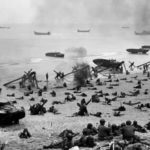
Guadalcanal marked the turning point of the war in the Pacific. In August 1942 the US went on the offensive for the first time when the First Marine Division, the Old Breed, landed on Guadalcanal and took the Japanese air base there. This set off a huge six month campaign, where US forces, often outnumbered on land, sea and in the air, fought and defeated the Imperial Army and Navy. The importance of Guadalcanal is well captured in this quote from Admiral William “Bull” Halsey: “Before Guadalcanal the enemy advanced at his pleasure. After Guadalcanal, he retreated at ours”.

Upon arrival on Guadalcanal, Lieutenant Gehring quickly became known as “Padre “ to the men of the Old Breed, the title usually bestowed upon chaplains, especially if they were Catholic priests. He soon became known for wanting to be where the fighting was in order to help the wounded and administer the Last Rites. Initially this took some of the Marines by surprise. Jumping into a foxhole during a heavy fire fight, a shocked Marine already in the foxhole, noticing the crucifix dangling from his neck, cried out to him, “Padre, what are you doing here?” Gehring calmly replied, “Where else would I be?” He would routinely say Masses so close to the fighting, that the Marines said that he would say Mass in Hell for Marines if he could drive his jeep there. The Marines quickly decided that it was a lost cause asking the Padre to stay behind the lines. They were doing well if they could convince him to stay within friendly lines! Three times he went out on behind the line missions to rescue trapped missionaries on the island, mostly Marist priests and sisters, rescuing 28 of them, assisted by natives of the Solomons. For this feat he was the first Navy chaplain to be awarded the Legion of Merit by the President. Continue reading
Guadalcanal: America Turns the Tide
Before Guadalcanal the enemy advanced at his pleasure. After Guadalcanal, he retreated at ours.
Admiral William “Bull” Halsey
Seventy years ago Marines of the First Division, The Old Breed, launched the first offensive of America in World War II, by landing on Guadalcanal and seized the Japanese air strip, named Henderson Field by the Marines. This set off a huge six month campaign, where US forces, often outnumbered on land, sea and in the air, fought and defeated the Imperial Army and Navy.
Once the Marines seized Henderson, the Japanese commenced a cycle of shipping troops by sea to Guadalcanal, called by Marines the Tokyo Express, to take it back. The Imperial Navy, waged battle after battle with the US Navy to cut the supply line of the Marines. In the skies above Guadalcanal the Japanese sent wave after wave of fighters and bombers to establish air supremacy and to make Henderson unusable through bombing.
The Japanese were unable to establish air supremacy due to the “Cactus Air Force”, Cactus being the Allied code name for Guadalcanal, heavily outnumbered Marine aviators, who, operating under the most primitive conditions imaginable, successfully contested Japanese control of the air, and, eventually, with American carrier based air, established American air supremacy above Guadalcanal.
The US Navy, in seven large battles against its Japanese counterpart, eventually established naval supremacy in the seas around Guadalcanal. The battles were hammer and tongs affairs, with some of the most desperate naval fighting in the entire War.
The Marines on Guadalcanal learned many useful lessons in fighting and beating the Japanese: Continue reading
Sunday in Paradise

Lieutenant j.g. Aloysius Schmitt had just finished morning mass aboard the USS Oklahoma. Acting chaplain of the Okie, a Sunday meant a busy day for him, a relaxed day for almost everyone else on board the ship. Since they were in port and the country was at peace a Sunday was a day of rest. Besides, the port was a tropical paradise. Life was good for the crew of the Okie.

Father Schmitt, born on December 4, 1909, was an Iowan, about as far from the sea as it is possible to be in the US. Studying in Rome for the priesthood, he was ordained on December 8, 1935. After serving at parishes in Dubuque Iowa and Cheyenne, Wyoming, Father Schmitt received permission to join the Navy and was commissioned a Lieutenant j.g. on June 28, 1939.
On December 7, 1941 at 8:00 AM the Japanese sneak attack on Pearl Harbor began. The Oklahoma and the other battleships on battleship row were the primary targets. Alarms began to sound on the Oklahoma, and the ship was hit almost immediately by nine torpedoes from Japanese torpedo bombers. The ship began to list badly and every sailor knew that it was probably just a few minutes before the Okie would capsize. Continue reading
The Fighting SeaBees
Construimus, Batuimus (We Build, We Fight)
At the outset of World War II, the Navy faced a task of unbelievable difficulty. Around the globe, and especially in the Pacific, the Navy would be fighting in regions practically untouched by the modern world. Everything to support military operations would have to be built from scratch: bases, ports, airstrips, and an endless parade of other facilities. The task was daunting, perhaps impossible. However, the Navy had a secret weapon: the American worker.
Forming Navy Construction Battalions, (C-Bs), the Navy turned to the civilian construction trades and asked for volunteers. The response was overwhelming with civilian workers flocking to the task, and placed under the leadership of Navy officers. These were older men, the average age of the volunteers being 37, and masters in their trades. They formed the bedrock of the eventual 325,000 men who would serve in the Seabees during the War. By V-J Day they had completed construction projects on six continents and 300 islands, many of the islands bearing strange and unfamiliar names like Guadalcanal, Tinian, Saipan, Tarawa and Iwo Jima. They went about their work often under fire, sometimes participating directly in combat, and usually in conditions that were miserable beyond belief. Tropical jungles, deserts, alpine mountains, arctic wastelands, nothing stopped them from doing their jobs, and usually completing their tasks ahead of schedule. Continue reading


(1 hours ago)
(3 hours ago)
(3 hours ago)
(3 hours ago)
(4 hours ago)
(4 hours ago)
(6 hours ago)
(6 hours ago)
(6 hours ago)
(6 hours ago)
(7 hours ago)
(9 hours ago)
(9 hours ago)
(9 hours ago)
(11 hours ago)
(11 hours ago)
(11 hours ago)
(1 days ago)
(1 days ago)
(1 days ago)
(1 days ago)
(1 days ago)
(1 days ago)
(1 days ago)