
Summa Theologica
Fortnight For Freedom Fourth of July: Catholicism and the Declaration of Independence
Beginning for two weeks, up to Independence Day, the Bishops are having a Fortnight For Freedom:

We here at The American Catholic are participating in the Fortnight For Freedom with special blog posts on each day. This is the final of these blog posts and is written by commenter Greg Mockeridge.
John Adams foresaw the all pomp with which we celebrate the 4th of July, but the date he gave for that was not the 4th but the 2nd. The reason he gave the 2nd was that independence was voted on and decided by the Continental Congress on the 2nd. What took place on the 4th was that final draft of the Declaration of Independence, after about a hundred revisions to Thomas Jefferson’s original draft, was approved.
It is actually more fitting that we celebrate independence on 4th as opposed to the 2nd because it isn’t merely independence we celebrate, but the ideas, principles, and truths this country was founded on. Fidelity to these very ideas really enable Americans to be Patriots as opposed to merely Nationalists. Just as one cannot be a good Catholic without a concerted effort to know and understand what it is he gives his assent of faith to, one cannot be a true American Patriot unless he likewise makes an effort to understand our heritage as Americans. No other U.S. founding document expresses these truths better than the Declaration of Independence. If more Americans became better acquainted with the Declaration, there would not be so much confusion regarding the Constitution.
Our Catholic faith not only does not relieve us of this patriotic duty, it actually reinforces it. An 1884 statement of the American bishops said it this way:
Teach your children to take a special interest in the history of our country. We consider the and laws as a work of special Providence, its framers “building wiser than they knew,” the Almighty’s hand guiding them….As we establishment of our country’s independence, the shaping of its liberties desire therefore that the history of the United States should be carefully taught in all our Catholic schools, and have directed that it should be specially dwelt upon in the education of the young ecclesiastical students in our preparatory seminaries; so also we desire that it form a favorite part of the home library and home reading.
A document from the Second Vatican Council “Pastoral Constitution of the Church in the Modern World” better known by its Latin title Gaudium et Spes says: “Citizens should cultivate a generous and loyal spirit of patriotism… “(#75) Continue reading
Addendum: Locke & Natural Law
Some questions have been raised in the discussion on my posts on Locke & Catholic political thought about the extent to which Locke’s political theory conforms to or detracts from natural law. This follow-up post, which will be relatively brief, should serve to answer such questions at least in part.
Stealing From The Poor
This article originally appeared on The New Theological Movement written by Reginaldus on July 29, 2010 Anno Domini. Re-posted with permission.
18th Sunday in Ordinary Time, Luke 12:13-21
The rich man of this Sunday’s Gospel is blessed with a bountiful harvest. Rather than thanking God for this gift, he hoards the grain in his barns – his heart is possessed by his possessions. At the moment of death, the Lord calls him a fool, for he was not rich in what matters to God.
The Fathers of the Church, and St. Thomas Aquinas following them, see in this parable a strong teaching of social justice. Their teachings have in turn been integrated into the Social Doctrine of the Church. Here we will consider St. Thomas’ exposition of the doctrine as well as several important quotations from the Church Fathers.?
The common destination of all goods and right to private property
We must first affirm that man has a right to own private property. All men have a natural right to make use of material goods. According to positive human law, men also have a right to private property – this is necessary for the good order of society and the proper care of the goods themselves, it also serves as a means of restraining greed and inciting toward generosity (a man can give alms only if he has some property of his own).
However, it is equally clear in the Church’s Tradition, as expressed by the Fathers of the Church and magisterial teachings, that the right to private property is subordinate to the universal destination of all goods. That is, the right to private property cannot be extended to the point of depriving others of the basic material necessities of life. Every man has the right to the material necessities of life – when he is deprived of these, while another has excess wealth, a grave injustice has occurred.
Feast Day of Saint Thomas Aquinas
January 28th, is the feast day St. Thomas Aquinas, my chosen saint as a convert. (It was a toss-up between Thomas the philosopher-theologian and Thomas Merton, the not-quite-saintly Trappist — both exercising an influence on my journey to Rome).
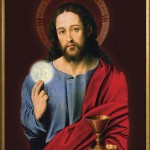
Here is a favorite prayer of mine, by St. Thomas Aquinas — for a holy life. It was said that he prayed this every day before the image of Christ:
Grant me, O merciful God, that what is pleasing to Thee I may ardently desire, prudently examine, truthfully acknowledge, and perfectly accomplish for the praise and glory of Thy name.
Ordain, O my God, my whole life, and what Thou requirest that I should do, grant me to know it and to fulfill as is meet and profitable to my soul.
Give me Thy grace, O Lord my God, that I may not fail in prosperity or in adversity, avoiding pride in the former and discouragement in the latter.
May I rejoice in nothing but what leads to Thee, grieve for nothing but what turns away from Thee. May I wish to please or displease n one but Thee.
May I despise, O Lord, all transitory things, and prize only that which is eternal. May I shun ant joy that is without Thee, nor wish for anything outside of Thee.
May I delight in any work taken up for Thee, and tire of any rest which is without Thee. Grant me, O my God, to direct my heart toward Thee, and in my failings constantly grieve, with the purpose of a amendment.
Make me, O Lord, my God, obedient without contradiction, poor without depression, chaste without corruption patient without murmuring, humble without pretence, cheerful without dissipation, mature without dullness, prompt without levity, fearing Thee without despair, truthful without duplicity, doing good without presumption, correcting my neighbor without haughtiness, and edifying him by word and example without hypocrisy.
Give me, O Lord God, a watchful heart, which no curious thought will turn away from Thee; a noble heart, which no unworthy affection will drag down; a righteous heart, which no irregular intention will twist aside; a firm heart, which no tribulation will break; a free heart, which no violent affection will claim for itself.
Grant me finally, O Lord my God, science in knowing Thee, diligence in seeking Thee, wisdom in finding Thee, a conduct pleasing to Thee, a perseverance trustfully awaiting Thee, and a confidence finally embracing Thee. May I endure Thy punishments by penitence; profit by Thy benefits by grace in this world, and enjoy Thy blessedness by glory in the next; Who livest and reignest, true God, forever and ever. Amen


(25 seconds ago)
(27 minutes ago)
(3 hours ago)
(3 hours ago)
(5 hours ago)
(7 hours ago)
(9 hours ago)
(9 hours ago)
(9 hours ago)
(9 hours ago)
(10 hours ago)
(10 hours ago)
(11 hours ago)
(11 hours ago)
(11 hours ago)
(11 hours ago)
(11 hours ago)
(11 hours ago)
(12 hours ago)
(12 hours ago)
(1 days ago)
(1 days ago)
(1 days ago)
(1 days ago)