Stephen Vincent Benet
King Philip
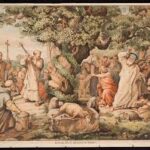
King Philip was there, wild and proud as he had been in life, with the great gash in his head that gave him his death wound.
Stephen Vincent Benet, The Devil and Daniel Webster
In his short story The Devil and Daniel Webster, Benet has Satan conjure up the damned souls of 12 villains from American history to serve as a jury in the case of Satan v. Jabez Stone. Only seven of these entities are named. This is the fifth in a series giving brief biographies of these men. Go here to read the biography of Simon Girty, here to read the “biography” of the Reverend John Smeet, here to read the biography of Major Walter Butler and here to read the biography of Thomas Morton. Our focus today is on King Philip.
Metacom, known to the white settlers as King Philip, was the second son of Massasoit, sachem of the Wampanoag, who had helped the Pilgrims survive during the first years of the colony. He became chief in 1662 when his brother Wamsutta, King Alexander, died. King Philip attempted to preserve peace with the whites. The Wampanoag were in a bad strategic situation, squeezed between ever-increasing white settlements in the East and an ever-expanding Iroquois Confederacy in the West. King Philip made major concessions to the whites, but war came anyway.
The great war of Seventeenth Century New England, King Philip’s War raged from 1675-1678 with the New England colonists, now numbering about 80,000, and their Mohican and Pequot allies confronting the Wampanoag, Nipmuck, Podunk, Narragansett and Nashaway tribes. The war was savage on both sides, with quarter rarely given.
The conflict began due to the suspicions of the New England colonists that Metacomet, named by them King Philip, Grand Sachem of the Wampanoag Confederacy, was attempting to rally the Indian tribes of New England into a great alliance for war against the whites. John Sassamon, a Christian Indian, graduate of Harvard and an advisor to Metacomet, informed the Governor of Plymouth colony of this plan. Metacomet was brought to trial in Plymouth. Lacking evidence the court merely warned him that further rumors of plots by him could lead to severe consequences for the Wampanoag.
Continue reading
Walter Butler
For there was Walter Butler, the loyalist, who spread fire and horror through the Mohawk Valley in the times of the Revolution.
Stpehen Vincent Benet, The Devil and Daniel Webster
In his short story The Devil and Daniel Webster, Benet has Satan conjure up the damned souls of 12 villains from American history to serve as a jury in the case of Satan v. Jabez Stone. Only seven of these entities are named. This is the third in a series giving brief biographies of these men. Go here to read the biography of Simon Girty and here to read the “biography” of the Reverend John Smeet. In this post we will examine the life of Major Walter Butler.
Walter Butler was a young man of 23 at the start of the Revolution, the son of John Butler, a wealthy Indian agent and a judge in frontier Tryon Country, soon to be the scene of many desperate frontier battles between Patriots and Loyalists, and their Indian auxiliaries. John Butler was a firm loyalist as was his son. Walter Butler served as an Ensign at the battle of Oriskany in 1777 during the Saratoga campaign. Shortly after Oriskany he was captured behind enemy lines. Sentenced to death he succeeded in escaping. When his father formed the Loyalist Butler’s Rangers, Walter served in it as a Captain.
On November 11, 1778 at Cherry Valley, New York, Butler, leading a mixed force of Loyalists and Mohawks and Seneca under Joseph Brant, easily overcame the heavily outnumbered 7th Massachusetts Continentals. In the aftermath of the battle, 30 settlers were murdered, including women and children. In his report Butler blamed Brant and his Indians and steadfastly insisted that he spared no effort to rescue settlers from them. However, Patriots claimed that Brant attempted to save settlers and that it was Butler who instigated the massacre. My estimate is that neither Brant nor Butler were directly responsible and that it was independent action by the Seneca and the Mowhawk, who had many scores to repay, that resulted in the murders. Like many historical questions the evidence now is too fragmentary and conflicting for complete certainty.
Butler was killed in a skirmish on October 30, 1781 and scalped by Oneidas fighting for the Patriots. Here is a contemporary account of his death by Philip Graff, a member of the Patriot militia in Mowhawk Valley New York: Continue reading
Daniel Webster and Leviathan
I have long admired Stephen Vincent Benet’s The Devil and Daniel Webster in which Daniel Webster defeats Satan in a jury trial for the soul of Jabez Stone. Far lesser known is an amusing story written by Benet in which Daniel Webster encounters Leviathan from the Bible:
“Well, Mr. Webster,” said Seth, and stared at his boots, “she says you’re quite a handsome man. She says she never did see anybody quite like you,” he went on. “I hate to tell you this, Mr. Webster, and I feel kind of responsible, but I think you ought to know. And I told you that you oughtn’t to have shot at her—she’s pretty proud of that. She says she knows just how you meant it. Well, I’m no great hand at being embarrassed, Mr. Webster, but, I tell you, she embarrassed me. You see, she’s been an old maid for about a hundred and fifty years, I guess, and that’s the worst of it. And being the last of her folks in those particular waters, there’s just no way to restrain her—her father and mother was as sensible, hard-working serpents as ever gave a feller a tow through a fog, but you know how it is with those old families. Well, she says wherever you go, she’ll follow you, and she claims she wants to hear you speak before the Supreme Court——”
“Did you tell her I’m a married man?” said Dan’l. “Did you tell her that?”
“Yes, I told her,” said Seth, and you could see the perspiration on his forehead. “But she says that doesn’t signify—her being a serpent and different—and she’s fixing to move right in. She says Washington’s got a lovely climate and she’s heard all about the balls and the diplomatic receptions. I don’t know how she’s heard about them, but she has.” He swallowed. “I got her to promise she’d kind of lie low for two weeks and not come up the Potomac by daylight—she was fixing to do that because she wants to meet the President. Well, I got her to promise that much. But she says, even so, if you don’t come to see her once an evening, she’ll hoot till you do, and she told me to tell you that you haven’t heard hooting yet. And as soon as the fish market’s open, I better run down and buy a barrel of flaked cod, Mr. Webster—she’s partial to flaked cod and she usually takes it in the barrel. Well, I don’t want to worry you, Mr. Webster, but I’m afraid that we’re in a fix.” Continue reading
The Reverend John Smeet
The Reverend John Smeet, with his strangler’s hands and his Geneva gown, walked as daintily as he had to the gallows. The red print of the rope was still around his neck, but he carried a perfumed handkerchief in one hand.
Stephen Vincent Benet, The Devil and Daniel Webster
In his short story The Devil and Daniel Webster, Benet has Satan conjure up the damned souls of 12 villains from American history to serve as a jury in the case of Satan v. Jabez Stone. Only seven of these entities are named. This is the second in a series giving brief biographies of these men. Go here to read the biography of Simon Girty.
The Reverend John Smeet long puzzled literary analysts of The Devil and Daniel Webster. No record could be uncovered as to his existence. Scholarly debate raged as to whether Benet had been referring to other historical personages. The mystery was not cleared up until 1960 when his widow, Rosemary Benet, wrote a letter to the New York Times Book Review in which she stated that Smeet was an imaginary character that her late husband simply inserted into the work. This was not unusual for Benet. He had invented a character called John Cotton, and even written a brief bio of him. I will now do the same for the Reverend Smeet.
Continue reading
Girty the Renegade
And there was Simon Girty, the renegade, who saw white men burned at the stake and whooped with the Indians to see them burn. His eyes were green, like a catamount’s, and the stains on his hunting shirt did not come from the blood of the deer.
Stephen Vincent Benet, The Devil and Daniel Webster
In his short story The Devil and Daniel Webster, Benet has Satan conjure up the damned souls of 12 villains from American history to serve as a jury in the case of Satan v. Jabez Stone. Only seven of these entities are named. This is beginning of a series to give short biographies on each of these figures.
Born in 1741 on the Pennsylvania frontier in 1741, Girty’s life took a sharp turn when he and his brothers were captured by the Seneca and adopted by them. It would be seven years before Girty was able to return to his family. By that time Girty was a Seneca in all but skin color. At the outset of the American Revolution Girty supported the patriots, but eventually became a loyalist. Frontier patriots regarded him as a turncoat and renegade. Continue reading
Fortnight For Freedom Day 1: Freedom is Not Just a Big Word
Beginning for two weeks, up to Independence Day, the Bishops are having a Fortnight For Freedom:
We here at The American Catholic are participating in the Fortnight For Freedom with special blog posts on each day. This is the first of these blog posts.
The video at the top of this post is a scene from the classic movie, The Devil and Daniel Webster (1941), based upon the short story by Stephen Vincent Benet, in which Daniel Webster bests Satan in a jury trial to save the soul of New Hampshireman Jabez Stone. In this scene Daniel Webster addresses a jury of the damned, all villains of American history. I have always thought this speech one of the most eloquent statements of what it means to be an American.
In regard to Freedom it reminds us that it is just not a word: Freedom is not just a big word — it is the bread and the morning and the risen sun. It was for freedom we came in boats and ships to these shores. It has been a long journey, a hard one, a bitter one. There is sadness in being a man, but it is a proud thing, too. Out of the suffering and the starvation, the wrong and the right, a new thing has come, a free man. When the whips of the oppressors are broken, and their names forgotten and destroyed, free men will be walking and talking under a free star. Yes, we have planted freedom here in this earth like wheat. This is the priceless treasure that Goverment encroachments like the HHS Mandate begin to take away from us.
Go here to read the passage in the Stephen Vincet Benet’s short story. Below is the scene as written in the screenplay:
Continue reading
The Devil and Daniel Webster: Closing Argument to the Jury of the Damned
A scene from the classic movie, The Devil and Daniel Webster (1941), based upon the short story by Stephen Vincent Benet, in which Daniel Webster bests Satan in a jury trial to save the soul of New Hampshireman Jabez Stone. In this scene Daniel Webster addresses a jury of the damned, all villains of American history. I have always thought this speech one of the most eloquent statements of what it means to be an American. Go here to read the passage in Stephen Vincet Benet’s short story. Below is the scene as written in the screenplay:
Continue reading
Alternate Georges
On the birthday of the Father of Our Country it is proper to take a moment and reflect that in all likelihood the United States of America would not exist today but for the leadership shown by George Washington during the Revolution. The poets Rosemary and Stephen Vincent Benet explored long ago some of the many different paths the life of Washington might have taken which would have altered our history so profoundly. We call Washington the Father of Our Country not to honor him, but as a simple statement of fact. Continue reading
February 6, 1862: Surrender of Fort Henry
Fate has a way of picking unlikely material,
Greasy-haired second lieutenants of French artillery,
And bald-headed, dubious, Roman rake-politicians.
Her stiff hands were busy now with an odd piece of wood,
Sometime Westpointer, by accident more than choice,
Sometime brevet-captain in the old Fourth Infantry,
Mentioned in Mexican orders for gallant service
And, six years later, forced to resign from the Army
Without enough money to pay for a stateroom home.
Turned farmer on Hardscrabble Farm, turned bill-collector,
Turned clerk in the country-store that his brothers ran,
The eldest-born of the lot, but the family-failure,
Unloading frozen hides from a farmer’s sleigh
With stoop-shouldered strength, whittling beside the stove,
And now and then turning to whiskey to take the sting
From winter and certain memories.
It didn’t take much. A glass or two would thicken the dogged tongue
And flush the fair skin beneath the ragged brown beard.
Poor and shabby–old “Cap” Grant of Galena,
Who should have amounted to something but hadn’t so far
Though he worked hard and was honest.
A middle-aged clerk,
A stumpy, mute man in a faded army overcoat,
Who wrote the War Department after Fort Sumter,
Offering them such service as he could give
And saying he thought that he was fit to command
As much as a regiment, but getting no answer.
So many letters come to a War Department,
One can hardly bother the clerks to answer them all–
Then a Volunteer colonel, drilling recruits with a stick,
A red bandanna instead of an officer’s sash;
A brigadier-general, one of thirty-seven,
Snubbed by Halleck and slighted by fussy Frémont;
And then the frozen February gale
Over Fort Henry and Fort Donelson,
The gunboats on the cold river–the brief siege–
“Unconditional surrender”–and the newspapers.
Stephen Vincent Benet
The taking of Fort Henry by Ulysses S. Grant on February 6, 1862, was important for a number of reasons:
1. It opened the Tennessee River to Union gunboats and transports down through northern Alabama, effectively allowing the Union to outflank Confederate
defenses in Memphis and throughout eastern Tennessee. Continue reading


(8 minutes ago)
(2 hours ago)
(3 hours ago)
(4 hours ago)
(4 hours ago)
(4 hours ago)
(5 hours ago)
(5 hours ago)
(5 hours ago)
(5 hours ago)
(6 hours ago)
(6 hours ago)
(6 hours ago)
(7 hours ago)
(8 hours ago)
(9 hours ago)
(10 hours ago)
(11 hours ago)
(1 days ago)
(1 days ago)
(1 days ago)
(1 days ago)
(1 days ago)
(1 days ago)