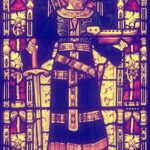
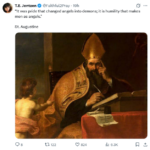
Saint Basil the Great
WJBA? In 2010 Would Jesus (Along With His Apostles & Saints) Be Arrested For Hate Speech?
A few short years ago the mere suggestion that the Son of God, His Apostles and Saints would face arrest for hate speech would have seemed absolutely ludicrous. However, events have spiraled out of control across the western world. In his opinion that strikes down California’s recently voter approved marriage law, Judge Vaughn Walker wrote that those who speak in the name of religion to put across their views that same sex marriage is wrong are “harmful to gays and lesbians.”
Across Europe and Canada, faithful Christians speaking out for traditional marriage face the threat of being hauled off to court for citing the teachings of the Catholic Church and various Evangelical Churches. Where will this all end? Some see a great persecution coming against the Christian faithful. Though possible, one need remember that the Christian faith always grew when persecuted.
The Catholic Church has long taught that some individuals have an inclination toward same sex attraction; they are to be loved as all people are to be loved. The Church teaches that these feelings are not to be acted upon. The Church goes on to teach that all individuals are given a cross to carry in this world and for those who are same sex attracted; this is their cross. An organization exists for those who are same sex attracted called COURAGE. It has many chapters and members.
Recently a profile was done in The New York Times on same sex attracted Eve Tushnet, the Ivy League educated Catholic daughter of Harvard Law professors. She has chronicled her growth in Catholicism and the logic of the Church’s teachings on sexuality. For years the Catholic Church took some heat from some quarters of Christianity for not stating that anyone who is same sex attracted would be going to hell. The Church now is facing a maelstrom of vitriol from those who claim the Church hates homosexuals.
For the Church to change her teachings would be to deny not only what Christ said (Matthew 11:20-24,) but his Apostles, not to mention Saint Paul’s lengthy discourse on the subject (Romans 1:26-28, 1 Corinthians 6:9-10.) In addition to the Apostles and saints, there is a rich history of saints writing on the subject, particularly the Early Church Fathers like Saint Augustine, St Justin Martyr, St. Basil and St John Chrysostom as well as Church intellectuals like St Thomas Aquinas, Saint Albert the Great (the greatest scientist of his time,) along with mystics like St Catherine of Sienna to name but a few. To say that the greatest minds of their respective eras were all wrong is simply breathtaking.
Many who disagree with the Church tend to forget that homosexuality was much more common and approved of by the Roman government in the early Christian era than it is even in 2010. Many in the upper echelons of Greek and Roman culture experimented with all sorts of sexual practices. It would have been far easier for Jesus, the apostles, saints and popes to approve of this conduct than it would to disapprove of it. Christianity might have grown at a faster pace. However, there was a reason for this swimming against the tide, and the faithful accepted it.
Stealing From The Poor
This article originally appeared on The New Theological Movement written by Reginaldus on July 29, 2010 Anno Domini. Re-posted with permission.
18th Sunday in Ordinary Time, Luke 12:13-21
The rich man of this Sunday’s Gospel is blessed with a bountiful harvest. Rather than thanking God for this gift, he hoards the grain in his barns – his heart is possessed by his possessions. At the moment of death, the Lord calls him a fool, for he was not rich in what matters to God.
The Fathers of the Church, and St. Thomas Aquinas following them, see in this parable a strong teaching of social justice. Their teachings have in turn been integrated into the Social Doctrine of the Church. Here we will consider St. Thomas’ exposition of the doctrine as well as several important quotations from the Church Fathers.?
The common destination of all goods and right to private property
We must first affirm that man has a right to own private property. All men have a natural right to make use of material goods. According to positive human law, men also have a right to private property – this is necessary for the good order of society and the proper care of the goods themselves, it also serves as a means of restraining greed and inciting toward generosity (a man can give alms only if he has some property of his own).
However, it is equally clear in the Church’s Tradition, as expressed by the Fathers of the Church and magisterial teachings, that the right to private property is subordinate to the universal destination of all goods. That is, the right to private property cannot be extended to the point of depriving others of the basic material necessities of life. Every man has the right to the material necessities of life – when he is deprived of these, while another has excess wealth, a grave injustice has occurred.
Are You Listening Madame Speaker?
Archbishop George H. Niederauer of San Francisco addressed on January 13, 2010 a free will defense of abortion by Nancy Pelosi, Speaker of the House:
In a recent interview with Eleanor Clift in Newsweek magazine (Dec. 21, 2009), House Speaker Nancy Pelosi was asked about her disagreements with the United States Catholic bishops concerning Church teaching. Speaker Pelosi replied, in part: “I practically mourn this difference of opinion because I feel what I was raised to believe is consistent with what I profess, and that we are all endowed with a free will and a responsibility to answer for our actions. And that women should have the opportunity to exercise their free will.”
Embodied in that statement are some fundamental misconceptions about Catholic teaching on human freedom. These misconceptions are widespread both within the Catholic community and beyond. For this reason I believe it is important for me as Archbishop of San Francisco to make clear what the Catholic Church teaches about free will, conscience, and moral choice.
Catholic teaching on free will recognizes that God has given men and women the capacity to choose good or evil in their lives. The bishops at the Second Vatican Council declared that the human person, endowed with freedom, is “an outstanding manifestation of the divine image.” (Gaudium et Spes, No. 17) As the parable of the Grand Inquisitor in Dostoevsky’s novel, The Brothers Karamazov, makes so beautifully clear, God did not want humanity to be mere automatons, but to have the dignity of freedom, even recognizing that with that freedom comes the cost of many evil choices.

(11 minutes ago)
(16 minutes ago)
(1 hours ago)
(1 hours ago)
(1 hours ago)
(2 hours ago)
(4 hours ago)
(4 hours ago)
(4 hours ago)
(11 hours ago)
(11 hours ago)
(12 hours ago)
(1 days ago)
(1 days ago)
(1 days ago)
(1 days ago)
(1 days ago)
(1 days ago)
(1 days ago)
(1 days ago)
(1 days ago)
(1 days ago)
(1 days ago)
(1 days ago)