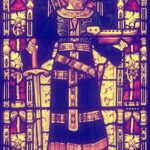
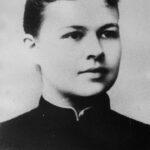
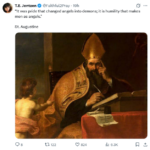
Saint Ambrose
Stealing From The Poor
This article originally appeared on The New Theological Movement written by Reginaldus on July 29, 2010 Anno Domini. Re-posted with permission.
18th Sunday in Ordinary Time, Luke 12:13-21
The rich man of this Sunday’s Gospel is blessed with a bountiful harvest. Rather than thanking God for this gift, he hoards the grain in his barns – his heart is possessed by his possessions. At the moment of death, the Lord calls him a fool, for he was not rich in what matters to God.
The Fathers of the Church, and St. Thomas Aquinas following them, see in this parable a strong teaching of social justice. Their teachings have in turn been integrated into the Social Doctrine of the Church. Here we will consider St. Thomas’ exposition of the doctrine as well as several important quotations from the Church Fathers.?
The common destination of all goods and right to private property
We must first affirm that man has a right to own private property. All men have a natural right to make use of material goods. According to positive human law, men also have a right to private property – this is necessary for the good order of society and the proper care of the goods themselves, it also serves as a means of restraining greed and inciting toward generosity (a man can give alms only if he has some property of his own).
However, it is equally clear in the Church’s Tradition, as expressed by the Fathers of the Church and magisterial teachings, that the right to private property is subordinate to the universal destination of all goods. That is, the right to private property cannot be extended to the point of depriving others of the basic material necessities of life. Every man has the right to the material necessities of life – when he is deprived of these, while another has excess wealth, a grave injustice has occurred.
David, Nathan and Freedom
In the Mass Readings last Sunday, for the reading from the Old Testament we had Nathan the Prophet denouncing King David for his sin of adultery with Bathsheba and his murder of her husband Uriah the Hittite after Bathsheba became pregnant with his child. It is a familiar tale for us, and the familiarity conceals from us just how remarkable it is and how important for us it is, not just in a religious sense but also in our secular lives.
A forgotten masterpiece from Hollywood, King David (1951), helps remind us of the importance of the two great sins of David and their aftermath. David is well-portrayed by Gregory Peck. No longer the shepherd boy, he is now an increasingly world-weary King. God who was close to him in his youth now seems distant. Rita Hayworth gives a solid performance as Bathsheba, David’s partner in sin. The best performance of the film is by Raymond Massey as Nathan. Each word he utters is with complete conviction as he reveals the word of God to those too deafened by sin to hear it. In the video clip above we see this when David attempts to argue that the soldier who died when he touched the Ark of the Covenant may have died of natural causes. “All causes are of God”, Nathan responds without hesitation. He warns David that he has been neglecting his duties and that the people are discontent.
Where Are You Saint Ambrose?

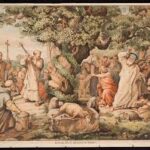
During a crisis within the Roman Empire, Emperor Theodosius I slaughtered 7,000 of his own citizens in 390 AD. Shortly after this massacre Emperor Theodosius arrived in Milan where Saint Ambrose resided as bishop. Upon hearing of the emperors arrival Saint Ambrose refused to meet nor offer the Holy Sacrifice to him. Instead he castigated the emperor and demanded he repent for his sins.
Emperor Theodosius quickly obeyed [emphasis mine],
“and, being laid hold of by the discipline of the Church, did penance in such a way that the sight of his imperial loftiness prostrated made the people who were interceding for him weep more than the consciousness of offence had made them fear it when enraged”. “Stripping himself of every emblem of royalty”, says Ambrose in his funeral oration, “he publicly in church bewailed his sin. That public penance, which private individuals shrink from, an Emperor was not ashamed to perform; nor was there afterwards a day on which he did not grieve for his mistake.”[1]
Ted Kennedy was the leading proponent of abortion on demand.
Millions of innocent humans died due to the policies that Ted Kennedy championed.
Ted Kennedy passed away without repenting nor showing remorse for his direct actions in the death of millions.
Instead of performing his duty as Archbishop of Boston and teaching Ted Kennedy the errors of his ways, Cardinal O’Malley does absolutely nothing and then presides at his funeral.
Saint Ambrose, ora pro nobis!
_._
(photo from WPIX)
[1] Loughlin, J. (1907). St. Ambrose. In The Catholic Encyclopedia. New York: Robert Appleton Company. Retrieved August 30, 2009 from New Advent: http://www.newadvent.org/cathen/01383c.htm
Cardinal Egan's Inability To Raise Vocations

Outgoing Archbishop of New York Cardinal Egan demonstrates why he is a complete failure in raising the number of vocations in his archdiocese. In comments made to a radio program in Albany two days ago Cardinal Egan [may have] insinuated that because priests aren’t allowed to marry was the cause of his inability to raise the number of vocations. Cardinal Egan openly admitted it was his “greatest” failure in bringing in more seminarians.
[I am using the Cardinal's own words in describing the issue of raising the number of vocations]
(1 hours ago)
(1 hours ago)
(3 hours ago)
(3 hours ago)
(4 hours ago)
(4 hours ago)
(4 hours ago)
(4 hours ago)
(4 hours ago)
(5 hours ago)
(5 hours ago)
(5 hours ago)
(5 hours ago)
(6 hours ago)
(8 hours ago)
(8 hours ago)
(8 hours ago)
(8 hours ago)
(9 hours ago)
(9 hours ago)
(11 hours ago)
(11 hours ago)
(1 days ago)
(1 days ago)