Waltzing Matilda
Something for the weekend. A first rate vido explaining the rollicking song Waltzing Matilda to those of us who do not speak Australian.
Continue reading
Remember
Something for the weekend. Scenes from the American Revolution set to the music of the film National Treaure. This Fourth of July weekend we should recall our heritage, especially the eight long years of war it took to achieve American independence. We should also remember these words of our second President John Adams in a letter to his wife Abigail on April 26, 1777:
Continue reading
Scotland the Brave
O’, I’m a Good Old Rebel
Something for the weekend. O’, I’m a Good Old Rebel by Major James Randolph. This rendition is sung by Bobby Horton, who has fought a one man crusade to bring Civil War music to modern audiences. It is the most moving rendition I have heard of this song, with Horton conveying well the bitterness and despair felt by almost all Confederates after the conclusion of the War. The author served on the staff of General J.E.B. Stuart. The song has always been popular in the South and was a favorite of Queen Victoria’s son, the future Edward VII, who referred to it as “that fine American song with cuss words in it.”
Continue reading
Holst the Planets: Neptune the Mystic
Something for the weekend. Neptune the Mystic from Gustav Holst‘s The Planets. A very mellow piece of music for what I hope will be a mellow weekend. Continue reading
Keynes vs. Hayek, Round Two
Russ Roberts and friends have come out with another Keynes vs. Hayek rap video:
The production values on this are great, and I like the noir look they’ve got with, but I have to admit I slightly prefer their original: Continue reading
What Wondrous Love is This?
Something for the weekend. What Wondrous Love is This? and the Pieta. After Michelangelo completed it and had the Pieta moved to display it, the workmen who did it refused to accept a penny for their hard labor, saying they would get their reward in Heaven. I pray that they did, and I pray we all meet a similar fate. Continue reading
Lilliburlero
Something for the weekend. The lilting strains of Lilliburlero from the classic movie Barry Lyndon (1975).
The song originated during the Not So Glorious Revolution of 1688, after the usurper William of Holland, with the help of English traitors, chased James II, the rightful King of England, from his throne due to James’ Catholicism. Like most of the Stuart monarchs, the bad points of James tended to outweigh his good points, but the obloquy heaped upon his reign in most of the histories of this period is largely a function of partisan distortion and outright religious bigotry. On the other hand, Jacobite views of this period of British history, which goes to 1746 and the smashing of the army of Bonnie Prince Charlie, the grandson of James II at Culloden, tend greatly to exaggerate the virtues of the “Kings across the waters” who, Old Pretender (James II), Young Pretender (James III) and Bonnie Prince Charlie, were basically selfish blockheads who probably would have been disasters as monarchs if they had succeeded in regaining the throne. History, alas, often gives us unpalatable alternatives.
Continue reading
Charlemagne
Something for the weekend. Charlemagne by the endlessly talented folks at music for history lovers, sung to the tune of Call Me by Blondie.
Charles the Great. He found the crown of the Roman emperors lying in the gutter of time, and by his efforts, against the odds, restored, in alliance with the popes, a Western Empire. Charlemagne laid the foundation that allowed Catholic Europe to survive the siege by Islam and to ultimately defeat the Vikings through conversion. In his reign Western Europe began waking from the long night described by Chesterton:
For the end of the world was long ago,
When the ends of the world waxed free,
When Rome was sunk in a waste of slaves,
And the sun drowned in the sea.
When Caesar’s sun fell out of the sky
And whoso hearkened right
Could only hear the plunging
Of the nations in the night.
When the ends of the earth came marching in
To torch and cresset gleam.
And the roads of the world that lead to Rome
Were filled with faces that moved like foam,
Like faces in a dream.
And men rode out of the eastern lands,
Broad river and burning plain;
Trees that are Titan flowers to see,
And tiger skies, striped horribly,
With tints of tropic rain.
Where Ind’s enamelled peaks arise
Around that inmost one,
Where ancient eagles on its brink,
Vast as archangels, gather and drink
The sacrament of the sun.
And men brake out of the northern lands,
Enormous lands alone,
Where a spell is laid upon life and lust
And the rain is changed to a silver dust
And the sea to a great green stone.
And a Shape that moveth murkily
In mirrors of ice and night,
Hath blanched with fear all beasts and birds,
As death and a shock of evil words
Blast a man’s hair with white.
And the cry of the palms and the purple moons,
Or the cry of the frost and foam,
Swept ever around an inmost place,
And the din of distant race on race
Cried and replied round Rome.
And there was death on the Emperor
And night upon the Pope: Continue reading
1988: Best Year Ever!
Advisory Warning: The video is rated R for skimpy clothing and suggestive sexual behavior. Youth should receive permission from their mother or father to view this video.
I’m a sucker for anything ’80s as you can tell, but you have to admit that it was pretty tamed back then compared to today. You could say that the 1980s today is what the 1950s were back then, but much more fun!
Take Me Home Tonight is a movie in in the summer of 1988 as it winds down. Three friends on the verge of adulthood attend an out-of-control party in celebration of their last night of unbridled youth. Starring Topher Grace, Anna Faris, Dan Fogler and Teresa Palmer. Take Me Home Tonight is a raunchy, romantic and ultimately touching blast from the past set to an awesome soundtrack of timeless rock and hip-hop hits.
Raunchy is an understatement.
Nonetheless I probably wouldn’t let anyone under the age of 17 watch it.
Here’s the trailer.
Viva Roma No. V!
Something for the weekend. From those endlessly talented folks at History for Music Lovers, Viva Roma No. V to the tune of Mambo No. 5.
Civis Romanus sum said Saint Paul, or its Greek equivalent, and even while Christians were savagely persecuted by the Roman Empire many of them remarked about what a wonder in human affairs it was.
Tertuallian, Christian Apologetics
Saint Augustine, living in the twilight of the Roman Empire in the West, with savage Vandals besieging Hippo at the time of his death, in his City of God raised the eyes of men to the imperishable City of God, while also yet acknowledging that God was the cause of the rise of the Roman Empire, along with the traditional Roman virtues: Continue reading
Hannibal and 16 Tons
Something for the weekend. A song about Hannibal to the tune of 16 Tons. Hattip to Hank at Eclectic Meanderings. I have read quite a bit about the Punic Wars, but I have never seen information on them conveyed more fetchingly than when sung by “Anna Domino”, as she does her dance of the elephant veil and sings her song. What a hoot! This is one of a series of videos put together by history for music lovers, and long may they prosper!
Continue reading
Shiloh’s Hill
Something for the weekend. Shiloh’s Hill. This moving song on the battle of Shiloh is based on a poem written by M. G. Smith who fought in the battle with Company C, 2nd Texas Volunteer Infantry. The song is performed by the 97th New York regimental string band.
Continue reading
The Vacant Chair
Something for the weekend. The incomparable Kathy Mattea singing the Civil War song The Vacant Chair. Originally written in 1862 to commemorate Second Lieutenant John William Grout, 15th Massachusetts, who was killed at age eighteen at Ball’s Bluff, one of the early battles of the War, it proved immensely popular North and South as the nation eventually mourned approximately 620,000 vacant chairs. Continue reading
Marines’ Hymn
Some people work an entire lifetime and wonder if they ever made a difference to the world. But the Marines don’t have that problem.
Ronald Reagan
Something for the weekend. The oldest of the official songs of a branch of the US military, the composer of the Marines’ Hymn is unknown, but is thought to have been a Marine serving in Mexico during the Mexican War, hence the “Halls of Montezuma”. The music is taken from the Gendarmes Duet from the Opera Genevieve de Brabant, written by Jacques Offenback in 1859.
Prior to 1929 the first verse used to end:
“ Admiration of the nation,
we’re the finest ever seen;
And we glory in the title
Of United States Marines”
which the then Commandant of the Marine Corps changed to the current lines. On November 21, 1942, Commandant Thomas Holcomb approved a change in the words of the first verse’s fourth line from “On the land as on the sea” to “In the air, on land, and sea”.
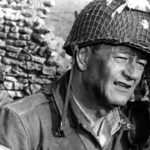
My favorite rendition of the hymn is in the movie The Sands of Iwo Jima (1949) This film earned John Wayne his first Oscar nomination as best actor. (Broderick Crawford would win for his stunning performance in All The King’s Men.) Wayne was initially reluctant to take the role, partly because he had not fought in World War II, and partly because he saw script problems and didn’t like the character of Sergeant Styker as initially written in the screen play. (There is evidence that Wayne, 34 at the time of Pearl Harbor, and with 3 kids, did attempt to volunteer in 1943 for the Marine Corps with assignment to John Ford’s OSS Field Photographic Unit, but was turned down.)
Wayne was convinced to take the role because the film had the enthusiastic backing of the Marine Corps, which viewed it as a fitting tribute to the Marines who fought in the Pacific, and to help combat a move in Congress to abolish the Corps. Marine Commandant Clifton B. Cates went to see Wayne to request that he take the role and Wayne immediately agreed. (Thus began a long association of John Wayne with the Marine Corps, including Wayne narrating a tribute to Marine Lieutenant General Chesty Puller.)
Appearing in the film were several Marine veterans of the Pacific, including Colonel David Shoup, who earned a Medal of Honor for his heroism at Tarawa, and who would later serve as a Commandant of the Corps, and Lieutenant Colonel Henry Crow who led a Marine battalion at Tarawa. The Marine Corp hymn is sung in the film after the death of Wayne’s character, one of ten films in which a Wayne character died, and as the raising of the flag is recreated.
Taking part in the flag raising were Rene Gagnon, Ira Hayes and John Bradley, the three survivors of the six flag raisers who survived the battle. (The three men who raised the flag and subsequently died in the battle were Franklin Sousely, Harlon Block and Michael Strank.) (First Lieutenant Harold Schrier, who led the flag raising party that raised the first, smaller, flag on Mount Suribachi, and who was awarded a Navy Cross and a Silver Star for his heroism on Iwo Jima, also appeared in the film.) The flag on top of Mount Suribachi could be seen across the island, and was greeted with cheers by the Marines and blaring horns by the ships of the Navy. A mass was said on Mount Suribachi at the time of the flag raising and I have written about that here. Go here to see the ending of the Sands of Iwo Jima and listen to the Marines’ Hymn. Continue reading
O Holy Night
Something for the weekend. O Holy Night. The rendition above is done by Celtic Woman. The hymn was written in 1847 by Placide Cappeau at the request of his parish priest. The English version was written by John Sullivan Dwight, a Unitarian Minister in 1855. Judging from the lyrics, it is amazing how orthodox this Unitarian Minister was: Continue reading
Katyusha
Rocky Top
Something for the weekend. I have never been particularly fond of Country and Western music, a musical genre that my late parents perhaps overdosed me on as I was growing up. However, I have always been fond of the rollicking Rocky Top. The video at the beginning of this post melds the song with pictures from the Volunteer State. Continue reading
Chester
Something for the weekend. Chester by William Billings. During the American Revolution, this was the unofficial national anthem for the new United States. As we participate in elections it is good to recall the struggles throughout our history that bequeathed to us the freedoms we enjoy today. We stand on the shoulders of the giants who preceded us, and we should never forget that. Continue reading
Army of the Free
Conquest
Something for the weekend. Conquest theme from the 1947 film Captain From Castile. As all University of Southern California alums know, the work was composed by Alfred Newman who bequeathed all rights in the work to the University to play at football games.
The movie Captain From Castile, based on the novel of the same name by Samuel Shellenbarger, is quite worth watching. Tyrone Power plays Pedro de Vargas, a nobleman on the run from the inquisition who becomes one of Hernan Cortez’ captains. Cortez is portrayed by Caesar Romero who steals every scene he is in. He captures Cortez perfectly: larger than life, endlessly innovative, always optimistic no matter the challenge, and overflowing with raw charisma. The film ends before the campaign to conquer Tenochtitlan which is a disappointment. Continue reading


Recent Comments
(2 hours ago)
(3 hours ago)
(6 hours ago)
(7 hours ago)
(8 hours ago)
(8 hours ago)
(9 hours ago)
(11 hours ago)
(11 hours ago)
(1 days ago)
(1 days ago)
(1 days ago)
(1 days ago)
(1 days ago)
(1 days ago)
(1 days ago)
(1 days ago)
(1 days ago)
(1 days ago)
(1 days ago)