Movies

1988: Best Year Ever!

Advisory Warning: The video is rated R for skimpy clothing and suggestive sexual behavior.  Youth should receive permission from their mother or father to view this video.

YouTube Preview Image

I’m a sucker for anything ’80s as you can tell, but you have to admit that it was pretty tamed back then compared to today.  You could say that the 1980s today is what the 1950s were back then, but much more fun!

Take Me Home Tonight is a movie in in the summer of 1988 as it winds down.  Three friends on the verge of adulthood attend an out-of-control party in celebration of their last night of unbridled youth. Starring Topher Grace, Anna Faris, Dan Fogler and Teresa Palmer.  Take Me Home Tonight is a raunchy, romantic and ultimately touching blast from the past set to an awesome soundtrack of timeless rock and hip-hop hits.

Raunchy is an understatement.

Nonetheless I probably wouldn’t let anyone under the age of 17 watch it.

Here’s the trailer.

YouTube Preview Image

Continue reading

LinkedInShare

Susannah York of ‘A Man For All Seasons’, Requiescat In Pace

Susannah York succumbed to cancer this past Friday at the age of 72.

She is best remembered for portraying Saint Thomas More‘s daughter, Margaret More, in what is arguably the greatest Catholic film of all time, A Man For All Seasons.

She was very beautiful and enchanting and her role as Margaret More captured the essences of an integrated Catholic life that is an excellent example for laypeople everywhere today.

The following clip is that of the King paying his Lord Chancellor, Saint Thomas More, a visit on his estate.  The King encounters More’s family and is introduced to More’s daughter, Margaret, at the :45 mark of the clip.  They engage in conversation at the 1:32 mark of the clip.  The entire 10 minutes should be viewed to really enjoy her performance and appreciate the film itself:

YouTube Preview Image

Here is the trailer to that magnificent Catholic film, A Man For All Seasons:

YouTube Preview Image

Post script:  I was unable to find out if Susannah York was a Catholic or not, but her portrayal of Margaret More is a fine example of living a Catholic life.

Cross-posted at Gulf Coast Catholic.

LinkedInShare

Sneak Peak At There Be Dragons Movie Trailer

UPDATE at the BOTTOM

The famous director of the movies The Mission and The Killing Fields, Roland Joffe, has just released a trailer teaser to his new film he is producing that encapsulates the early life of Saint Josemaria Escriva.

The film is about a news reporter investigating the life of his father where he discovers that his father was a lifelong friend of Saint Josemaria Escriva.

YouTube Preview Image

Continue reading

LinkedInShare

Stallone, Schwarzenegger, and Willis Together Finally

Sly, Ahnold, and Bruno finally make my dream action flick I’ve been waiting for since the 1980′s called the Expendables.

YouTube Preview Image

Unfortunately, Ahnold and Bruce only make a cameo appearance.  But the film is packed with 80′s and contemporary action stars, from Dolph Lundgren to the under-rated Jason Statham.

The rest of the film looks real good, so I’ll be watching this movie at my first opportunity.

Here is a preview from Reuters:

It is the action hero dream team. Sylvester Stallone will shoot a scene with Bruce Willis and Arnold Schwarzenegger soon for his upcoming adventure “The Expendables,” due to hit theatres in 2010.

The man behind the successful Rambo and Rocky franchises has also brought Jason Statham, Jet Li, Mickey Rourke and Dolph Lundgren on board for the story of a team of mercenaries who head to South America on a mission to overthrow a dictator.

Continue reading

LinkedInShare

Top Ten Patriotic Movies for the Fourth

Last year I listed here my top ten picks for movies about the America Revolution for the Fourth.  This year here is my list of patriotic movies for the Fourth.

YouTube Preview Image

10. National Treasure (2004)-Sure it’s cursed with a ridiculous plot involving the masons and a treasure, it is still a lot of fun and calls us back to the foundation document, the Declaration of Independence, that is the cornerstone of our Republic.

9. Hamburger Hill (1987)-Content advisory: very, very strong language in the video clip which may be viewed here.  All the Vietnam veterans I’ve mentioned it to have nothing but praise for this film which depicts the assault on Hill 937 by elements of the 101rst Division, May 10-20, 1969.  It is a fitting tribute to the valor of the American troops who served their country in an unpopular war a great deal better than their country served them.

YouTube Preview Image

8.    Yankee Doodle Dandy (1942)-James Cagney in perhaps the greatest film bio of them all, a salute to George M. Cohan, the legendary composer, playwright and patriot.

YouTube Preview Image

7.    The Alamo (1960)-“The Republic” scene from The Alamo, a film which was basically John Wayne’s love note to America.

YouTube Preview Image

YouTube Preview Image

6.    Gettysburg (1993)-The movie that I think comes the closest to conveying to us the passions of the Civil War.  You really can’t understand America unless you understand the Civil War.  As Shelby Foote, one of the greatest historians of the war, said:  “Any understanding of this nation has to be based, and I mean really based, on an understanding of the Civil War. I believe that firmly. It defined us. The Revolution did what it did. Our involvement in European wars, beginning with the First World War, did what it did. But the Civil War defined us as what we are and it opened us to being what we became, good and bad things. And it is very necessary, if you are going to understand the American character in the twentieth century, to learn about this enormous catastrophe of the mid-nineteenth century. It was the crossroads of our being, and it was a hell of a crossroads.”

YouTube Preview Image

5.    Mr. Smith Goes to Washington (1939)-This movie came out at a time when fascism and communism seemed to be the wave of the future.  In the face of that dark reality, Mr. Smith is a brilliant paean to American democracy, and the idealism and devotion to the principles of the Founding Fathers that constantly battles against political corruption.

YouTube Preview Image

4.    Glory (1989)-The tale of the 54th Massachusetts in the Civil War, and a long overdue salute to the black troops who fought for the Union.  A superb film in every regard, and a model of  how history should be recreated on film.

YouTube Preview Image

3.    Wake Island (1942)-At the beginning of World War II the 1rst Marine Defense Battalion on Wake Island, gallantly supported by civilian workers, made an unforgettable stand against the Japanese.  This is the story of the American Thermopylae.

YouTube Preview Image

2.  Abe Lincoln in Illinois (1940)-Raymond Massey gives the performance of a life time as the greatest President this nation has ever had, save, perhaps, for George Washington.

YouTube Preview Image

1. 1776  (1972)-Singing and dancing Founding Fathers!  What’s not to love?  The film does a good job of depicting what a leap of faith the Declaration of Independence was.  For all the Founding Fathers knew, they could have all ended up dangling from British nooses, and cursed by their posterity.  They banished their fears and went boldly forward with their revolution, the most successful revolution in history, and which is still underway.

LinkedInShare

C.S. Lewis Book, The Great Divorce, Coming to the Big Screen

The following is from Alex Birko of the A.V. Club reporting on C.S. Lewis‘s book, The Great Divorce, being produced into a movie:

Last week marked the arrival of the trailer for the third “Chronicles Of Narnia” movie, The Voyage Of The Dawn Treader, and as everybody knows, C.S. Lewis news always comes in twos. It appears that Lewis’ religious allegory The Great Divorce is the latest of his work be slated for the big screen, according to Variety’s announcement that production studios Beloved Pictures and Mpower Pictures are joining forces to co-produce. Children’s author N.D. Wilson, known for the 100 Cupboards fantasy trilogy and his parodies of the Left Behind series, is attached to adapt the screenplay. With luck, the arrival of Mpower (The Stoning Of Soroya M.) will jump-start the project, and let it avoid the seemingly never-ending gestation plaguing the film adaptation of Lewis’ The Screwtape Letters, which was announced back in 2006, scheduled for a 2008 release, and delayed until 2010. It’s seen little discernable progress since.

Continue reading

LinkedInShare

Under the Roman Sky

YouTube Preview Image

A new film, Under the Roman Sky, starring James Cromwell as Pius XII, details the heroic efforts of Pius XII to save the Jews of Rome from the Nazis, after Rome came under Nazi occupation subsequent to the fall of Mussolini following the Allied invasion of southern Italy in 1943.

Rabbi David G. Dalin, in his review of a Moral Reckoning, a tome by Daniel Goldhagen which sought to blame Catholicism for the Holocaust, details the efforts of the Pope to save the Jews of Rome:

Goldhagen’s centerpiece is the outrageous allegation that Pius XII “did not lift a finger to forfend the deportations of the Jews of Rome” or of other parts of Italy “by instructing his priests and nuns to give the hunted Jewish men, women and children sanctuary.”  Much of this is lifted straight from anti-Pius books like Susan Zuccotti’s Under His Very Windows–and thus Goldhagen repeats the errors of those books and adds extras, all his own, in his determined attempt to extend their thesis into over-the-top railings against the sheer existence of Catholicism.

Continue reading

LinkedInShare

Gibbon, Hypatia and Bigotry

YouTube Preview Image

One of my favorite historians is Edward Gibbon.  I have made my way through his Decline and Fall of the Roman Empire several times.  I find his style entertaining, his wit dry, and his scholarship, for his time, adequate.  Unfortunately Gibbon was also an anti-Catholic bigot, in part a reaction to a brief conversion to the Faith as a teen-ager, which exposed him to considerable paternal displeasure.  His bigotry is on full display whenever he treats of the Church, but usually he does not distort the facts.  That was not the case in his account of the female philosopher Hypatia, and the fate she met in Egypt in 391 AD.  That account, usually in distorted form, is a staple of anti-Catholic and atheist websites.  Now Hypatia is the heroine of a Catholic bashing movie Agora. The English trailer of the movie is at the top of this post.  David Hart has a superb post at First Things correcting Gibbon and the movie.

The occasion of my misery is the release of Alejandro Amenábar’s film Agora, which purports to be a historical account of the murder of the female philosopher Hypatia by a Christian mob in the early fifth century, of the destruction of the Great Library of Alexandria, and (more generally) of an alleged conflict that raged in the ancient world between Greek science and Christian faith. I have not actually seen the movie, and have no intention of doing so (I would say you couldn’t pay me to watch it, but that’s not, strictly speaking, true). All I know about it is what I have read in an article by Larry Rohter in the New York Times. But that is enough to put my teeth on edge.

Continue reading

LinkedInShare

The Infidel

A comedy from the U.K. where a devout British Muslim finds out he was not born a Muslim.

Watch the rest of the trailer for some really good English humour!

YouTube Preview Image
LinkedInShare

Res et Explicatio for AD 2-3-2010

Salvete TAC readers!

Here are my Top Picks in the Internet from the world of the Catholic Church and secular culture:

1. On ABC’s “This Week” this past Sunday Arianna Huffington, of the Huffington Post accused Glenn Beck of “inciting the American people” to commit violence against Obama by talking about “people being slaughtered.”

Here is Glenn Beck’s response from last night:

YouTube Preview Image

Continue reading

LinkedInShare

Hollywood Angelology

I probably shouldn’t be surprised, but I am.

Last fall I saw a trailer for a new movie that’s coming out next week called Legion, in which Michael the archangel defends humanity against the armies of (good?) angels which God has sent to wipe out humanity. Here’s the plot summary from Wikipedia:

Continue reading

LinkedInShare

Advent and John the Baptist

YouTube Preview Image

In Advent my thoughts frequently turn to John the Baptist, the last, and the greatest, of the prophets who foretold the coming of Christ.  The Jews lived in expectation for many centuries for the coming of the Anointed One, the Christ.  It was left for the Baptist to be His final herald.  His cries for repentance in preparing the way for the Lord are a useful reminder to us as to the proper spirit to celebrate the birth of Christ.

Of the film portrayals of John the Baptist, my favorite is that of Charlton Heston in the movie The Greatest Story Ever Told, who conveys well the sheer force of the Baptist’s message and the courage with which he conveyed it.  John came to testify to the Truth and nothing would stop him from doing it, not even death as the last 2000 years can attest.

YouTube Preview Image
LinkedInShare

No Islamic Holy Sites Destroyed in 2012 Movie, Fear of Fatwa

Grand Mosque of Mecca

Due to the fear of a death threat in the form of a fatwa from Muslim scholars, movie director Roland Emmerich chose not to shoot any scenes depicting the destruction of Islamic holy sites in his new end-of-the-world film, 2012.  Though Roland Emmerich says this did not stop him when filming scenes depicting the destruction of Christian landmarks such as the Sistine Chapel, Saint Peter’s Basilica, and the Christ the Redeemer statue in Rio de Janeiro.  He wanted to make sure his views of opposition to “organized religion” were not soft-pedaled in the movie 2012.

Of course, “organized religion” is a euphemism for the apostolic churches of the Catholic and Orthodox faiths.  Hence why you’ll see the dome of Saint Peter’s Basilica topple over in the 2012 film and not the Ka’aba inside the Grand Mosque of Mecca collapse.

Continue reading

LinkedInShare

Cinema Classics: The Thin Man Movies

Giving strength to the phase “they’re not making them like that any more” is the classic series of film noir take-offs the Thin Man movies, starring William Powell and Myrna Loy.
YouTube Preview Image
The first movie, The Thin Man (1934), was based on a novel by one of the godfathers of noir, Dashiell Hammett, who also worked on the screenplays for the first two movies. However the chemistry of Powell and Loy make the movie of The Thin Man a good deal more fun than the book: classy, witty and all-around a good time.

The movie was such a success it was followed in 1936 by Another Thin Man, and eventually a total of six Thin Man movies were made, ending with the 1947 Song of the Thin Man. To my mind, the three 30s movies are the best, with the feel of the movies changing slightly in the later movies.

LinkedInShare

The 13th Day

YouTube Preview Image

[Updates at the bottom of this post as of 10:33 pm CST for 8-20-2009 AD]

The 13th Day is a film based on the true story of the Marian apparitions to three shepherd children at Fatima Portugal on the 13th day of six consecutive months in 1917, starting on 13 May.  The three children were Lucia Santos and her cousins, siblings Jacinta and Francisco Marto.  These apparitions at Fatima were officially declared worthy of belief by the Catholic Church.

Continue reading

LinkedInShare

"50 Best Catholic films of all time"

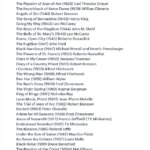
William Park (InsideCatholic.com) lists, in his judgement, “the fifty best Catholic movies of all time”.

Some readers, myself included, were very surprised by the absence of The Mission. A magnificent cast (including Robert DeNiro, Jeremy Irons and Liam Neeson); a play by Robert Bolt (A Man for All Seasons) — it has, in my estimation, one of the most powerful illustrations of penance and forgiveness in cinema.

The Mission deservedly won seven Academy Awards, and made the top 15 films under ‘Religion’ selected by the Vatican, commemorating 100 years of cinema.

So why didn’t it make the list? — the author doesn’t offer much of an explanation, save that “Bolt’s screenplay for The Mission looks at the Church from the point of view of Dostoevsky’s “Grand Inquisitor.” Steven D. Greydanus, however, explores the complexities and ambiguities of The Mission for DecentFilms.com.

Question for our readers: do you agree with the list? — Do you agree with Warren’s list? Any notable omissions? What would you have selected?

LinkedInShare

"Taken" Some Life Lessons

I saw the movie with Liam Neeson entitled “Taken”, the other night. It is the ultimate ‘Dads protecting daughters’ fantasy. It plays on a whole lot of primal emotions- particularly the temptation to give oneself over to extreme violence to protect the lives and sanctity of one’s children. Every father wants to imagine himself capable of defending his beloved children from any and all threats- and the father in “Taken” was that ultimate fatherly force. He represented more of a divine Angelic father who slays spiritually evil forces, than a realistic earthly dad- and as such I was able to excuse the incredible violence as something of a parable of ultimate accountability for those humans who perpetrate the evils of human trafficking and slavery.

Continue reading

LinkedInShare

Top Ten Movies For the Fourth


YouTube Preview Image

A number of feature films and miniseries have been made about the events of the American Revolution.  Here are my top ten choices for Fourth of July viewing:

10.  The Devil’s Disciple (1959)- I am not a big fan of the plays of George Bernard Shaw, but this film has its moments.  Set during the Saratoga campaign of 1777, Laurence Olivier was an inspired choice as General “Gentleman Johnnie” Burgoyne, and Burt Lancaster and Kirk Douglas as the two American protagonists have their usual fine chemistry together on film.  Not a classic but certainly an overlooked gem.

Continue reading

LinkedInShare

Pity and Fear

Aristotle taught that the purpose of tragedy is to inspire pity and fear in the audience, thence causing catharsis, a purging of emotion. I’ve always found his explanation of tragedy compelling, but as I get older (queue laughter at the thirty-year-old getting “older”) I find that I want to achieve catharsis much less than I used to. Not that my life is layered in tragedy or anything, indeed, far from it. But somehow, one just doesn’t feel as much like seeking out pity and fear at thirty as at twenty.

This has been running through my head as I’ve been reading about The Stoning of Soraya M.

Continue reading

LinkedInShare

Follow us!

Bookmark and Share

Subscribe by email!

Enter your email address:

Vatican Endorsed & Imprimatur

Recent Comments

RealCatholicTV.com

Digest of Top Posts in St. Blogs

Visitors to our website

Our Subscribers…

Archives