Memorial Day

Black Jack Logan and Memorial Day

YouTube Preview Image

Freedom is not only a gift, but also a summons to personal responsibility. Americans know this from experience — almost every town in this country has its monuments honoring those who sacrificed their lives in defense of freedom, both at home and abroad.

                                                         Pope Benedict, April 16, 2008

John A. Logan is the father of Memorial Day.  Today he is largely forgotten except to Civil War buffs and that is a shame.  He was a fascinating man and he is largely responsible for establishing the tradition of putting aside a day in the calendar to our nation’s war dead.

Logan began the Civil War as a Democrat congressman from southern Illinois.  He was ardently anti-War even after the firing on Fort Sumter, denouncing the Lincoln administration and calling for peace and compromise.  He was attacked as being disloyal to the Union and an almost advocate of the Confederacy. 

This perception changed in the twinkling of an eye at the battle of Bull Run.  Like many another congressman he went out to view the Union army launch an attack on the Confederates.  Unlike the other congressmen, Logan picked up a musket and, attaching himself to a Michigan regiment, blazed away at the Confederates with that musket.  This experience transformed Logan into an ardent advocate of the War.

He returned to southern Illinois and gave a fiery speech in Marion, Illinois for the Union that helped swing that section of the state in support of the War.  Resigning from Congress, he helped raise an infantry regiment from southern Illinois, and was made colonel of the regiment, the 31rst Illinois.

Logan quickly made a name for himself as a fighter.  At the battle of Belmont he led his regiment in a successful charge, and was noted for his exceptional courage.  He would eventually be promoted to major general and was one of the best corp commanders in the Union army, briefly commanding the Army of the Tennessee.  He was wounded three times in the War, one of the wounds being serious enough that he was erroneously reported as killed, a report that might have been proven to be accurate if he had not been nursed back  to health by his wife.

Logan was never beaten in any engagement that he fought in during the War.  He was popular with his men who affectionately called him “Black Jack”, and would often chant his name on the battlefield as he led them from the front.  On May 24th 1865, as a tribute to his brilliant war record, he commanded the Army of the Tennessee during the victory Grand Review of the Union armies in Washington.

After the War, Logan began his political career anew, serving as a congressman from Illinois and a senator.  He was now a radical Republican and fought ardently for civil rights for blacks.  He ran for Vice President in 1884 on the Republican ticket that was defeated by Grover Cleveland.  He was considered the leading candidate for the Republican nomination in 1888, and might well have been elected President that year, but for his untimely death in 1886 at the age of sixty.

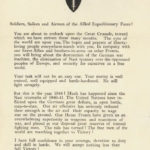
From 1868 to 1871, Logan served three consecutive terms as commander in chief of the Grand Army of the Republic, the Union veteran’s association.  He started the custom of remembering the Union war dead on May 30th when he issued General Order Eleven on May 5, 1868: Continue reading

LinkedInShare

Top Ten Films For Memorial Day Weekend

 YouTube Preview Image

“When You Go Home, Tell Them Of Us And Say,
For Your Tomorrow, We Gave Our Today”

              Inscription on the memorial to the dead of the British 2nd Infantry Division at Kohima.

The upcoming Memorial Day weekend, the unofficial start of summer, is a time of fun here in the US.  However, it should also be a time of memory.  Memorial day is derived from the Latin “memoria”, memory, and we are duty bound this weekend to remember those who died in our defense, and who left us with a debt which can never be repaid.  One aid to memory can be films, and here are a few suggestions for films to watch this weekend.

10.  300-This may seem like an odd choice, not involving Americans, and a fairly bizarre retelling of the battle of Thermopylae.  However, it celebrates the idea of never forgetting those who died for their country.  “Go tell the Spartans passerby, that here, obedient to their laws, we lie.”  So wrote Simonides, the greatest poet of his time, in tribute to the Spartans who fell at Thermopylae.  The speech of Dilios at the end of the film, which may be viewed here, reminds us of our duty to remember those who laid down their lives for us, a message to be recalled this weekend.

  9.   They Were Expendable (1945) John Ford and John Wayne tell the story of the doomed PT Boat crews that fought against overwhelming odds during the invasion of the Philippines in 1941-42.  The film has a gritty downbeat feel, appropriate to the subject matter, but an oddity for a film made during the War.

YouTube Preview Image

  8.    Hamburger Hill (1987)-Content advisory: very, very strong language in the video clip which may be viewed here.  All the Vietnam veterans I’ve mentioned it to have nothing but praise for this film which depicts the assault on Hill 937 by elements of the 101rst Division, May 10-20, 1969.  It is a fitting tribute to the valor of the American troops who served their country in an unpopular war a great deal better than their country served them.

   7.   Porkchop Hill (1959)-Korea has become to too many Americans The Forgotten War, lost between World War II and Vietnam.  There is nothing forgotten about it by the Americans who served over there, including my Uncle Ralph McClarey who died recently, and gained a hard won victory for the US in one of the major hot conflicts of the Cold War.  This film tells the story of the small American force on Porkchop Hill, who held it in the face of repeated assaults by superior forces of the Chinese and North Koreans.  As the below clip indicates it also highlights the surreal element that accompanies every war and the grim humor that aspect often brings.

YouTube Preview Image

  6.    Glory (1989)-A long overdue salute to the black troops who served in the Union Army during the Civil War.  Robert Gould Shaw the white colonel who led the 54th Massachusetts died at Fort Wagner in the assault of the 54th.  He was buried by the Confederates with his black troops.  His parents were given an opportunity to have his body exhumed and returned to Boston for burial.  Their reply was immortal:    We would not have his body removed from where it lies surrounded by his brave and devoted soldiers….We can imagine no holier place than that in which he lies, among his brave and devoted followers, nor wish for him better company – what a body-guard he has!

YouTube Preview Image Continue reading

LinkedInShare

Enemies No Longer

The American Civil War was the bloodiest in our history, a total war of attrition waged on our own territory, which an at times none to congenial peace. It is, thus, all the more inspiring to read about the reunion which was held at Gettysburg in 1913, celebrating the 50th anniversary of one of the war’s bloodiest battles. An open invitation was made to all those who had served in either army, north or south, and been honorably discharged, and more than 50,000 men came to the three day event.

Personnel from the United States Army Quartermaster Corps and Engineer Corps arrived at Gettysburg National Military Park in 1912 to plan military and civilian support for the encampment. The engineers surveyed the field adjacent to the fields of “Pickett’s Charge” where they laid out the arrangement for “The Great Camp”, divided into areas for Union veterans and for Confederate veterans. Soldiers installed utility systems, erected hundreds of tents to house the veterans, built picnic tables, benches, and boardwalks throughout the camp. By the first of June the sprawling Great Camp occupied 280 acres, included 47 1/2 miles of avenues and company streets, was lit by 500 electric arc lights, and 32 bubbling ice water fountains were installed. Over 2,000 army cooks and bakers manned 173 field kitchens, ready to provide three hot meals per day for veterans and camp personnel alike….


The first veterans arrived on June 25 and within days the Great Camp swelled to overflowing. Every veteran was provided a cot and bedding in a tent that would hold eight men. Meals were served from a kitchen at the end of each company street and varied from fried chicken suppers to roast pork sandwiches with ice cream for desert. By the end of the reunion, the army kitchens had supplied over 688,000 meals to reunion participants. Invariably the days were hot and the thermometer topped 102 degrees on July 2. Heat exhaustion and physical fatigue resulted in hospitalization of several hundred veterans. Over 9,980 patients were treated by medical personnel for ailments ranging from heat exhaustion to stomach disorders. Remarkably, only nine veterans passed away during the week-long encampment. Despite the heat and often dusty conditions, nothing could keep the aged men in camp and hundreds wandered the battlefield. Many visited battle sites where they or their comrades had been fifty years before. Confederate veterans especially were pleased to find old cannon mounted on metal carriages to mark the locations where their batteries had been during that fateful battle. Invariably, the presence of khaki-clad US Army personnel caused a lot of excitement. The soldiers were there to guard camp supplies, give demonstrations, and provide services to the veterans who delighted themselves discussing the modern weapons of war. Many an aged veteran was eager to explain how much things had changed in fifty years to any soldier who was handy and army personnel were constantly entertained by the old soldiers at every turn. [source]

One of the major events of the reunion was a reenactment of Pickett’s Charge. Confederate veterans assembled to walk the three-quarters-of-a-mile across open fields towards Union lines, retracing the charge which on which fifty years before 12,500 men had set out and suffered 50% casualties. As union veterans watched the men in gray approaching them across the field again, many eyes were far from dry. And as the Confederate veterans approached the wall, their old adversaries broke ranks and came forward to meet them, not with lead and steel this time, but with the embraces of friendship.

YouTube Preview Image
LinkedInShare

Memorial Day: Our Poor Power to Add or Detract

YouTube Preview Image

Memorial Day is a legacy of the Civil War.  Approximately 640,000 American soldiers, sailors and marines, North and South, died in that war.  Out of a population of  some 30,000,000, the death toll would be the equivalent of the US today losing six million dead in a war.  It was a rare family that was untouched by this great national tragedy and the mourning for the lives cut short went on for decades.

Immediately after the war, events honoring the fallen began to be held.   Among the first of these was on May 1, 1865 in Charleston, South Carolina where a largely black crowd honored the Union dead.  Such memorials quickly spread throughout the Country.  Usually these gatherings involved decorating and cleaning the graves of soldiers.  On May 5, 1868, General John “Blackjack”  A. Logan, an Illinois Congressman and an able combat general during the war, in his capacity as Commander-in-Chief of the Grand Army of the Republic, issued a proclamation that commemorations of the Union war dead and the decorating of their graves should occur on each May 30.   “It is the purpose of the Commander-in-Chief to inaugurate this observance with the hope it will be kept up from year to year, while a survivor of the war remains to honor the memory of his departed comrades. He earnestly desires the public press to call attention to this Order, and lend its friendly aid in bringing it to the notice of comrades in all parts of the country in time for simultaneous compliance therewith.”

The May 30 Decoration Day events became a fixture of life in the Northern states.  The states of the old Confederacy had similar events but on different dates, varying from state to state.  The term Memorial Day was first used in 1882, but the name Decoration Day remained for the holiday until after World War II.  As Civil War veterans aged and passed from the scene, the day was broadened to remember all of America’s war dead.  The Uniform Monday Holiday Act in 1968 moved Memorial Day to the fourth Monday in May.

As Lincoln noted in the Gettysburg address, it is “altogether fitting and proper” that we honor our war dead, but in what way can we honor them?  The monuments we raise to them are really for us, to remind us of the value of valor and sacrifice.  They do not walk among us to view them.  They cannot tell us what they think of the speeches praising them or read the blog posts written about them.  Their lives are done and they have been judged by God, as we all will be judged, and are now in Eternity.  Other than the important task of praying for the repose of their souls, nothing that we say or do about them on Earth has any impact upon them.

We honor and remember them not to aid them, but to aid ourselves.  Gratitude is one of the noblest of human emotions, and it would say something appalling about us if we did not express it to our war dead.  Almost all men fear death, and we honor those who faced death for us.  Men who have had their lives taken away in our service, are entitled to all the gratitude we can muster.  If our war dead could speak to us I suspect they would echo the sentiments of the memorial to the dead of the British 2nd Division at Kohima, India: 

“When You Go Home, Tell Them Of Us And Say,
For Their Tomorrow, We Gave Our Today”. Continue reading

LinkedInShare

Memorial Day 2009

YouTube Preview Image

Almighty God, our heavenly Father, let thy protection be upon all those who are in the service of our country; guard them from all harm and danger of body and soul; sustain and comfort those as home, especially in their hours of loneliness, anxiety, and sorrow; prepare the dying for death and the living for your service; give success to our arms on land and sea and in the air; and grant unto us and all nations a speedy, just and lasting peace. Amen.

– Prayer in Time of War

LinkedInShare

Follow us!

Bookmark and Share

Subscribe by email!

Enter your email address:

Vatican Endorsed & Imprimatur

Recent Comments

RealCatholicTV.com

Digest of Top Posts in St. Blogs

Visitors to our website

Our Subscribers…

Archives