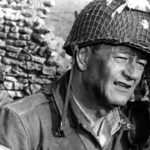
John Wayne

John Ford, John Wayne and Grierson’s Raid

YouTube Preview Image

Well, you Yankees and your holy principle about savin’ the Union. You’re plunderin’ pirates that’s what. Well, you think there’s no Confederate army where you’re goin’. You think our boys are asleep down here. Well, they’ll catch up to you and they’ll cut you to pieces you, you nameless, fatherless scum. I wish I could be there to see it.

   Miss Hannah Hunter of Greenbriar, portrayed by Constance Towers in The Horse Soldiers 


One of my commenters at Almost Chosen People, the American history blog I run with Paul Z, noted my post on movies for a Memorial Day weekend and directed me to a review he had written of The Horse Soldiers (1959), the classic retelling of Grierson’s Raid during the Civil War by John Ford, and the last of the “cavalry collaboration” films between Ford and John Wayne.  I enjoyed the review, and Fabio Paolo Barbieri, the author, has given me permission to repost it here:

 John Ford’s THE HORSE SOLDIERS.  About half of this movie is one of the greatest war films ever done; indeed, one of the greatest that can possibly be made – more, perhaps, may be made, but not better.  It would, in my view, be impossible to give a better, a more painful, a more affecting and tragic view of war.  War is one of the greatest subjects in the arts, and it affords a virtually infinite field for reflection and for emotion; and it is my view – or rather, I think, my experience, that the authors of this movie reached to its very bottom.  More ketchup sauce, more plastic severe limbs, more and more savage special effects, could not possibly increase its impact, because that impact is not on the gut and the nerves, but on the emotions and on the mind.  It is a work of thought, as well as of magisterial narrative control.

 
(That, incidentally, is why I find The Bridge on the River Kwai overrated.  It collapses at its very last frame, when the American character describes everything that has gone on until then as “madness, madness”.  Whatever its implications and its emotional content, it clearly was not madness; and the impact of those final words is that of a simple refusal to think about what the movie had shown – an inexcusable retreat into irrationalism.  That any reflection would be very painful is an explanation but not an excuse.)

 
Great narrative artists think in plot structure, and the plot structure of that half of The Horse Soldiers - the significant half, the masterpiece half – is both unique and extraordinarily well realized.  The climax of the story is not where we expect it to be; and both the false and the true climax are worked up to with exacting, time-burning care, for maximum impact.  The story concerns a U.S. cavalry raid – said to be a real historical event – to destroy an important Confederate railway line and depot and so deny besieged Vicksburg vitally needed supplies.  The cavalry column, led by a former railway worker promoted to Colonel on the battlefield, will be moving from beginning to end in enemy territory, and have to keep its mission secret down to the very moment in which it will accomplish it.  The movie does an excellent job of displaying the difficulties and the dreadful exhaustion of such a mission; indeed, it is typical of the way in which every narrative element is used to build up, that the meeting of officers with which it starts takes place in a downpour  – this immediately informs us that this mission will be no joy ride.  (And because John Ford is economical and does not abuse story elements, the downpour is not repeated – although the cavalrymen enjoy the pleasures of forced marching, bug swarms, swamp rides, injuries, amputations without anaesthetic, fever, battle deaths, sunstroke and exhaustion.  To inform the public that this story is to be taken seriously is one thing; to repeat oneself unnecessarily is another.)

 
Dodging Confederate forces and possible spies (but pausing to rescue one decent Southern sheriff from two villainous defectors – a charming scene), the cavalrymen reach their target, which they find virtually ungarrisoned, its few soldiers under the command of an armless veteran who once was the friend of one of the Union officers (a fine touch, reminding us of what a civil war actually does).  Indeed, just as they are sitting in the captured village, a Confederate train appears on the line – as if just coming to fall right into waiting Union hands.

 
It seems too good to be true, and it is.  Quick inquiries by the suspicious ex-railwayman colonel (John Wayne) bring out the fact that the captured enemy commander had been found in the telegraph office.  A minimum of rushed orders send the practiced Union veterans scurrying to set their own trap, around the only road down which the enemy must charge; and when the Confederate soldiers of which the train was full come charing out, they are met with murderous fire on all sides and slaughtered nearly to the last man.

 
As I said, there is no abuse of ketchup sauce or flying body part; this is not Quentin Tarantino.  But Ford makes damn well sure that we understand, first, that these are extraordinarily brave men – they go on charging at an impossibly entrenched enemy as long as there is one of them left standing; and, second, that their only reward for their bravery is agonizing death or lifelong deformity and mutilation.  Not only is the battle itself a model of perfect staging and shooting (indeed, throughout this movie, Ford’s always luminous photography reaches an especial pitch of inspiration), but he takes some considerable time after the battle scene to give us an account of the desperate and mostly unavailing medical care given the injured Confederates by medics of both sides.  At the same time, not to miss any opportunity for bitter and powerful contrasts, the Union cavalrymen are carefully destroying, with considerable and rowdy good humour, every bit of railway they can reach and the whole content of the local depot.

Continue reading

PinterestRedditPrintFriendlyShare

Father Matthew Munoz Talks About The Conversion of His Grandfather: John Wayne

YouTube Preview Image

Hattip to Matthew Archbold at Creative Minority Report.  I have written previously on the deathbed conversion of John Wayne:   John Wayne-Cardiac Catholic.  His grandson, Father Matthew Munoz, has recently talked about his grandfather’s conversion.

“My grandmother, Josephine Wayne Saenz, had a wonderful influence on his life and introduced him to the Catholic world,” said 46-year-old Fr. Muñoz, a priest of the Diocese of Orange in California.  

“He was constantly at Church events and fundraisers that she was always dragging him to and I think that, after a while, he kind of got a sense that the common secular vision of what Catholics are and what his own experience actually was, were becoming two greatly different things.”

Fr. Muñoz’s grandparents married in 1933 and had four children, the youngest of whom – Melinda – is his mother. The couple civilly divorced in 1945 although, as a Catholic, Josephine did not re-marry until after John Wayne’s death. She also never stopped praying for her husband’s conversion – a prayer which was answered in 1978. Continue reading

PinterestRedditPrintFriendlyShare

James Arness, Requiescat in Pace


YouTube Preview Image

For all of my childhood, James Arness, and the show he starred in, Gunsmoke, were a constant presence.  The television show, a sequel to the radio show of the same name, came on the air in 1955 and ran for 20 years.  I was born in 57 and graduated from high school in 75.  Each week my family would watch the show, even the reruns.  We  had a slight personal connection to the show, my grandfather, a shoemaker, making a pair of boots for James Arness to wear in his role of Matt Dillon.  Continue reading

PinterestRedditPrintFriendlyShare

The Horse Soldiers

YouTube Preview Image

In 1959 John Ford and John Wayne, in the last of their “cavalry collaborations”, made The Horse Soldiers, a film based on Harold Sinclair’s novel of the same name published in 1956, which is a wonderful fictionalized account of Grierson’s Raid.

Perhaps the most daring and successful Union cavaly raid of the war, Colonel Benjamin Grierson, a former music teacher and band leader from Jacksonville, Illinois, who, after being bitten by a horse at a young age, hated horses, led from April 17-May 2, 1863 1700 Illinois and Iowa troopers through 600 miles of Confederate territory from southern Tennessee to the Union held Baton Rouge in Louisiana.  Grierson and his men ripped up railroads, burned Confederate supplies and tied down many times their number of Confederate troops and succeeded in giving Grant a valuable diversion as he began his movement against Vicksburg.

The video at the beginning of the post shows an interview done of Harold Sinclair during the making of the film.  Go here to read a note by Sinclair at the beginning of his novel in which he describes the liberties taken in the novel from the historical events.

John Wayne gives a fine, if surly, performance as Colonel Marlowe, the leader of the Union cavalry brigade.  William Holden as a Union surgeon serves as a foil for Wayne.  Constance Towers, as a captured Southern belle, supplies the obligatory Hollywood love interest.

Overall the film isn’t a bad treatment of the raid, and the period.  I especially appreciated two scenes.  John Wayne refers to his pre-war activities as “Before this present insanity” and Constance Towers gives the following impassioned speech:

Well, you Yankees and your holy principle about savin’ the Union. You’re plunderin’ pirates that’s what. Well, you think there’s no Confederate army where you’re goin’. You think our boys are asleep down here. Well, they’ll catch up to you and they’ll cut you to pieces you, you nameless, fatherless scum. I wish I could be there to see it. Continue reading

PinterestRedditPrintFriendlyShare

Marines’ Hymn

YouTube Preview Image

Some people work an entire lifetime and wonder if they ever made a difference to the world. But the Marines don’t have that problem.

Ronald Reagan

Something for the weekend.  The oldest of the official songs of a branch of the US military, the composer of the Marines’ Hymn is unknown, but is thought to have been a Marine serving in Mexico during the Mexican War, hence the “Halls of Montezuma”.  The music is taken from the Gendarmes Duet from the Opera Genevieve de Brabant, written by Jacques Offenback in 1859.

Prior to 1929 the first verse used to end:

“ Admiration of the nation,
we’re the finest ever seen;
And we glory in the title
Of United States Marines”

which the then Commandant of the Marine Corps changed to the current lines.  On November 21, 1942,  Commandant Thomas Holcomb approved a change in the words of the first verse’s fourth line from “On the land as on the sea” to “In the air, on land, and sea”.

My favorite rendition of the hymn is in the movie The Sands of Iwo Jima (1949)  This film earned John Wayne his first Oscar nomination as best actor.  (Broderick Crawford would win for his stunning performance in All The King’s Men.)   Wayne was initially reluctant to take the role, partly because he had not fought in World War II, and partly because he saw script problems and didn’t like the character of Sergeant Styker as initially written in the screen play.  (There is evidence that Wayne, 34 at the time of Pearl Harbor, and with 3 kids, did attempt to volunteer in 1943 for the Marine Corps with assignment to John Ford’s OSS Field Photographic Unit, but was turned down.) 

Wayne was convinced to take the role because the film had the enthusiastic backing of the Marine Corps, which viewed it as a fitting tribute to the Marines who fought in the Pacific, and to help combat a move in Congress to abolish the Corps.  Marine Commandant Clifton B. Cates went to see Wayne to request that he take the role and Wayne immediately agreed.  (Thus began a long association of John Wayne with the Marine Corps, including Wayne narrating a tribute to Marine Lieutenant General Chesty Puller.)  

 Appearing in the film were several Marine veterans of the Pacific, including Colonel David Shoup, who earned a Medal of Honor for his heroism at Tarawa, and who would later serve as a Commandant of the Corps, and Lieutenant Colonel Henry Crow who led a Marine battalion at Tarawa.  The Marine Corp hymn is sung in the film after the death of Wayne’s character, one of ten films in which a Wayne character died, and as the raising of the flag is recreated. 

 Taking part in the flag raising were Rene Gagnon, Ira Hayes and John Bradley, the three survivors of the six flag raisers who survived the battle.  (The three men who raised the flag and subsequently died in the battle were Franklin Sousely, Harlon Block and Michael Strank.)  (First Lieutenant Harold Schrier, who led the flag raising party that raised the first, smaller, flag on Mount Suribachi, and who was awarded a Navy Cross and a Silver Star for his heroism on Iwo Jima, also appeared in the film.)  The flag on top of Mount Suribachi could be seen across the island, and was greeted with cheers by the Marines and blaring horns by the ships of the Navy.  A mass was said on Mount Suribachi at the time of the flag raising and I have written about that here.  Go here to see the ending of the Sands of Iwo Jima and listen to the Marines’ Hymn. Continue reading

PinterestRedditPrintFriendlyShare

When Masculine Virtues Go Out of Fashion

The following is a column written by Tom Hoffman of the American Thinker.

The culture war begun in the sixties has, in large part, been won by the left. Nowhere is this clearer than in the feminization of men. The virtues of manhood which had been extolled and celebrated throughout the middle ages right up to the 1950s have been completely expunged from academia and pop culture. The baby boom generation was the last to be taught the values of rugged individualism, risk-taking, courage, bravery, loyalty, and reverence for tradition. John Wayne epitomized the rugged individual who was committed to fighting “the bad guy,” but he was only one of a whole host of competing figures cut out of the same cloth. What happened?

Today, the Boy Scouts are fighting the last battle in a lost cause. Any man who stands up to the “women’s movement” is completely marginalized as a sexist and homophobe. These names have become just as stigmatizing as “racist” used to be. It is no wonder that women now are the majority of college graduates and are increasing their role in every institution from private enterprise to public service, including the military. Is this a healthy trend? The answer is clearly “no.”

Edward Gibbon chronicles the increasing femininity of the Roman Empire in his six-volume work, The Decline and Fall of the Roman Empire. He catalogues the progressive decadence that rendered the once-proud republic into spoils for barbarian hordes. The consuls in the early republic, who were warrior-generals adhering to a strict code of honor, gradually gave way to the backroom emperors who were no more than brazen criminals and thugs. It is the same script in all noble human enterprise: The fabric which bred success is torn apart by the complacency of the successful. When warfare is demonized as violence and negotiation is raised to an art, the end is near. Today, we are there.

Continue reading

PinterestRedditPrintFriendlyShare

The Three Godfathers

YouTube Preview Image

John Wayne in a Christmas movie?  Yep, The Three Godfathers in 1948!   Another fruitful John Ford and John Wayne collaboration, the film was released in December 1948.  Three bank robbers, John Wayne, Pedro Armedariz and Harry Carey, Jr.,  stumble across a dying woman and her newborn son in a desert in the American Southwest.  The three outlaws, although they are attempting to elude a posse, promise the dying woman to look after her son.

Continue reading

PinterestRedditPrintFriendlyShare

Bipartisan Hope

YouTube Preview Image YouTube Preview Image

Bob Hope was a Republican, but, above all, he was a comedian, and he never let politics stand in the way of a good punch line.  A death bed Catholic convert like John Wayne, he will be the subject of a future post here on AC.

PinterestRedditPrintFriendlyShare

John Wayne-Cardiac Catholic

YouTube Preview Image

John Wayne died on June 11, 1979.  Like many Americans at the time I felt as if a personal friend had died.  Growing up, Wayne was a part of my childhood both on TV and at the local theater.  Remarkably, three decades after his demise, he still routinely appears among the top ten favorite actors in polls.  For three and a half decades he dominated American film screens and became the archetypal Western hero.  Frequently savaged by film critics in his life, something which bothered him little, his appearance as a Centurion in the film The Greatest Story Ever Told, the video clip which begins this post, was a special target,  Wayne’s work has endured the test of time.  A staunch conservative, Wayne upheld a love of country when such love was popular and when it was unpopular.  Eventually he became a symbol of America, recognizable around the globe.  What is less known about Wayne is his religion, and, at the end, his conversion to Catholicism. Continue reading

PinterestRedditPrintFriendlyShare

Follow us!

Bookmark and Share

Subscribe by email!

Enter your email address:

Vatican Endorsed & Imprimatur

Recent Comments

RealCatholicTV.com

Digest of Top Posts in St. Blogs

Visitors to our website

Our Subscribers…

Archives

TAC works best with these browsers: