Dignity of Work
Employment for All: A Response
Last week, Alex of Christian Economics wrote a piece arguing, on the basis of both catholic social teaching and modern monetary theory, for the government to act as an employer of last resort. In this post, I’d like to respond to several aspects of his argument. This kind of exchange is always challenging as on the one hand I want to give the fullest possible justice to Alex’s argument, but on the other in an internet debate it seems impossible to respond to every point without both sides getting totally bogged down in novel-length posts. As such, this post will be comprised of several titled sections dealing with different aspects of Alex’s post which I thought most interesting to present counter-arguments to.
The Purpose of Unemployment: Why Looking For Work Is Work
Just a couple months into my first full time job, I was laid off. It was 2000 and the tech bubble was in the middle of bursting, and I was a college senior trying to work full time while finishing off my last few classes. The web hosting company that I was working for had built itself on an unsustainable business model so one day my whole office showed up to work and found out that every single one of us was laid off. Even though I was young enough and my expenses were low enough that I could weather joblessness fairly easily (despite not qualifying for unemployment since I hadn’t been working the job long enough) if was definitely one of the uncomfortable experiences of my working life. Looking at the job listings was infuriating — it seemed like there were dozens of jobs that I could do (and, of course many, many more which required experience or qualifications I didn’t have) but they remained steadfastly silent as I sent out applications and resumes. It only took me a few weeks to find a part-time job at similar wages, and only a month longer to find a full time job that actually paid slightly more than the job I’d been laid off from, but it seemed like a very long time.
I bring up the personal angle because it seems to me that job searching serves very different purposes for the individual job hunter and for society as a whole. Continue reading
Union Impressions: Rules vs. Work
All of the discussion in the Catholic blogosphere, and the wider public square, about unions (and public employee unions in particular) has given me cause to think a bit about my attitude towards organized labor. There are a lot of rational political, economic and moral reasons I can give for why I don’t like labor unions as they exist in the US, but as is so often the case with deeply held opinions, my most basic reaction to unions has a lot to do with my personal experiences relation to work and to unions. As such, it seemed like a good way to address the issue is through the lens of the experiences which have helped shape my opinion of unionization.
1. Most of my exposure to unions was through my father, who held a staff position at a community college for twenty-five years, retiring just a month before losing a multi-year battle with cancer. (In a state college, the major divide is between staff — which includes basically everyone who is neither an instructor nor a manager — and faculty, who are the actual instructors. Since he only had a bachelor’s degree, Dad’s position was classified as staff, and staff positions were represented by a state school employees union which is a member of the AFL-CIO.) The college was not unionized when Dad got his job, but it became a union shop half-way through his time there, via an election which he always wondered about the validity of. (Union members and non-union members were given different colored ballots, so it certainly would have been easy to cheat if someone had wanted to.) Not only were the union’s politics diametrically opposed to my father’s (he always used their “state issues” political mailing to decide how not to vote) but the union supported people for the college board of directors who hired a college president who eventually drove the college into the financial ditch, resulting in constant fear and occasional layoffs. His more daily frustration, however, was the effect of the union’s vigorous protection of people who did not do their jobs well.
Continue reading
John Mackey on Capitalism and Running a Business
Whole Foods CEO John Mackey attracted quite a bit of ire a few months back when he wrote an editorial for the Wall Street Journal in which he advocated that Obama and the congress consider an approach to health care reform similar to the health benefits which Whole Foods provides its employees (centered around high deductible coverage and health savings accounts.) Within days, several progressive sites were calling for boycotts of Whole Foods, seeing Mackey as giving aid to anti-Obama forces. Mackey himself is somewhat bemused by the firestorm his editorial caused.
“President Obama called for constructive suggestions for health-care reform,” he explains. “I took him at his word.” Mr. Mackey continues: “It just seems to me there are some fundamental reforms that we’ve adopted at Whole Foods that would make health care much more affordable for the uninsured.”
Though he’s not gunning to cause any more controversies, Mackey has an interesting weekend interview in the Journal where he talks, among other things, about his philosophy regarding capitalism and business, and how it’s changed over the years since he founded Whole Foods with $45,000 in friends and family-raised seed funding in 1978.
“Before I started my business, my political philosophy was that business is evil and government is good. I think I just breathed it in with the culture. Businesses, they’re selfish because they’re trying to make money.”
Continue reading
Subsidiarity at Work

Everyone here at the American Catholic hoped that you all have had a happy Labor Day weekend.
The principle of Subsidiarity states that government should undertake only those initiatives which exceed the capacity of individuals or private groups acting independently.
Pope Leo XIII developed the principle in his AD 1891 encyclical Rerum Novarum. The principle was further developed by Pope Pius XI in his AD 1931 encyclial Quadragesimo Anno.
_._
To learn more about Subsidiarity click here.
To read Pope Leo XIII’s encyclical Rerum Novarum click here.
To read Pope Pius XI‘s encyclical Quadragesimo Anno click here.
For more Dilbert funnies click here.
The Dignity of the Working Man
It is perhaps not a bad time to devote a few thoughts to the dignity of work. Work is not always seen in a wholly positive light. Many of us don’t like going to work, and the rigors of labor are reflect in Adam’s curse, when after the fall he is told that he shall eat only by the sweat of his brow, struggling to win sustenance from an unfriendly soil.
Yet we also recognize that that is an essential dignity to labor. Through labor we meet the essential needs of life, and labor is frequently a service: Husbands and wives labor for each others’ sake, parents labor to support children, we share the fruits of our labor with our churches, with the less fortunate, with our friends and family. We rightly take great pleasure and pride in serving others this way. As a father, even the most tiresome or repetitive task can be a source of satisfaction to me when I know that by this means I am providing for the needs and pleasures of my wife and children.
Continue reading
Saint Isidore the Laborer

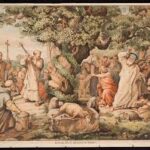
On this day on which we celebrate the workers of America, it is good to recall a simple day laborer who became one of Spain’s most beloved saints. Also known as Saint Isidore the farmer, he was born around 1170 and lived his entire life in the vicinity of Madrid, in service as a farm laborer to the family of Juan de Vargas. Some of his fellow workers complained to Vargas that Saint Isidore was late for work due to his habit of attending Mass each day. Checking up on his worker, he found Saint Isidore praying while an angel was doing the plowing! Eventually Vargas made Saint Isidore bailiff of his entire estate. Tales of miracles surround Saint Isidore. One relates how he brought the daughter of his employer back to life. Another tells how he found water during a time of drought. He was noted for his charity to the poor and to animals.
Prayer to Saint Joseph the Workman

O Glorious St. Joseph, model of all those who are devoted to labor, obtain for me the grace to work conscientiously, putting the call of duty above my natural inclinations, to work with gratitude and joy, in a spirit of penance for the remission of my sins, considering it an honor to employ and develop by means of labor the gifts received from God, to work with order, peace, moderation and patience, without ever shrinking from weariness and difficulties, to work above all with purity of intention and detachment from self, having always death before my eyes and the account that I must render of time lost, of talents wasted, of good omitted, of vain complacency in success, so fatal to the work of God. All for Jesus, all through Mary, all after thine example, O Patriarch, St. Joseph. Such shall be my watch-word in life and in death.
Amen
Pope Saint Pius X
Pius XI on Catholic Social Teaching
From Divini Redemptoris:
55. To give to this social activity [that which was recommended in Quadragesimo Anno -- J.H.] a greater efficacy, it is necessary to promote a wider study of social problems in the light of the doctrine of the Church and under the aegis of her constituted authority. If the manner of acting of some Catholics in the social-economic field has left much to be desired, this has often come about because they have not known and pondered sufficiently the teachings of the Sovereign Pontiffs on these questions. Therefore, it is of the utmost importance to foster in all classes of society an intensive program of social education adapted to the varying degrees of intellectual culture. It is necessary with all care and diligence to procure the widest possible diffusion of the teachings of the Church, even among the working-classes. The minds of men must be illuminated with the sure light of Catholic teaching, and their wills must be drawn to follow and apply it as the norm of right living in the conscientious fulfillment of their manifold social duties. Thus they will oppose that incoherence and discontinuity in Christian life which We have many times lamented. For there are some who, while exteriorly faithful to the practice of their religion, yet in the field of labor and industry, in the professions, trade and business, permit a deplorable cleavage in their conscience, and live a life too little in conformity with the clear principles of justice and Christian charity. Such lives are a scandal to the weak, and to the malicious a pretext to discredit the Church. (emphasis added)
Divini Redemptoris is an excellent supplement to Quadragesimo Anno and yet another example of the brilliance of Pope Pius XI.
Overwork in the Age of Multi-tasking
The weekend’s WSJ had an interesting article about work hours — the hours that people think they work, and the hours they actually do.
Over the past two decades of rapid technological deployment and globalization, it has become an article of faith among the professional set that we work sweatshop hours. Sociologist Juliet Schor started the rumor with her 1992 book, “The Overworked American,” which featured horror stories of people checking their watches to know what day it was.
Then God created the BlackBerry and things got worse. In late 2005, Fortune’s Jody Miller claimed that “the 60-hour weeks once thought to be the path to glory are now practically considered part-time.” In late 2006, the Harvard Business Review followed up with an article on “the dangerous allure of the 70-hour workweek,” calling jobs that required such labor the new standard for professionals. The authors featured one “Sudhir,” a financial analyst who claimed to work 90-hour weeks during summertime, his “light” season. He’s got nothing on a young man I met at a party recently who told me he was working 190 hours a week to launch his new company.
It was a curious declaration; I would certainly invest in a start-up that had invented a way to augment the 168 hours that a week actually contains.
Dehumanizing Work and Obstructionary Unions
When looking at the economic crater which is the US auto industry, liberals have a tendency to blame “big business” while conservatives tend to blame the UAW’s stranglehold on the big three. Both are right to an extent. Detroit’s current straights are the result of bad strategic decisions, bad design, bad regulation and the immense financial drag of pension and health benefit promises made to its workers back in the 60s and 70s when the US auto industry reigned supreme in the world, and promising future payouts seemed no object. In this last regard, the unions had quite a hand in planting the seeds of their own fall. And although they’re striven to be more flexible in recent years, union work rules still provide major obstacles to change in union plants.
The problem, he argues, is not just the high level of benefits that the United Auto Workers has secured for its members but the work rules—some 5,000 pages of them—it has imposed on the automakers. As Kaus points out, unionism as established by the Wagner Act is inherently adversarial. The union once certified as bargaining agent has a duty not only to negotiate wages and fringe benefits but also to negotiate work rules and to represent workers in constant disputes about work procedures.
The plight of the Detroit Three auto companies raises the question of why people ever thought this was a good idea.
The answer to that question which he provides is interesting, and I think illustrative for those seeking a proper understanding of the dignity of work in its relationship to unionism and good business practices:
(4 hours ago)
(5 hours ago)
(7 hours ago)
(8 hours ago)
(8 hours ago)
(8 hours ago)
(10 hours ago)
(10 hours ago)
(11 hours ago)
(11 hours ago)
(11 hours ago)
(11 hours ago)
(1 days ago)
(1 days ago)
(1 days ago)
(1 days ago)
(1 days ago)
(1 days ago)
(1 days ago)
(1 days ago)
(1 days ago)
(1 days ago)
(1 days ago)
(1 days ago)