Constitutional Law

The Left Suddenly Uncomfortable with Concept of Judicial Review

Don has covered President Obama’s not too subtle threat to the Court that it not dare strike down all or even part of Obamacare.  Yesterday he somewhat toned down his remarks, but still managed to step in it.

At an appearance this afternoon, a reporter asked Obama a question following up on yesterday’s comments: “Mr. President, you said yesterday that it would be ‘unprecedented’ for a Supreme Court to overturn laws passed by an elected Congress. But that is exactly what the court’s done during its entire existence. If the court were to overturn the individual mandate, what would you do, or propose to do, for the 30 million people who wouldn’t have health care after that ruling?”

Obama’s answer to the question was that he expects to win in court, and “as a consequence, we’re not spending a whole bunch of time planning for contingencies.” He went on to talk at some length about the “human element”–that is, people who would supposedly suffer in the absence of ObamaCare. Message: Obama cares, though not enough to spend “a whole bunch of time planning for contingencies.”

But the most interesting part of his answer was the beginning, in which he tried to walk back, or at least clarify, his statement from yesterday. He spoke slowly, with long pauses, giving the sense that he was speaking with great thought and precision: “Well, first of all, let me be very specific. Um [pause], we have not seen a court overturn [pause] a [pause] law that was passed [pause] by Congress on [pause] a [pause] economic issue, like health care, that I think most people would clearly consider commerce. A law like that has not been overturned [pause] at least since Lochner,right? So we’re going back to the ’30s, pre-New Deal.”

As James Taranto points out, this response is wrong on multiple levels.  The case that Obama cites in fact pre-dates the New Deal by a good thirty year.  Second, the full title of the case – Lochner vs. New York – tells us that this was a case involving state law, not federal legislation.  As Taranto further explains, there have been plenty of Supreme Court cases in which the high court struck down state laws, some dealing with economic matters.  And there of course have been plenty of cases where the Court has in fact declared federal statutes unconstitutional.  In fact two cases in the late 90s – US v. Lopez and US v. Morrison – directly implicated the commerce clause, and in both cases the Court rendered a 5-4 decision overturning acts of Congress which relied upon the commerce clause for their justification.

But other than that, I guess Obama was spot on.

The broader issue, other than Obama’s seeming ignorance of constitutional law, is that the left has suddenly decided that they don’t much care for this concept of judicial review. Continue reading

PinterestRedditPrintFriendlyShare

Hollow Victories

There is some excitement that oral arguments are going well for opponents of Obamacare.  Though oral arguments are not perfectly indicative of how the Supreme Court will vote in the end, there is some cause for guarded optimism.  That being said, even if the Court completely strikes down Obamacare, it will be something of a hollow victory.

Don’t get me wrong.  There is no other correct course of action for the Court to take than to strike down the individual mandate and thus effectively kill Obamacare.  It is one of those remarkable monstrosities that happens to be both bad policy and unconstitutional.  The problem is that something this monumental is essentially being decided on the whims of a single Justice.  How did we reach the point where our basic liberties come down to what Anthony Kennedy may have had for breakfast one day?

I don’t mean to be flip, but it feels like we’ve taken a very wrong turn somewhere along the line.  Continue reading

PinterestRedditPrintFriendlyShare

It is Time to Get Rid of Most Campaign Finance Laws

One of the big items today is news that the Romney campaign is bleeding cash.  Considering his all out assault first on Newt Gingrich, and now Rick Santorum, this comes as no surprise.  Yet while Romney spends more in a day than Santorum spent through most of the campaign thus far (only a slight exaggeration, I think), Santorum continues continues to poll ahead of Romney nationally and is neck-and-neck in Romney’s home state.  Of course Romney still has plenty in reserve thanks largely to his Super PAC.  Even Newt Gingrich’s fledgling campaign is still alive thanks to the generosity of one supporter funding a pro-Newt Super PAC.

These Super PACs have come under fire.  They are the indirect result of the McCain-Feingold campaign finance law, a law which itself amended the Federal Election Campaign Act (FECA), a law meant to restrict the amount of money that individuals could donate to individual candidates.  FECA created a two-tiered structure that basically divided federal contributions into two categories: hard money and soft money.  Professional sports fans probably recognize the terms as related to soft and hard caps, and it’s really the same concept. Under FECA individuals could only contribute $1,000 to a candidate per election cycle.  Yet there were no restrictions placed on “soft money,” meaning contributions to party committees.  This was the original end-run around campaign finance law.  Under the Bipartisan Campaign Reform Act (BCRA), or McCain-Feingold, individual contribution maxes to candidates were raised, but soft money contributions were phased out.  This, in turn, gave rise to other organizations, mainly 527s, which were able to raise unlimited amounts of money to air issue advocacy ads against candidates.  These various organizations are not technically affiliated with any candidate, and it is a violation of campaign finance law for candidates to collaborate in any way with these groups.

So is it time for another set of reforms?  Indeed it is.  And the reform is simple: repeal all these ridiculous (and arguably unconstitutional) provisions, and allow individuals to contribute whatever amount of money they want directly to candidates.

Continue reading

PinterestRedditPrintFriendlyShare

The Lemon Test Strikes Again!


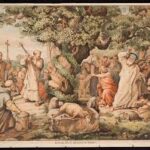
Senior Federal District Judge Ronald Lagueux, a 1986 Reagan appointee, has ordered the Cranston High School in Cranston, Rhode Island to remove a mural, pictured above, depicting a school prayer.  The mural had been in the school since 1963.  The suit, as is usual in these modern iconoclastic cases, was brought by the American Civil Liberties Union on behalf of an atheist student and her father, Mark Ahlquist.  Jessica Ahlquist, the 16 year old atheist who brought the suit, has become an atheist celeb on atheist sites on the internet.  She doesn’t think much of the Catholic Church, is indeed a fallen away Catholic, and Cranston is 90% Catholic, so this suit was her way, actually I suspect more her father’s way, to poke a stick in the eye of local Catholics.  Go here to read the opinion.  Judge Lagueux’s decision is notable for its overall reliance on the Lemon test, and I will leave to Justice Scalia below to set forth my views of that court created doctrine.

In few areas of the law has the Constitution been more twisted and deformed than in the area of First Amendment allowance of religious expression in schools.  Justice Scalia gave a useful summary in 1993 in the Lamb’s Chapel v. Moriches Union Free School District case:

As to the Court’s invocation of the Lemon test: Like some ghoul in a late night horror movie that repeatedly sits up in its grave and shuffles abroad, after being repeatedly killed and buried, Lemon stalks our Establishment Clause jurisprudence once again, frightening thelittle children and school attorneys of Center Moriches Union Free School District. Continue reading

PinterestRedditPrintFriendlyShare

Constitution, Shmonstitution

President Obama does his best Hugo Chavez impression as he chucks the U.S. Constitution for election gain.

Election 2012 can’t come soon enough for this tin teapot to get booted out of office.

Continue reading

PinterestRedditPrintFriendlyShare

Activism! They Cried

The reaction to Judge Hanson’s ruling in Virginia v. Sebelius was predictable:  rejoicing on the right . . . not so much on the left.  A few people actually attempted to analyze the decision on a legal, rather than policy basis.  (Shocking!)

It’s also not surprising in the least to hear the talking point going out – like on the appropriately named Talking Points Memo blog linked above – that this demonstrates conservative hypocrisy with regards to judicial activism.  After all, don’t conservatives bemoan activist judges who overturn the will of democratic legislatures?  This would be a fair point if it actually captured the gist of conservative sentiment on judicial matters.

Happily for us all I wrote a post some two and a half years back detailing why I didn’t like the term judicial activism.  I’ll re-post most of it here. Continue reading

PinterestRedditPrintFriendlyShare

Constitutional Ignorance

I see that my co-blogger MJ Andrew has already posted about the Christine O’Donnell-Chris Coons debate, and I thank him as that saves me the trouble of having to sort through a whole bunch of links.

I disagree with him, though somewhat reservedly.  Having listened to the entire clip it does seem to me that O’Donnell is questioning whether the concept of the separation of Church and State is in the First Amendment, not the Establishment Clause.  There was some crosstalk at this point in the debate, and it appears to me that she’s just repeating her question with regards to the issue of separation.  It’s debatable, though, and a candidate should do a better job clearly establishing what she’s talking about in such a setting.

That being the case,  I was more intrigued by  Coons’s own response to the question.  While O’Donnell possibly made a gaffe – an unfortunate one if indeed it was a gaffe – Coons’s response is the more troubling aspect of this exchange. Continue reading

PinterestRedditPrintFriendlyShare

Sharia Law and the U.S. Constitution

[Update I:  I have streamlined the following post to be easily readable to the average layman, but informative enough for a lawyer or law professor to learn a bit more on the similarities and differences between Sharia and U.S. Law]

Is Sharia compatible with the U.S. Constitution?

The simple answer is of course “no”.

But lets take a look at some aspects of Sharia Law and where it may or may not conflict with the U.S. Constitution.  (For disclosure I am not a lawyer nor a legal expert in Sharia or U.S. Law.)

First, what is Sharia?

Wikipedia states Sharia refers to the sacred law of Islam.  All Muslims believe Sharia is God’s law, but they have differences between themselves as to exactly what it entails.  Which will be difficult to discern what to apply when, but we’ll labor along for the sake of discussion.

In Western countries, where Muslim immigration is more recent, Muslim minorities have introduced Sharia family law, for use in their own disputes. Attempts to impose Sharia have been accompanied by controversy, violence, and even warfare (Second Sudanese Civil War).

The recent incidents at the Arab International Festival have reinforced the poor image of Sharia inside the United States and its incompatibility with American culture and law.

The following is a truncated version with a couple of modifications (eliminating repetitious ibids and links) of multiple Wikipedia entries [with my comments]:

Legal and Court Proceedings:

Wikipedia states that Sharia judicial proceedings have significant differences with other legal traditions, including those in both common law and civil law.

1. Sharia courts do not generally employ lawyers; plaintiffs and defendants represent themselves.

Continue reading

PinterestRedditPrintFriendlyShare

Sharia in Dearborn?

YouTube Preview Image

Apparently the police acting to unconstitutionally arrest individuals attempting to hand out proselytizing literature to Muslims in Dearborn is not unusual according to this release from the Thomas More Law Center:

In what some have described as police enforcement of Sharia law at the annual Dearborn Arab International Festival, last Friday night Dearborn Police Officers arrested four Christian missionaries and illegally confiscated their video cameras which were recording the events surrounding their arrests.  The Thomas More Law Center, a public interest law firm based in Ann Arbor, Michigan, today announced it is representing all of the Christian missionaries.

Continue reading

PinterestRedditPrintFriendlyShare

Follow us!

Bookmark and Share

Subscribe by email!

Enter your email address:

Vatican Endorsed & Imprimatur

Recent Comments

RealCatholicTV.com

Digest of Top Posts in St. Blogs

Visitors to our website

Our Subscribers…

Archives

TAC works best with these browsers: