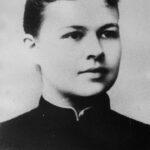
Blessed John Henry Cardinal Newman

Cardinal Newman on the Assumption

YouTube Preview Image

AS soon as we apprehend by faith the great fundamental truth that Mary is the Mother of God, other wonderful truths follow in its train; and one of these is that she was exempt from the ordinary lot of mortals, which is not only to die, but to become earth to earth, ashes to ashes, dust to dust. Die she must, and die she did, as her Divine Son died, for He was man; but various reasons have approved themselves to holy writers, why, although her body was for a while separated from her soul and consigned to the tomb, yet it did not remain there, but was speedily united to her soul again, and raised by our Lord to a new and eternal life of heavenly glory.

And the most obvious reason for so concluding is this—that other servants of God have been raised from the grave by the power of God, and it is not to  be supposed that our Lord would have granted any such privilege to anyone else without also granting it to His own Mother.

We are told by St. Matthew, that after our Lord’s death upon the Cross “the graves were opened, and many bodies of the saints that had slept”—that is, slept the sleep of death, “arose, and coming out of the tombs after His Resurrection, came into the Holy City, and appeared to many.” St. Matthew says, “many bodies of the Saints”—that is, the holy Prophets, Priests, and Kings of former times—rose again in anticipation of the last day.

Can we suppose that Abraham, or David, or Isaias, or Ezechias, should have been thus favoured, and not God’s own Mother? Had she not a claim on the love of her Son to have what any others had? Was she not nearer to Him than the greatest of the Saints before her? And is it conceivable that the law of the grave should admit of relaxation in their case, and not in hers? Therefore we confidently say that our Lord, having preserved her from sin and the consequences of sin by His Passion, lost no time in pouring out the full merits of that Passion upon her body as well as her soul. Continue reading

Cardinal Newman on Lent


Is it not, I say, quite a common case for men and for women to neglect religion in their best days? They have been baptized, they have been taught their duty, they have been taught to pray, they know their Creed, their conscience has been enlightened, they have opportunity to come to Church. This is their birthright, the privileges of their birth of water and of the Spirit; but they sell it, as Esau did. They are tempted by Satan with some bribe of this world, and they give up their birthright in exchange for what is sure to perish, and to make them perish with it. Esau was tempted by the mess of pottage which he saw in Jacob’s hands. Satan arrested the eyes of his lust, and he gazed on the pottage, as Eve gazed on the fruit of the tree of knowledge  of good and evil. Adam and Eve sold their birthright for the fruit of a tree—that was their bargain. Esau sold his for a mess of lentils—that was his. And men now-a-days often sell theirs, not indeed for any thing so simple as fruit or herbs, but for some evil gain or other, which at the time they think worth purchasing at any price; perhaps for the enjoyment of some particular sin, or more commonly for the indulgence of general carelessness and spiritual sloth, because they do not like a strict life, and have no heart for God’s service. And thus they are profane persons, for they despise the great gift of God. Continue reading

Pope Paul VI and the Smoke of Satan


(When we went with our new format in November of last year, some of our earlier posts didn’t carry over, including this one.  I am republishing it today with some slight modifications so that it may not be lost in internet oblivion eventually, and in the spirit of Blessed John Henry Cardinal Newman’s Advent series of sermons on the Anti-Christ which may be viewed here, here, here and here.  I have always thought that Advent is a good time to look at evil, since it is at this time of the year that we are reminded of the ultimate triumph of good through Christ.)


I have long heard about Pope Paul VI having referred to the “smoke of Satan” having entered the Church.  Usually most references to it do not mention when it was said and in what context.  The quote apparently was said on June 29, 1972 by Pope Paul VI on the ninth anniversary of his coronation during a homily given at a mass for the solemnity of Saint Peter and Saint Paul.  The Italian text is here.  As far as I know there is no official translation.  On November 13, 2006 Jimmy Atkin posted at his blog  a translation done of the homily by Father Stephanos Pedrano.  Please note that the text that is translated is a summary of what the Pope said and not a word for word transcript of what the Pope said.  Father Pedrano’s translation is as follows (I have placed in red the portion of the text that refers to Satan): Continue reading

40 Martyrs of England and Wales and Cardinal Newman

YouTube Preview Image

In so many ways we moderns are pygmies who stand on the shoulders of giants.  One group of giants for all English-speaking Catholics is the 40 martyrs of England and Wales who were canonized by Pope Paul VI on October 25, 1970.   They deserve to be remembered for their heroic deaths for Christ, and here are their names:

3 Carthusians:

  • Augustine Webster  d.1535
  • John Houghton  1486-1535
  • Robert Lawrence   d.1535

1 Augustinian friar:

  • John Stone  d. 1538

1 Brigittine:

  • Richard Reynolds  d. 1535

2 Franciscans:

  • John Jones   d. 1598 (Friar Observant – also known as John Buckley, John Griffith, or Godfrey Maurice)
  • John Wall   d. 1679 (Franciscan  – known at Douai and Rome as John Marsh, and by other aliases while on the mission in England)

3 Benedictines:

  • John Roberts   d. 1610
  • Ambrose Barlow  d. 1641
  • Alban Roe   d. 1642

10 Jesuits:

  • Alexander Briant   1556-81
  • Edmund Campion   1540-81
  • Robert Southwell   1561-95
  • Henry Walpole    1558-95
  • Nicholas Owen   1540-1606
  • Thomas Garnet    1575-1608
  • Edmund Arrowsmith  1585–1628
  • Henry Morse   1595-1644
  • Philip Evans   1645-79
  • David Lewis   1616-79

13 Priests of the Secular Clergy:

  • Cuthbert Mayne   1543–77
  • Ralph Sherwin    1558-81
  • Luke Kirby    1549-82
  • John Paine    d. 1582
  • John Almond    d. 1585
  • Polydore Plasden    d. 1591
  • Eustace White   1560-91
  • Edmund G(J)ennings   1567-91
  • John Boste    1544-94
  • John Southworth   1592-1654
  • John Kemble    1599-1679
  • John Lloyd     d. 1679
  • John Plessington   d. 1679

7 members of the laity

4 lay men:

  • Richard Gwyn  1537-84
  • Swithun Wells  1536-91
  • Philip Howard  1557-95
  • John Rigby  1570-1600   and

3 lay women, all of them mothers:

  • Margaret Clitherow  1586
  • Margaret Ward  1588
  • Anne Line  1601

They were torches that God sent to us to light our way in a frequently dark world.  They were representatives of hundreds of martyrs who died for the Faith in England and Wales in the Sixteenth and Seventeenth Centuries.  With the Anglican Ordinariate established by Pope Benedict perhaps what Blessed John Henry Cardinal Newman said in the Nineteenth Century will come true in the Twenty-First: Continue reading

Cardinal Newman on Lying and Equivocation

The Catholic blogosphere has been ablaze recently with discussions revolving around the actions of Lila Rose and Live Action and their sting operation against Worse Than Murder, Inc, with some bloggers like our own Joe Hargrave condemning these tactics since they involved lying, and other bloggers such as myself holding that there is nothing morally wrong with the tactics used in the sting.  I certainly do not wish to raise from the dead this well flogged horse, but I thought our readers might find interesting a fascinating overview of lying, equivocation and morality in Note G of Blessed John Henry Cardinal Newman’s Apologia Pro Vita Sua.  It is a typical tour de force by Newman where he demonstrates his knowledge of the history, reasoning and practical application of a Church teaching on morality.  Here is the note:

ALMOST all authors, Catholic and Protestant, admit, that when a just cause is present, there is some kind or other of verbal misleading, which is not sin. Even silence is in certain cases virtually such a misleading, according to the Proverb, “Silence gives consent.” Again, silence is absolutely forbidden to a Catholic, as a mortal sin, under certain circumstances, e.g. to keep silence, when it is a duty to make a profession of faith.

Another mode of verbal misleading, and the most direct, is actually saying the thing that is not; and it is defended on the principle that such words are not a lie, when there is a “justa causa,” as killing is not murder in the case of an executioner.

Another ground of certain authors for saying that an untruth is not a lie where there is a just cause, is, that veracity is a kind of justice, and therefore, when we have no duty of justice to tell truth to another, it is no sin not to do so. Hence we may say the thing that is not, to children, to madmen, to men who ask impertinent questions, to those whom we hope to benefit by misleading.

Another ground, taken in defending certain untruths, ex justâ causâ, as if not lies, is, that veracity is for the sake of society, and that, if in no case whatever we might lawfully mislead others, we should actually be doing society great harm.

Another mode of verbal misleading is equivocation or a play upon words; and it is defended on the theory that to lie is to use words in a sense which they will not bear. But an equivocator uses them in a received sense, though there is another received sense, and therefore, according to this definition, he does not lie.

Others say that all equivocations are, after all, a kind of lying,—faint lies or awkward lies, but still lies; and some of these disputants infer, that therefore we must not equivocate, and others that equivocation is but a half-measure, and that it is better to say at once that in certain cases untruths are not lies.

Others will try to distinguish between evasions and equivocations; but though there are evasions which are clearly not equivocations, yet it is very difficult scientifically to draw the line between the one and the other.

To these must be added the unscientific way of dealing with lies,—viz. that on a great or cruel occasion a man cannot help telling a lie, and he would not be a man, did he not tell it, but still it is very wrong, and he ought not to do it, and he must trust that the sin will be forgiven him, though he goes about to commit it ever so deliberately, and is sure to commit it again under similar circumstances. It is a necessary frailty, and had better not be thought about before it is incurred, and not thought of again, after it is well over. This view cannot for a moment be defended, but, I suppose, it is very common.
I think the historical course of thought upon the matter has been this: the Greek Fathers thought that, when there was a justa causa, an untruth need not be a lie. St. Augustine took another view, though with great misgiving; and, whether he is rightly interpreted or not, is the doctor of the great and common view that all untruths are lies, and that there can be no just cause of untruth. In these later times, this doctrine has been found difficult to work, and it has been largely taught that, though all untruths are lies, yet that certain equivocations, when there is a just cause, are not untruths. Continue reading

Newman: Reflections at the Beginning of Advent


“Thine eyes shall see the King in his beauty: they shall behold the land that is very far off.” Isaiah xxxiii. 17.

 YEAR after year, as it passes, brings us the same warnings again and again, and none perhaps more impressive than those with which it comes to us at this season. The very frost and cold, rain and gloom, which now befall us, forebode the last dreary days of the world, and in religious hearts raise the thought of them. The year is worn out: spring, summer, autumn, each in turn, have brought their gifts and done their utmost; but they are over, and the end is come. All is past and gone, all has failed, all has sated; we are tired of the past; we would not have the seasons longer; and the austere weather which succeeds, though ungrateful to the body, is in tone with our feelings, and acceptable. Such is the frame of mind which befits the end of the year; and such the frame of mind which comes alike on good and bad at the end of life. The days have come in which they have no pleasure; yet they would hardly be young again, could they be so by wishing it. Life is well enough in its way; but it does not satisfy. Thus the soul is cast forward upon the future, and in proportion as its conscience is clear and its perception keen and true, does it rejoice solemnly that “the night is far spent, the day is at hand,” that there are “new heavens and a new earth” to come, though the former are failing; nay, rather that, because they are failing, it will “soon see the King in His beauty,” and “behold the land which is very far off.” These are feelings for holy men in winter and in age, waiting, in some dejection perhaps, but with comfort on the whole, and calmly though earnestly, for the Advent of Christ. Continue reading

Follow TAC by Clicking on the Buttons Below
Bookmark and Share
Subscribe by eMail

Enter your email:

Recent Comments
Archives
Our Visitors. . .
Our Subscribers. . .