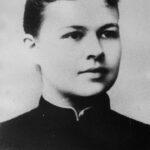
Archbishop John Carroll
Fortnight For Freedom Day 4: John Carroll, Bishop and Patriot
Nor, perchance did the fact which We now recall take place without some design of divine Providence. Precisely at the epoch when the American colonies, having, with Catholic aid, achieved liberty and independence, coalesced into a constitutional Republic the ecclesiastical hierarchy was happily established amongst you; and at the very time when the popular suffrage placed the great Washington at the helm of the Republic, the first bishop was set by apostolic authority over the American Church. The well-known friendship and familiar intercourse which subsisted between these two men seems to be an evidence that the United States ought to be conjoined in concord and amity with the Catholic Church.
Pope Leo XIII on John Carroll, first Bishop in the United States
Beginning for two weeks, up to Independence Day, the Bishops are having a Fortnight For Freedom:
We here at The American Catholic are participating in the Fortnight For Freedom with special blog posts on each day. This is the fourth of these blog posts.
From the beginning of our Republic, American Catholics were at the forefront of the battle to free America from British rule and to enshrine a committment to liberty in our founding documents. The remarkable Carroll family of Maryland was at the head of this effort by American Catholics. Charles Carroll of Carrollton signed the Declaration of Independence. His cousin Daniel Carroll signed both the Articles of Confederation and the Constitution. Daniel Carroll’s younger brother John Carroll, was the first bishop in the United States of America.
Born on January 8, 1735 in Maryland, he went abroad to study in Flanders and France, joined the Society of Jesus and was ordained a priest in 1769. With the suppression of the Jesuits in 1773, he returned to his native Maryland as a missionary priest. A patriot, he served on a diplomatic mission to Canada for the Continental Congress in 1776. During the War he continued his efforts as a missionary priest, along with efforts to persuade the new states to remove disabilities from Catholics in their new state constitutions. He was ever an advocate for religious freedom:
On June 6, 1784 he was appointed by the Pope as superior of the missions in the United States. On November 6, 1789, he was appointed by the Pope as Bishop, after being elected to the post by American priests, a procedure previously approved by the Pope. Continue reading
Bishop John Carroll, Joshua Barney and the Bonapartes
One of the difficulties that I often experience when preparing a post on a historical topic for the blog, is deciding what to leave out. Oftentimes I have far more material than I can put in a post, unless I want to transform the post into a treatise. In the case of my recent post on Joshua Barney, American naval hero of the American Revolution and the War of 1812, I had to leave out quite a bit on his life. One portion that I think might be of interest to our readers is his involvement with Jerome Bonaparte, brother to Napoleon Bonaparte.
God Bless America?
If were to ask you what some Catholic traditionalists and some radical leftists had in common, you might be left scratching your head for a few moments. On most matters you wouldn’t expect them to agree on much of anything. But there’s one issue they do tend to converge upon, and that is their take on American history.
When I read some Catholic trad descriptions of American history and Catholicism’s place in it, I find myself wondering if I’d accidentally picked up and began reading something by Charles Beard or Howard Zinn. I’m not associating these tendencies in order to delegitimize the Catholic trad critique – which contains, as do most critiques which catch on with at least some people, elements of truth. But the trad critique, in its shrillness and its refusal to engage historical facts that may falsify or at least cast reasonable doubt upon its substantive claims, deserves to be set alongside the vulgar leftist critique of American history. And bear in mind, I say this as a Catholic trad myself, albeit one who is more of a romanticist than a true reactionary.
I also say it as someone who once bought into this whole idea. As a young man emerging from a long and involved commitment to Marxism, both academic and political, into Catholicism, a religion I had little to do with since the age of 13, I had sort of stumbled upon this narrative on my own. There was still something romantic and alluring about rejecting “Americanism”, now from a Catholic perspective.
After all, the two critiques often make use of a lot of the same themes – a rejection of individualism, of bourgeois Protestant values, a savage critique of the Enlightenment, invocations of slavery and other manifestations of racism and inequality, and perhaps more specific to the Catholic angle, reminders of Freemasonry and the Illuminati (though to be fair, Mozart was a Freemason too, back in the days when it wasn’t yet forbidden by the Church. I don’t think that’s ever stopped a trad from enjoying his Requiem, but I digress).
Now, given the popularity of this critique, not only among trads, but also among the Catholic left, the “peace and justice” crowd – of course, for much different reasons and to much different ends – one would surely expect to find a solid foundation or at least an implied resonance within Church history, tradition, and teaching.
If you hold that expectation, prepare to be utterly disappointed. Or delighted, as the case may be.
Pope Benedict XVI congratulates President Barack Obama; Cardinal George proposes "an agenda for dialogue and action"
Text of Pope Benedict XVI’s telegram to the 44th president of the United States, Barack Obama:
The Honorable Barack Obama
President of the United States of America
The White House
Washington, D.C.
On the occasion of your inauguration as the Forty-fourth president of the United States of America I offer cordial good wishes, together with the assurance of my prayers that the Almighty God will grant you unfailing wisdom and strength in the exercise of your high responsibilities.


(1 hours ago)
(1 hours ago)
(2 hours ago)
(2 hours ago)
(2 hours ago)
(3 hours ago)
(3 hours ago)
(3 hours ago)
(3 hours ago)
(3 hours ago)
(3 hours ago)
(3 hours ago)
(3 hours ago)
(4 hours ago)
(4 hours ago)
(4 hours ago)
(4 hours ago)
(4 hours ago)
(4 hours ago)
(4 hours ago)
(4 hours ago)
(4 hours ago)
(4 hours ago)
(4 hours ago)