American Civil War
Pat Murphy of the Irish Brigade
Something for the weekend. Pat Murphy of the Irish Brigade sung by Bobby Horton, who has waged a one man crusade to bring Civil War music to modern audiences. Immigrants, especially Irish and German, were a mainstay of the Army of the Potomac, and wherever you have Irish fighting you are going to have Irish songs about the fighting.
For the great Gaels of Ireland
Are the men that God made mad,
For all their wars are merry,
And all their songs are sad.
G. K. Chesterton Continue reading
July 22, 1862: Lincoln Advises Cabinet of Emancipation Proclamation
One of the more momentous dates in American history. On July 22, 1862, President Lincoln stuns his cabinet by showing them a preliminary draft of the Emancipation Proclamation. Artist Francis Carpenter in February 1864 heard from Mr. Lincoln’s own lips about this cabinet meeting. This was appropriate since Carpenter spent six months in the White House immortalizing the scene for future generations in his painting First Reading of the Emancipation Proclamation by President Lincoln which is at the bottom of this post. Here is what Carpenter recalled Lincoln saying:
“It had got to be,” said he, “midsummer, 1862. Things had gone on from bad to worse, until I felt that we had reached the end of our rope on the plan of operations we had been pursuing; that we had about played our last card, and must change our tactics, or lose the game! I now determined upon the adoption of the emancipation policy; and, without consultation with, or the knowledge of the Cabinet, I prepared the original draft of the proclamation, and, after much anxious thought, called a Cabinet meeting upon the subject. This was the last of July, or the first part of the month of August, 1862.” (The exact date he did not remember.) “This Cabinet meeting took place, I think, upon a Saturday. All were present, excepting Mr. Blair, the Postmaster-General, who was absent at the opening of the discussion, but came in subsequently. I said to the Cabinet that I had resolved upon this step, and had not called them together to ask their advice, but to lay the subject-matter of a proclamation before them; suggestions as to which would be in order, after they had heard it read….. Various suggestions were offered. Secretary Chase wished the language stronger in reference to the arming of the blacks. Mr. Blair, after he came in, deprecated the policy, on the ground that it would cost the Administration in the fall elections. Nothing, however, was offered that I had not already fully anticipated and settled in my own mind, until Secretary Seward spoke. He said in substance: “Mr. President, I approve of the proclamation, but I question the expediency of its issue at this juncture. The depression of the public mind, consequent upon our repeated reverses, is so great that I fear the effect of so important a step. It may be viewed as the last measure of an exhausted government, a cry for help; the government stretching forth its hands to Ethiopia stretching forth her hands to the government.” His idea,” said the President, “was that it would be considered our last shriek, on the retreat.” (This was his precise expression.) “Now,’ continued Mr. Seward, ‘while I approve the measure, I suggest, sir, that you postpone its issue, until you can give it to the country supported by military success, instead of issuing it, as would be the case now, upon the greatest disasters of the war!’” Mr. Lincoln continued: “The wisdom of the view of the Secretary of State struck me with very great force. It was an aspect of the case that, in all my thought upon the subject, I had entirely overlooked. The result was that I put the draft of the proclamation aside, as you do your sketch for a picture, waiting for a victory.” Continue reading
John Ford, John Wayne and Grierson’s Raid
Well, you Yankees and your holy principle about savin’ the Union. You’re plunderin’ pirates that’s what. Well, you think there’s no Confederate army where you’re goin’. You think our boys are asleep down here. Well, they’ll catch up to you and they’ll cut you to pieces you, you nameless, fatherless scum. I wish I could be there to see it.
Miss Hannah Hunter of Greenbriar, portrayed by Constance Towers in The Horse Soldiers
One of my commenters at Almost Chosen People, the American history blog I run with Paul Z, noted my post on movies for a Memorial Day weekend and directed me to a review he had written of The Horse Soldiers (1959), the classic retelling of Grierson’s Raid during the Civil War by John Ford, and the last of the “cavalry collaboration” films between Ford and John Wayne. I enjoyed the review, and Fabio Paolo Barbieri, the author, has given me permission to repost it here:
John Ford’s THE HORSE SOLDIERS. About half of this movie is one of the greatest war films ever done; indeed, one of the greatest that can possibly be made – more, perhaps, may be made, but not better. It would, in my view, be impossible to give a better, a more painful, a more affecting and tragic view of war. War is one of the greatest subjects in the arts, and it affords a virtually infinite field for reflection and for emotion; and it is my view – or rather, I think, my experience, that the authors of this movie reached to its very bottom. More ketchup sauce, more plastic severe limbs, more and more savage special effects, could not possibly increase its impact, because that impact is not on the gut and the nerves, but on the emotions and on the mind. It is a work of thought, as well as of magisterial narrative control.
(That, incidentally, is why I find The Bridge on the River Kwai overrated. It collapses at its very last frame, when the American character describes everything that has gone on until then as “madness, madness”. Whatever its implications and its emotional content, it clearly was not madness; and the impact of those final words is that of a simple refusal to think about what the movie had shown – an inexcusable retreat into irrationalism. That any reflection would be very painful is an explanation but not an excuse.)
Great narrative artists think in plot structure, and the plot structure of that half of The Horse Soldiers - the significant half, the masterpiece half – is both unique and extraordinarily well realized. The climax of the story is not where we expect it to be; and both the false and the true climax are worked up to with exacting, time-burning care, for maximum impact. The story concerns a U.S. cavalry raid – said to be a real historical event – to destroy an important Confederate railway line and depot and so deny besieged Vicksburg vitally needed supplies. The cavalry column, led by a former railway worker promoted to Colonel on the battlefield, will be moving from beginning to end in enemy territory, and have to keep its mission secret down to the very moment in which it will accomplish it. The movie does an excellent job of displaying the difficulties and the dreadful exhaustion of such a mission; indeed, it is typical of the way in which every narrative element is used to build up, that the meeting of officers with which it starts takes place in a downpour – this immediately informs us that this mission will be no joy ride. (And because John Ford is economical and does not abuse story elements, the downpour is not repeated – although the cavalrymen enjoy the pleasures of forced marching, bug swarms, swamp rides, injuries, amputations without anaesthetic, fever, battle deaths, sunstroke and exhaustion. To inform the public that this story is to be taken seriously is one thing; to repeat oneself unnecessarily is another.)
Dodging Confederate forces and possible spies (but pausing to rescue one decent Southern sheriff from two villainous defectors – a charming scene), the cavalrymen reach their target, which they find virtually ungarrisoned, its few soldiers under the command of an armless veteran who once was the friend of one of the Union officers (a fine touch, reminding us of what a civil war actually does). Indeed, just as they are sitting in the captured village, a Confederate train appears on the line – as if just coming to fall right into waiting Union hands.
It seems too good to be true, and it is. Quick inquiries by the suspicious ex-railwayman colonel (John Wayne) bring out the fact that the captured enemy commander had been found in the telegraph office. A minimum of rushed orders send the practiced Union veterans scurrying to set their own trap, around the only road down which the enemy must charge; and when the Confederate soldiers of which the train was full come charing out, they are met with murderous fire on all sides and slaughtered nearly to the last man.
As I said, there is no abuse of ketchup sauce or flying body part; this is not Quentin Tarantino. But Ford makes damn well sure that we understand, first, that these are extraordinarily brave men – they go on charging at an impossibly entrenched enemy as long as there is one of them left standing; and, second, that their only reward for their bravery is agonizing death or lifelong deformity and mutilation. Not only is the battle itself a model of perfect staging and shooting (indeed, throughout this movie, Ford’s always luminous photography reaches an especial pitch of inspiration), but he takes some considerable time after the battle scene to give us an account of the desperate and mostly unavailing medical care given the injured Confederates by medics of both sides. At the same time, not to miss any opportunity for bitter and powerful contrasts, the Union cavalrymen are carefully destroying, with considerable and rowdy good humour, every bit of railway they can reach and the whole content of the local depot.
May 8, 1862: Battle of McDowell
Always mystify, mislead, and surprise the enemy, if possible; and when you strike and overcome him, never let up in the pursuit so long as your men have strength to follow; for an army routed, if hotly pursued, becomes panic-stricken, and can then be destroyed by half their number. The other rule is, never fight against heavy odds, if by any possible maneuvering you can hurl your own force on only a part, and that the weakest part, of your enemy and crush it. Such tactics will win every time, and a small army may thus destroy a large one in detail, and repeated victory will make it invincible.
General Thomas J. Jackson
True genius is a rarity on this planet, and it is amazing when it suddenly appears. Humans who display it often do so unexpectedly. So it was with Confederate General Thomas J. Jackson, nicknamed Stonewall, after the decisive role played by his forces at the battle of First Manassas (First Bull Run) in 1861. The name probably seemed appropriate to the few observers at the time who had followed his career. Jackson had a reputation as an unimaginative, albeit valiant, soldier. As a Professor of Natural Philosophy, Optics and Artillery Tactics (!) at VMI prior to the War he had a reputation as a deadly dull instructor who would repeat his lectures word for word if his students failed to grasp the lesson that he was teaching. He once spent a night in an office at VMI because his superior told him to wait for him, and then forgot about his appointment with Jackson. Other than his part in the victory at First Manassas, Jackson had distinguished himself mostly by being an almost fanatically strict disciplinarian. If genius were needed in the War, Jackson would not have been the man even those who admired him would turn to. Yes, the nickname Stonewall suited this stolid soldier.
It took the Valley Campaign of 1862,where he outmarched and outfought numerous Union armies, each larger than the force he led, for Jackson to astonish North and South with the fact that behind this dull facade lurked one of the Great Captains of History.
Jackson opened the Campaign on March 23, 1862 with an attack on part of General Nathaniel Bank’s Union forces in the Shenandoah at Kernstown. Outnumbered almost three to one, Jackson suffered a tactical defeat but a strategic victory. This attack by a Confederate force so far north in the Valley and so close to Washington caused Lincoln to take a division from the Army of the Potomac and send it to the Shenandoah, to cancel any plans to reinforce the Army of the Potomac with troops from the Shenandoah and to order that McDowell’s corps would stay close to Washington during the ensuing Peninsula Campaign, rather than advancing overland towards Richmond to help McClellan on the Virginia Peninsula. Few defeats have been so beneficial as First Kernstown (there was a second battle of Kernstown during the 1864 Valley Campaign) was for the Confederacy.
The Valley Campaign now entered a long quiet period during which Jackson’s command skirmished with the various Union forces beginning to mass against his army. On May 7, 1862 Jackson saw an opportunity on the southwestern fringe of the Valley as Fremont’s men under General Robert Milroy, consisting of three regiments, were in an exposed position south of McDowell. Milroy on Shenandoah Mountain escaped an attempted encirclement by Jackson and withdrew to McDowell. There he was joined at 10:00 AM on May 8th, by Brigadier General Robert Schenck and his command that had arrived with after a forced march from Franklin, West Virginia. Schenck being senior took command of the combined force of approximately 6500 opposing Jackson’s army of 6000. Fighting continued until dark with the Union force, which had been on attack most of the day, withdrawing in good order. Casualties were fairly light: 259 for the Union (34 killed, 220 wounded, 5 missing), and for the Confederates 420 (116 killed, 300 wounded, 4 missing). It could be argued that tactically the battle was a draw, but in the following week the Union force retreated back to Franklin with Jackson pursuing all the way, returning to the Valley on May 15, 1862. This turned what was a tactical draw into a strategic victory. More posts on the Valley Campaign during this May and June. Here is Jackson’s report on the battle of McDowell:
Continue reading
Surrender of New Orleans
The largest city of the Confederacy, New Orleans also controlled all shipment from the Mississippi and into the Mississppi. Even a cursory look at a map would indicate that New Orleans was a crucial city for the Confederacy and a crucial target for the Union. In early 1862 the Union assembled a force to take this prize: 18,000 soldiers commanded by Major General Benjamin Butler, and a naval armada under Flag Captain David G. Farragut, 6o years old, but possessed of energy that few men in their twenties possess, and a veteran of over half a century of service in the Navy.
In Mid-March Farragut began moving his fleet into the mouth of the Mississippi. The approach to New Orleans up the Mississippi was guarded by two Confederate forts: Jackson on the west bank and Saint Philip on the east bank. The Confederate defenses were aided on the river by three ironclads: the CSS Manassas, the CSS Mississippi, and the CSS Louisiana, backed up by an improvised fleet of converted merchant vessels, gunboats and rams, none of which stood any chance against the might of the Union fleet. If Farragut’s force was going to be stopped, it would have to be by the forts.
From April 18-April 23 the forts were bombarded by 26 mortar schooners under the command of Farragut’s foster brother Captain David Porter, with whom Farragut had an uneasy relationship. Porter had used his influence in Washington to require Farragut to give him the chance to reduce the forts by bombardment. Farragut was sceptical and he was right. Although the bombardment was fierce, the forts remained in action. On the 24th, Farragut successfully had his ships run past the forts, destroying the Confederate fleet in the process. Almost defenseless New Orleans surrendered to the fleet after three days of negotiation on April 29. Butler’s army took the forts bloodlessly on the 29th, aided by a mutiny of the Confederate troops at Fort Jackson. The richest strategic prize of the War fell to the Union swiftly, and with amazingly few casualties. Farragut was promoted to Rear Admiral for this feat, the first admiral in US history. The Union took a large step to victory with the fall of the Crescent City. Continue reading
Civil War Death Toll
“War means fighting. And fighting means killing.”
Lieutenant General Nathan Bedford Forrest
Hattip to my co-blogger Paul Zummo. One hundred and fifty years later we are still learning about the greatest war in US history, even in regard to such a basic fact of the conflict as the number of men killed in it:
For 110 years, the numbers stood as gospel: 618,222 men died in the Civil War, 360,222 from the North and 258,000 from the South — by far the greatest toll of any war in American history.
But new research shows that the numbers were far too low.
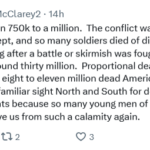
By combing through newly digitized census data from the 19th century, J. David Hacker, a demographic historian from Binghamton University in New York, has recalculated the death toll and increased it by more than 20 percent — to 750,000. Continue reading
April 3, 1862: Johnston Begins His March to Shiloh
It is rare for any soldier to attain the rank of general, but Albert Sidney Johnston managed that feat in three armies: rising from private to brigadier general in the army of the Republic of Texas, brevet brigadier general in the United States Army, and full general in the Confederate States Army. On April 3, 1862 he led his newly created Army of Mississippi out of the town of Corinth, Mississippi and began the march which would end in the surprise Confederate attack in the early morning of April 6, 1862, the beginning of the two day mammoth battle known to history as Shiloh.
The battle would result in the death of Johnston, his dying caused probably by his act of mercy in dispatching his personal surgeon to attend a wounded Union officer and none of his remaining staff having the presence of mind to fashion a tourniquet to stanch Johnston’s bleeding after he was wounded, and the fighting would inflict over 23,000 total Union and Confederate casualties, exceeding in two days all of the battlefield casualties in all of America’s wars prior to the Civil War. Shiloh told the nation, North and South, that this was going to be a very grim war, and that their adversary would fight it with all the strength and will that they could muster. After Shiloh the myth of a quick victorious war died on both sides.
Continue reading
The Russo-Union Alliance: A Marriage of Convenience
Our progress in degeneracy appears to me to be pretty rapid. As a nation, we began by declaring that “all men are created equal.” We now practically read it, “all men are created equal except negroes.” When the Know-nothings get control, it will read, “all men are created equal except negroes and foreigners and Catholics.” When it comes to this, I shall prefer emigrating to some country where they make no pretense of loving liberty–to Russia, for instance, where despotism can be taken pure, and without the base alloy of hypocrisy.
ABRAHAM LINCOLN, letter to Joshua F. Speed, Aug. 24, 1855
SHADOWED so long by the storm-cloud of danger,
Thou whom the prayers of an empire defend,
Welcome, thrice welcome! but not as a stranger,
Come to the nation that calls thee its friend!
Bleak are our shores with the blasts of December,
Fettered and chill is the rivulet’s flow;
Throbbing and warm are the hearts that remember
Who was our friend when the world was our foe.
Look on the lips that are smiling to greet thee,
See the fresh flowers that a people has strewn
Count them thy sisters and brothers that meet thee;
Guest of the Nation, her heart is thine own!
Fires of the North, in eternal communion,
Blend your broad flashes with evening’s bright star!
God bless the Empire that loves the Great Union;
Strength to her people! Long life to the Czar!
So Oliver Wendell Holmes wrote in 1871 in honor of the visit of Grand Duke Alexei, fourth son of Tsar Alexander II, as a good will ambassador to the US. He encountered in the Northern states a vast reservoir of good will towards Russia for its steadfast support of the Union during the Civil War. Russia and Great Britain were enmeshed in the cold war known as the Great Game for control of Central Asia. The Russians viewed the United States as a power traditionally hostile to Great Britain and viewed the Civil War with alarm as a possible diminution of the power of the United States, along with a potential Anglo-Confederate alliance if the South achieved independence. From the beginning the Russian government publicly proclaimed its support for the Union and its opposition to any attempt by other powers to intervene in the conflict. Continue reading
Memoriae Positum
He leads for aye the advance,
Hope’s forlorn-hopes that plant the desperate good
For nobler Earths and days of manlier mood;
James Russell Lowell
Memoriae Positum, memory laid down. The Latin phrase is a good short hand description of what History accomplishes. In 1864 the poet James Russell Lowell wrote a poem entitled Memoriae Positum in tribute to Colonel Robert Gould Shaw who died heroically at age 25 leading the unsuccessful assault of the 54th Massachusetts, one of the first black Union regiments, on the Confederate stronghold of Fort Wagner at Charleston, South Carolina on July 18th, 1863. The poem predicts that Shaw’s memory will live forever and feels sorrow only for those, unlike Shaw, who are unwilling or unable to risk all for their beliefs. It is a poem completely out of step with the pre-dominant sentiments of our day which seem to value physical survival and enjoyment above everything else. Here is the text of the poem:
Continue reading
The Nation is Worth Fighting For
Lincoln, six feet one in his stocking feet,
The lank man, knotty and tough as a hickory rail,
Whose hands were always too big for white-kid gloves,
Whose wit was a coonskin sack of dry, tall tales,
Whose weathered face was homely as a plowed field–
Abraham Lincoln, who padded up and down
The sacred White House in nightshirt and carpet-slippers,
And yet could strike young hero-worshipping Hay
As dignified past any neat, balanced, fine
Plutarchan sentences carved in a Latin bronze;
The low clown out of the prairies, the ape-buffoon,
The small-town lawyer, the crude small-time politician,
State-character but comparative failure at forty
In spite of ambition enough for twenty Caesars,
Honesty rare as a man without self-pity,
Kindness as large and plain as a prairie wind,
And a self-confidence like an iron bar:
This Lincoln, President now by the grace of luck,
Disunion, politics, Douglas and a few speeches
Which make the monumental booming of Webster
Sound empty as the belly of a burst drum.
Stephen Vincent Benet
Today is the 203rd birthday of the Sixteenth President of the United States, Abraham Lincoln. The above video is an interesting and imaginative interview of Lincoln, if the film technology of the Thirties of the last century had been available in 1860.
Lately I have been reading a book on Lincoln with my autistic son. I point at the words and he reads them aloud, an early morning ritual we have carried out for the last 14 years. Young Lincoln’s struggles against the poverty of his early years, and his lack of more than one year in total of formal education, strikes a chord with me in regard to my son’s struggles against his autism. One of the many reasons why I find Mr. Lincoln’s life endlessly fascinating is the theme throughout it of the most extraordinary possibilities in all of us, no matter the cards that Fate dealt to us initially.
Lincoln in a speech to the men of the 166th Ohio as they were returning home, their enlistments completed, on August 22, 1864 touched upon this: Continue reading
February 6, 1862: Surrender of Fort Henry
Fate has a way of picking unlikely material,
Greasy-haired second lieutenants of French artillery,
And bald-headed, dubious, Roman rake-politicians.
Her stiff hands were busy now with an odd piece of wood,
Sometime Westpointer, by accident more than choice,
Sometime brevet-captain in the old Fourth Infantry,
Mentioned in Mexican orders for gallant service
And, six years later, forced to resign from the Army
Without enough money to pay for a stateroom home.
Turned farmer on Hardscrabble Farm, turned bill-collector,
Turned clerk in the country-store that his brothers ran,
The eldest-born of the lot, but the family-failure,
Unloading frozen hides from a farmer’s sleigh
With stoop-shouldered strength, whittling beside the stove,
And now and then turning to whiskey to take the sting
From winter and certain memories.
It didn’t take much. A glass or two would thicken the dogged tongue
And flush the fair skin beneath the ragged brown beard.
Poor and shabby–old “Cap” Grant of Galena,
Who should have amounted to something but hadn’t so far
Though he worked hard and was honest.
A middle-aged clerk,
A stumpy, mute man in a faded army overcoat,
Who wrote the War Department after Fort Sumter,
Offering them such service as he could give
And saying he thought that he was fit to command
As much as a regiment, but getting no answer.
So many letters come to a War Department,
One can hardly bother the clerks to answer them all–
Then a Volunteer colonel, drilling recruits with a stick,
A red bandanna instead of an officer’s sash;
A brigadier-general, one of thirty-seven,
Snubbed by Halleck and slighted by fussy Frémont;
And then the frozen February gale
Over Fort Henry and Fort Donelson,
The gunboats on the cold river–the brief siege–
“Unconditional surrender”–and the newspapers.
Stephen Vincent Benet
The taking of Fort Henry by Ulysses S. Grant on February 6, 1862, was important for a number of reasons:
1. It opened the Tennessee River to Union gunboats and transports down through northern Alabama, effectively allowing the Union to outflank Confederate
defenses in Memphis and throughout eastern Tennessee. Continue reading
Howard Zinn, Neo-Confederate
While I disagree with him on a host of political issues, I follow Ta-Nehisi Coates’s blog at The Atlantic closely because of his consistently well written and fascinating posts on history and literature. Many of these are on the Civil War, which has in recent years become a topic of great interest to him.
There was a particularly interesting pair of these a couple weeks ago in which Coates and his commenters discussed (in the context of Ron Paul’s repeated statements that the Civil War was unnecessary) the fact that left wing icon Howard Zinn actually peddles the several of the neo-confederate tropes: that the Civil War was fought for Northern economic domination and had little to do with slavery, and that a the Civil War clearly wasn’t necessary in order to end slavery anyway. [First post on Ron Paul, Howard Zinn and the Civil War. Second, followup post.] The specific Howard Zinn text that they go after (because it’s conveniently online) is a lecture he gave called Three Holy Wars, in which he tries to make a case for why people should not see the Revolutionary War, American Civil War or American involvement in World War II as moral or just — something he argues is important because seeing any past wars as just allows people to justify other wars on analogy.
Zinn proceeds to run through most of the standard complaints against the “War of Northern Aggression”:
It was really, really bad:
Slavery. Slavery, nothing worse. Slavery. And at the end of the Civil War, there’s no slavery. You can’t deny that. So, yeah, you have to put that on one side of the ledger, the end of slavery. On the other side, you have to put the human cost of the Civil War in lives: 600,000. I don’t know how many people know or learn or remember how many lives were lost in the Civil War, which was the bloodiest, most brutal, ugliest war in our history, from the point of view of dead and wounded and mutilated and blinded and crippled. Six hundred thousand dead in a country of 830 million. Think about that in relation today’s population; it’s as if we fought a civil war today, and five or six million people died in this civil war. Well, you might say, well, maybe that’s worth it, to end slavery. Maybe. Well, OK, I won’t argue that. Maybe. But at least you know what the cost is.
The Civil War didn’t meaningfully free them anyway: Continue reading


(19 minutes ago)
(1 hours ago)
(2 hours ago)
(2 hours ago)
(2 hours ago)
(3 hours ago)
(5 hours ago)
(6 hours ago)
(7 hours ago)
(1 days ago)
(1 days ago)
(1 days ago)
(1 days ago)
(1 days ago)
(1 days ago)
(1 days ago)
(1 days ago)
(1 days ago)
(1 days ago)
(1 days ago)
(1 days ago)
(1 days ago)
(1 days ago)
(1 days ago)