Advent

Advent Light in Darkest Night

 It is time to awaken from sleep. It is time for a waking up to begin somewhere. It is time to put things back where God the Lord put them.

Father Alfred Delp, SJ

During Advent 1944 Father Alfred Delp, a Jesuit, wrote a reflection on Advent.  Go here to read it.  It is a fine Advent meditation.  The circumstances of its writing demonstrate that the light of Christ, which I have always felt most strongly during Advent, can permeate any darkness.  Father Delp wrote it while he was a prisoner of the Gestapo in Nazi Germany.

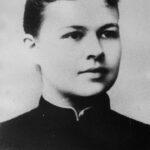
Alfred Delp first saw the light of this world on September 15, 1907 in Mannheim Germany.  The son of a Catholic mother and a Protestant father, he was raised as a Protestant although he was baptized as a Catholic.  He was confirmed in the Lutheran church in 1921.  Following a bitter argument with his Lutheran pastor, he embraced Catholicism, made his first communion and was confirmed.  His Catholic pastor, seeing rare intelligence in the boy, arranged for him to continue his studies.

In 1926 he joined the Jesuits.  In 1937 he was ordained as a priest.  His further philosophical studies curtailed at  the University of Munich due to his anti-Nazi beliefs, Father Delp worked on a Jesuit publication until it was suppressed by the Nazis in April 1941.  He was then assigned as rector of Saint Georg church in Munich.  All the while he was helping Jews escape into Switzerland.  Father Delp’s Jesuit provincial Augustin Rosch was active in the anti-Nazi underground.  He introduced Father Delp to the Kreisau Circle of anti-Nazi activists.  Father Delp taught Catholic social teaching to the Circle and arranged contacts between them and  Catholic leaders. Continue reading

PinterestRedditPrintFriendlyShare

Pope Paul VI and the Smoke of Satan


(When we went with our new format in November of last year, some of our earlier posts didn’t carry over, including this one.  I am republishing it today with some slight modifications so that it may not be lost in internet oblivion eventually, and in the spirit of Blessed John Henry Cardinal Newman’s Advent series of sermons on the Anti-Christ which may be viewed here, here, here and here.  I have always thought that Advent is a good time to look at evil, since it is at this time of the year that we are reminded of the ultimate triumph of good through Christ.)


I have long heard about Pope Paul VI having referred to the “smoke of Satan” having entered the Church.  Usually most references to it do not mention when it was said and in what context.  The quote apparently was said on June 29, 1972 by Pope Paul VI on the ninth anniversary of his coronation during a homily given at a mass for the solemnity of Saint Peter and Saint Paul.  The Italian text is here.  As far as I know there is no official translation.  On November 13, 2006 Jimmy Atkin posted at his blog  a translation done of the homily by Father Stephanos Pedrano.  Please note that the text that is translated is a summary of what the Pope said and not a word for word transcript of what the Pope said.  Father Pedrano’s translation is as follows (I have placed in red the portion of the text that refers to Satan): Continue reading

PinterestRedditPrintFriendlyShare

Messianic Prophecies: Isaiah 7: 11-16 and 9: 1-7

YouTube Preview Image

Something for the weekend.  Lo How a Rose Ere Blooming.  Continuing on with our Advent examination of major Messianic prophecies, we come to Isaiah 7: 11-16:

11 Ask thee a sign of the LORD thy God; ask it either in the  depth, or in the height above.

12 But Ahaz said, I will not ask, neither will I tempt the LORD.

13 And he said, Hear ye now, O house of David; Is it a small thing for you to weary men, but will ye weary my God also?

14 Therefore the Lord himself shall give you a sign; Behold, a virgin shall conceive, and bear a son, and shall call his name Immanuel.

15 Butter and honey shall he eat, that he may know to refuse the evil, and choose the good.

16 For before the child shall know to refuse the evil, and choose the good, the land that thou abhorrest shall be forsaken of both her kings.

and Isaiah 1-7:

1Nevertheless the dimness shall not be such as was in her vexation, when at the first he lightly afflicted the land of Zebulun and the land of Naphtali, and afterward did more grievously afflict her by the way of the sea, beyond Jordan, in Galilee of the nations.

2The people that walked in darkness have seen a great light: they that dwell in the land of the shadow of death, upon them hath the light shined.

3Thou hast multiplied the nation, and not increased the joy: they joy before thee according to the joy in harvest, and as men rejoice when they divide the spoil.

4For thou hast broken the yoke of his burden, and the staff of his shoulder, the rod of his oppressor, as in the day of Midian.

5For every battle of the warrior is with confused noise, and garments rolled in blood; but this shall be with burning and fuel of fire.

6For unto us a child is born, unto us a son is given: and the government shall be upon his shoulder: and his name shall be called Wonderful, Counsellor, The mighty God, The everlasting Father, The Prince of Peace.

7Of the increase of his government and peace there shall be no end, upon the throne of David, and upon his kingdom, to order it, and to establish it with judgment and with justice from henceforth even for ever. The zeal of the LORD of hosts will perform this.

Saint Cyril of Alexandria commented upon this passage: Continue reading

PinterestRedditPrintFriendlyShare

Messianic Prophecies: Book of Wisdom


YouTube Preview Image

Something for the weekend.  O Come, O Come Emmanuel.  We start Advent tomorrow, and my thoughts have been turning to the many messianic prophecies in the Old Testament that are applicable to Christ.  I do not think there is adequate treatment in contemporary catechesis of the remarkable string of prophecies in the Old Testament that find their completion in Christ.  All Catholics need to be familiar with these prophecies, for they are an anchor for our Faith.  One example is Wisdom 2:12-20: Continue reading

PinterestRedditPrintFriendlyShare

Handel’s Advent Messiah

YouTube Preview Image

The Advent portions of Handel’s Messiah.  The above video is the Overture.

YouTube Preview Image

Next we have “Comfort Ye” which is a messianic text from Isaiah 40.

“Comfort ye, comfort ye My people, saith your God. Speak ye comfortably to
Jerusalem, and cry unto her, that her warfare is accomplished, that her
iniquity is pardoned. The voice of him that crieth in the wilderness,
prepare ye the way of the Lord. Make straight in the desert a highway for
our God. ”

YouTube Preview Image Continue reading

PinterestRedditPrintFriendlyShare

Ember Days

[This guest post was submitted by regular TAC commenter "Pinky" and is particularly timely as we near Christmas.]

“If virtue is a habit, perhaps it’s time to form some more habits around denial of appetite.” – DarwinCatholic

It has always been the practice of the Church to prepare for feast days with prayer and fasting. The opportunity to take part in one of the Church’s oldest traditions is approaching on the 15th, 16th, and 18th of December this year, the tradition of Ember days.

Ember days likely came into being in the years when the Catholic Church was expanding into pagan lands and Christianizing their rituals, although some have dated them back to the time of the Apostles. Further confusing the origin of the practice is the unknown derivation of the word “ember” itself: possibly from the Latin word tempor (time) or the Celtic word ymbren (seasonal cycle).

On the Wednesday, Friday, and Saturday of four weeks spaced throughout the year, the faithful have been encouraged to prayer, fasting, and partial abstinence (meat was allowed during the one meal except on Fridays or during Lent). These Ember weeks were standardized in 1095 to begin on the Wednesday following the Feast of the Exultation of the Cross (Sept.14) , the Feast of Saint Lucy (Dec.13), Ash Wednesday, and Pentecost. Ember Saturdays are popular days for ordinations. Continue reading

PinterestRedditPrintFriendlyShare

Advent: God So Loved The World

YouTube Preview Image

Advent might be summarized by John 3:16:   “For God so loved the world, that He gave His only begotten Son, that whoever believes in Him should not perish, but have eternal life.”

In daily life it is often easy to lose sight of the fact that we are always in the hands of an infinitely loving God who became one of us, His creatures, as a result of that love.  Men often fear and deny God I think out of a profound belief that they are unworthy of this love.  Peter, the prince of the apostles, after meeting Christ asked Him to leave him because Peter was a sinful man.  In our times, drenched in cynicism and wallowing in sin, love is in short supply it seems, and the idea of a loving God is one that many of us flee from and attempt to futilely deny.  This attitude calls to mind this passage from the Screwtape letters:

The truth is I slipped by mere carelessness into saying that the Enemy really loves the humans. That, of course, is an impossibility. He is one being, they are distinct from Him. Their good cannot be His. All His talk about Love must be a disguise for something else—He must have some real motive for creating them and taking so much trouble about them. The reason one comes to talk as if He really had this impossible Love is our utter failure to out that real motive. What does He stand to make out of them? That is the insoluble question. I do not see that it can do any harm to tell you that this very problem was a chief cause of Our Father’s quarrel with the Enemy. When the creation of man was first mooted and when, even at that stage, the Enemy freely confessed that he foresaw a certain episode about a cross, Our Father very naturally sought an interview and asked for an explanation. The Enemy gave no reply except to produce the cock-and-bull story about disinterested love which He has been circulating ever since. This Our Father naturally could not accept. He implored the Enemy to lay His cards on the table, and gave Him every opportunity. He admitted that he felt a real anxiety to know the secret; the Enemy replied “I wish with all my heart that you did”. It was, I imagine, at this stage in the interview that Our Father’s disgust at such an unprovoked lack of confidence caused him to remove himself an infinite distance from the Presence with a suddenness which has given rise to the ridiculous enemy story that he was forcibly thrown out of Heaven. Since then, we have begun to see why our Oppressor was so secretive. His throne depends on the secret. Members of His faction have frequently admitted that if ever we came to understand what He means by Love, the war would be over and we should re-enter Heaven. And there lies the great task. We know that He cannot really love: nobody can: it doesn’t make sense. If we could only find out what He is really up to! Hypothesis after hypothesis has been tried, and still we can’t find out. Yet we must never lose hope; more and more complicated theories, fuller and fuller collections of data, richer rewards for researchers who make progress, more and more terrible punishments for those who fail—all this, pursued and accelerated to the very end of time, cannot, surely, fail to succeed. Continue reading

PinterestRedditPrintFriendlyShare

Newman: Reflections at the Beginning of Advent


“Thine eyes shall see the King in his beauty: they shall behold the land that is very far off.” Isaiah xxxiii. 17.

 YEAR after year, as it passes, brings us the same warnings again and again, and none perhaps more impressive than those with which it comes to us at this season. The very frost and cold, rain and gloom, which now befall us, forebode the last dreary days of the world, and in religious hearts raise the thought of them. The year is worn out: spring, summer, autumn, each in turn, have brought their gifts and done their utmost; but they are over, and the end is come. All is past and gone, all has failed, all has sated; we are tired of the past; we would not have the seasons longer; and the austere weather which succeeds, though ungrateful to the body, is in tone with our feelings, and acceptable. Such is the frame of mind which befits the end of the year; and such the frame of mind which comes alike on good and bad at the end of life. The days have come in which they have no pleasure; yet they would hardly be young again, could they be so by wishing it. Life is well enough in its way; but it does not satisfy. Thus the soul is cast forward upon the future, and in proportion as its conscience is clear and its perception keen and true, does it rejoice solemnly that “the night is far spent, the day is at hand,” that there are “new heavens and a new earth” to come, though the former are failing; nay, rather that, because they are failing, it will “soon see the King in His beauty,” and “behold the land which is very far off.” These are feelings for holy men in winter and in age, waiting, in some dejection perhaps, but with comfort on the whole, and calmly though earnestly, for the Advent of Christ. Continue reading

PinterestRedditPrintFriendlyShare

Handel's Advent Messiah, Part III

YouTube Preview Image

The culmination of the Advent portions of Handel’s Advent Messiah.  Part I is here and Part II is here.  Handel heralds the coming of Christ with the immortal words of Isaiah Chapter 9, verse 6:

For unto us a child is born, unto us a son is given: and the government shall be upon his shoulder: and his name shall be called Wonderful, Counselor, The mighty God, The everlasting Father, The Prince of Peace.

PinterestRedditPrintFriendlyShare

Advent and Anti-Christ, Part IV

The fourth and final part of my presentation of the four sermons on the Anti-Christ delivered by John Henry Cardinal Newman before his conversion during Advent in 1835.  Part I is here, part II is here and Part III is here.

In this last sermon Newman speaks of the persecution that will attend the reign of the anti-Christ.  In Newman’s day, living memory could recall the savage persecution that the Church endured dring the initial years of the French Revolution.  In our time, we have the blood-stained last century when millions of Christians were martyred for their faith.  It is all too easy to suspect that those terrible persecutions were trial runs for the persecution of the Anti-Christ.  The last century brought to reality these words of Newman:  “Let us then apprehend and realize the idea, thus clearly brought before us, that, sheltered as the Church has been from persecution for 1500 years, yet a persecution awaits it, before the end, fierce and more perilous than any which occurred at its first rise.” Certainly all prior persecutions pale before what Christians experienced in the Terrible Twentieth.

This is an interesting passage from Newman’s sermon:  ”Again, another anxious sign at the present time is what appears in the approaching destruction of the Mahometan power. This too may outlive our day; still it tends visibly to annihilation, and as it crumbles, perchance the sands of the world’s life are running out.” I assume that Newman was thinking of the decline of the Ottoman Empire of his day, the sick man of Europe.  Freed from this adversary, perhaps Europe would unite behind one man, reform or revive the Roman Empire, and bring about the conditions for the Anti-Christ.  Small wonder that Hitler was frequently deemed the Anti-Christ during his lifetime.  Of course Hitler was not the Anti-Christ, but perhaps merely one of myriads of anti-Christs who have arisen and fallen in the centuries since the coming of Christ, or perhaps he is a precursor of the Anti-Christ.

Continue reading

PinterestRedditPrintFriendlyShare

Follow us!

Bookmark and Share

Subscribe by email!

Enter your email address:

Vatican Endorsed & Imprimatur

Recent Comments

RealCatholicTV.com

Digest of Top Posts in St. Blogs

Visitors to our website

Our Subscribers…

Archives

TAC works best with these browsers: