The Motley Monk

The Motley Monk is Fr. Richard Jacobs, O.S.A., a Professor of Education and Public Administration at Villanova University. His academic specialities include: organization theory; leadership ethics; Catholic eduational leadership; and, U.S. Catholic educational history. Fr. Jacobs writes the blog, "The Motley Monk" (http://themotleymonk.blogspot.com/).

SCOTUS derails women’s ordination…

As expected, the U.S. Supreme Court has ruled that a church school  cannot be sued in court over an employee’s  discrimination complaint.

In a unanimous decision SCOTUS overturned the earlier ruling by the 6th U.S. Circuit Court of Appeals  in Hosanna-Tabor Evangelical Lutheran Church and School v. Equal Employment Opportunity Commission et al which had allowed the lawsuit to move  forward, saying the teacher’s work was more secular than religious.

The high court disagreed.

Consistent with precedent, SCOTUS ruled that the First Amendment’s  guarantee of freedom of religion shields churches and their operations from the  reach of anti-discrimination laws when dealing with employees of religious  institutions.  SCOTUS also extended this precedent to include complaints of discrimination under the Americans With Disabilities Act.

Writing for the Court, Chief Justice John Roberts noted:

The purpose of the exception is not to safeguard a church’s decision to fire a minister only when it is made for a religious reason. The exception instead ensures that the authority to select and control who will minister to the faithful is the church’s alone….(c) Today the Court holds only that the ministerial exception barsan employment discrimination suit brought on behalf of a minister, challenging her church’s decision to fire her. The Court expresses no view on whether the exception bars other types of suits.

The Court’s decision is a clear defeat for those in the U.S. Catholic Church advocating women’s ordination.  While the Catholic Church discriminates in favor of males for theological reasons, civil suits based upon gender discrimination cannot be brought.  “[The] authority to select and control who will minister to the faithful is the church’s alone” [italics added].


To read the SCOTUS decision in Hosanna-Tabor Evangelical Lutheran Church and School v. Equal Employment Opportunity Commission et al, click on the following link:
http://www.supremecourt.gov/opinions/11pdf/10-553.pdf


LinkedInRedditPrintFriendlyShare

Will the U.S. Supreme Court deal a legal setback to those adovcating for women’s ordination?

While the media and pundits are focused like lasers upon the U.S. Supreme Court (SCOTUS) oral arguments and decision concerning the so-called “Obamacare” reforms, The Motley Monk is focused like a laser upon a case the SCOTUS has already heard, Hosanna-Tabor Evangelical Lutheran Church and School v. The U.S. Equal Employment Opportunity Commission (597 F.3d 769 (6th Cir. 2010) [2010 BL 49772]).

Argued on October 5, 2011, the case concerns whether the exemption from federal employment discrimination statutes which applies to church employees who perform religious functions also applies to teachers at religious elementary schools.  The courts have generally upheld the former.  But, according to the facts of this case, a teacher at a religious elementary school—who happened to be a commissioned (“called”) minister—suffers from narcolepsy and was fired on February 11, 2005.  School officials deemed that the teacher could not fulfill her contractual responsibilities.

Even though the school’s religious denomination forbids lawsuits among believers—based upon 1 Corinthians 6:1-8—the teacher did so on May 17, 2005.  Filing a charge of discrimination and retaliation with the EEOC, the teacher alleged that the school had discriminated and retaliated against her in violation of her rights under the Americans with Disabilities Act.

Representing the EEOC to SCOTUS, the Assistant to the Solicitor General, Department of Justice Leondara R. Kruger argued that the religious school could not fire the teacher for filing a complaint to the government even if church teaching forbids it.

For The Motley Monk, this principle allows for a very dangerous breach of the wall of separation between Church and State.

For example, consider the case of an unmarried teacher in a Catholic school who was fired for becoming pregnant by artificial insemination and subsequently filed a complaint with the EEOC, arguing that her firing is rooted in gender discrimination.  After all, she asserted in her filing, men who donate sperm are not likely to be fired while for women a pregnancy and baby are difficult to hide.  Should the government be able to require the school to rehire the teacher and provide her restitution for lost wages and emotional pain and suffering endured?

Yes…if the teacher is considered an employee as would any employee in a secular organization.

No…if the teacher is considered an employee in a religious organization which is exempt from federal employment discrimination statutes.

Then, too, what also about Catholic women using this principle to sue the Catholic Church in the United States because they are excluded from the priesthood?  There’s absolutely no doubt that when it comes to ordination, the Catholic Church discriminates in favor of males.  Should SCOTUS be able to tell the Catholic Church in the United States that it must redress the imbalance?

Yes…if, as an organization, the Catholic Church is bound by federal employment discrimination statutes.

No…if, as an organization, the U.S. Catholic Church is exempt from federal employment discrimination statutes.


The transcript of the oral arguments indicates that several SCOTUS Justices were particularly interested in the answer to the question of ordination, including Chief Justice John Roberts as well as Associate Justices Antonin Scalia, Samuel Alito, Elena Kagan, and Stephen Bryer.

In response to the Justices’ questions, Kruger noted that the two situations are different—not categorically, but rather  because “the private and public interests are very different in the two  scenarios.”  Kruger added:

The government’s general interest in eradicating discrimination in the  workplace is simply not sufficient to justify changing the way that the Catholic  Church chooses its priests, based on gender roles that are rooted in religious  doctrine.

But, the government does have a compelling and indeed overriding  interest in ensuring that individuals are not prevented from coming to the  government with information about illegal conduct.

It would seem the Ms. Kruger’s position—arguing on behalf of the Obama administration—is that the government isn’t interested in telling religions groups how to govern themselves internally, unless the issue concerns violations of law.

Who, then, is to decide?  After all, gender discrimination is illegal in the United States and were SCOTUS to affirm the government’s principle, this would set a legal precedent that those seeking women’s ordination in the U.S.Catholic Church could exploit.  Aware of this, Justice Scalia asked Ms. Kruger:

There is nothing in the Constitution that explicitly prohibits the  government from mucking around in a labor organization, but there, black on white in the text of the Constitution are special  protections for religion. And you say that makes no difference?


Kruger’s explained what the government considers

…the core of the ministerial exception as it was originally conceived…which is  that there are certain relationships within a religious community that are so  fundamental, so private and ecclesiastical in nature, that it will take an  extraordinarily compelling governmental interest to (allow) just  interference.


The good news in the Hosanna-Tabor Evangelical Lutheran Church and School case is that the Justices’ questions reveal some grave reservations about the principle being asserted by the Obama administration.  Justice Alito pointed out, in particular, that this distinction between the Lutherans’ lawsuit prohibition on the one hand, and the Catholic Church’s male priesthood on the other, seemed arbitrary which, of course, is itself a violation of substantive due process.


Alert to the problems associated with finding on behalf of the teacher, it may very well be that SCOTUS will decide in favor of the denomination and its school, dealing a legal setback to those who advocate women’s ordination in the Catholic Church.

The Motley Monk has his sights set like a laser on this case.


To learn more about Hosanna-Tabor Evangelical Lutheran Church and School v. The U.S. Equal Employment Opportunity Commission, click on the following links:

http://www.scotusblog.com/case-files/cases/hosanna-tabor-evangelical-lutheran-church-and-school-v-eeoc/

http://www.supremecourt.gov/Search.aspx?FileName=/docketfiles/10-553.htm


To read the transcript of the oral arguments before the SCOTUS, click on the folowing link:
http://www.supremecourt.gov/oral_arguments/argument_transcripts/10-553.pdf

LinkedInRedditPrintFriendlyShare

Is this where Protestantism is headed in the United States?

A recently released LifeWay Research report indicates that 10% of Protestant pastors did not plan to hold services on Christmas Day.  Commenting upon this finding, the President of LifeWay Research, Ed Stetzer, said:

Having church on Christmas Day when it falls on a Sunday seems as if it would be as much of a given as having Thanksgiving on a Thursday, but this has been an issue of discussion and contention in recent years.  Also, just because an overwhelming majority of pastors think that way doesn’t mean those in their congregations necessarily share their perspective.


The data are worth contemplating:

  • 6% of Protestant churches planned to have a Christmas Eve service, but no service on Christmas Day.  28% planned to have service on Christmas Day, but no service on Christmas Eve.  63% planned to hold services on both Christmas Eve and Christmas Day.  Compared to other regions of the nation, Protestant pastors in the South are the least likely (62%) to hold Christmas Eve services.
  • Full-time (71%) and part-time (74%) pastors are more likely to be planning a Christmas Eve service than bivocational or volunteer (53%) pastors.  Pastors identifying themselves as “mainline” (87%) are more likely to have a service on Christmas Eve compared to those identifying themselves as Evangelical (70%).
  • Nearly as many Protestant pastors plan to host services on New Year’s Day (88%) as Christmas Day (91%).  26% are planning for their church to hold services on New Year’s Eve.
  • 74% of Americans agree (strongly or somewhat) that “Christmas is primarily a day for religious celebration and observance.”  But, 67% agree that, “Many of the things I enjoy during the Christmas season have nothing to do with the birth of Jesus Christ.”


Is this snapshot in time an anomaly or does it portend what will become a trend?  What may be going on here?

The Motley Monk offers two interpretations:

  1. Secularism: “Christmas” has become “Giftmas.”  Electronic devices, snacks, and food provide the glue binding families together   Having everything we want, who needs the Incarnation?
  2. Me and My God – We’re fine with each other:  Like it or not, the liturgies planned for the “domestic church” are far more meaningful to many people today.  Celebrating the Christmas and Easter liturgies as well as Memorial Day, Labor Day, and Thanksgiving Day liturgies at home builds up the domestic church.  And don’t forget the mega-liturgy of Super Bowl Sunday!  Requiring attendance at church on a family day is nothing but a man-made legalism, forcing people to focus upon an institution and contributing big collections than it is about authentic worship of God.


Where these two ideas hold sway, it makes sense that pastors would limit the number of worship services.  After all, many have families of their own!

But, as this idea takes root in a congregation, it is likely to become engrained as an attitude in young people.  In a generation or two, public worship on Christmas Day (and Easter Sunday) becomes an artifact of a quaint but bygone era.


Golfing is a form of worship as is community service


These results reveal nothing new to The Motley Monk.  It’s an attitude held by many of his European friends who identify themselves as Christian.  For them, celebrating Christmas and Easter are important family liturgies that do not require attending church services.  These friends assert that “spirituality” is a very important part of their lives but is entirely unrelated to belonging to or practicing any institutional form of religion.

The Motley Monk respectfully disagrees.  This attitude slowly erodes families and society of the important moral values that religion and religious practices inculcate.

How long will it before Festivus replaces Christmas so that no one will be offended?


Let the discussion begin…


To read the LifeWay article, click on the following link:
http://www.lifeway.com/Article/LifeWay-Research-Pastors-plan-to-host-Christmas-services-despite-busyness-of-Christmas-Day

LinkedInRedditPrintFriendlyShare

Following the Annunciation of the Blessed Virgin Mary…

It’s another year and it’s yet another billboard that the self-proclaimed Anglican “progressive” church—St. Matthew’s-in-the-City Church—in Auckland, New Zealand, has posted to get people to consider the authentic meaning of Christmas.

Two years ago, the billboard depicted Mary and a dejected-looking Joseph lying in bed, with the tagline, “Poor Joseph, God was a hard act to follow.”  Last year, the billboard read, “For those who can’t make Mass this Christmas, we’ve blessed this billboard. (Go ahead, touch it).”  After a storm, the church bottled and auctioned online the rainwater running off the billboard, calling it “holy water,” to raise money for the church’s charity work.

This year, the billboard depicts the Blessed Virgin Mary after reading the results of her early pregnancy test.

The Blessed Virgin Mary gets her early pregnancy test results

According to a CNSNews.com article, the pseudo-Renaissance style billboard carries no tagline.  Instead, the church’s leaders, vicar Glynn Cardy and associate priest Clay Nelson, have invited people to offer their own thoughts.

One Catholic activist, Arthur Skinner of the Catholic Action Group, took the church leaders at their word.  Skinner expressed his thoughts by tearing the billboard in half during a prayer protest.  In a television interview, he said:

Even people who aren’t Catholics know instinctively you don’t attack the Blessed Virgin who gave us the savior of the world.  To see this at this time is an absolute abomination.

Skinner warned that if the provocative image is replaced, he will damage it again.

Cardy and Nelson denounced Skinner’s self-expression as representing “Christian intolerance.”  They said:

Frankly, we are tired of Christian intolerance—and embarrassed by it.  When will we recognize that none of us have the whole truth?  When will we recognize that those who hold contrary opinions are not “of the devil?  When will we recognize that truth comes in many guises, often in unexpected ways?

Okay, like it or not, the church’s leaders are “inclusive” of a “diversity” of belief and they are inviting people to express their beliefs.

However, while the billboard undoubtedly “pushes the envelope,” it doesn’t offend or outrage The Motley Monk.  Yes, an EPT test doesn’t conform with scripture.  Yes, bigots will post thoughts ridiculing Christian doctrine.  Yes, some zealots will be offended and outraged, using the billboard to express themselves.  And yes, The Motley Monk would not have posted the billboard.

But, all of that overlooks how the billboard depicts something substantive, namely, the genuinely human element present at the Annunciation that is entirely in conformity with scripture.  Following God’s will oftentimes presents tremendous challenges and at great personal cost.  The substantive question is whether or not a person will accept those challenges and pay those costs.

That said, if The Motley Monk had the opportunity to express his thoughts, he would paint a tag line at the bottom of the billboard’s sign: “Let it be done unto me, according to your word.”


Let the discussion begin…


To read the CNSNews.com article, click on the following link:
http://cnsnews.com/news/article/progressive-church-offers-christmas-billboard-showing-virgin-mary-pregnancy-test

LinkedInRedditPrintFriendlyShare

The Higgs boson: Seeking to have the mind of God?

The Motley Monk was surprised to learn of the “Higgs boson” in a Washington Post article.  Nicknamed “the God particle,” scientists believe that Higgs boson is essential to understanding of how the  universe works.

Scientists in the the 1960s and 70s theorized that Higgs boson would explain a force field that permeates the universe and imbues other particles—like protons and electrons—with their mass, which is not their weight, but  rather their resistance to efforts to move them.  If scientists confirm the particle, the discovery close the chapter on  the fundamental theory of particle physics, called “the Standard Model,” which for physicists is the  equivalent of the chemists’ periodic table, as it describes all the known particles and forces in the universe.


If scientists cannot confirm the existence of Higgs boson, it’s not quite back to “square one.”  But, scientists will remain unable to explain nature’s deepest structure.

All of this reminds The Motley Monk of the Book of Genesis, where God forbade the first human beings from eating of the fruit of the tree of knowledge of good and evil.  To know what is good and evil and to be able to distinguish one from the other infallibly would rid the human beings of having to live with ambiguity, due to omniscience.  Hence the problem: humans would not be creatures but gods.

Now, there’s absolutely nothing wrong with the search to understand nature’s deepest mysteries.  After all, God endowed human beings with minds that are capable of engaging in that search.  But, for human beings to believe they can know nature’s deepest structure would be to possess the mind of its Creator.  As Blessed John Paul II noted in Fides et ratio, science and faith must be in dialogue for each to fulfill its important purpose in advancing knowledge.  One without the other is the breeding ground of human failure, oftentimes catastrophic in its consequences.

Yet, some human beings do want to figure out what’s in the mind of nature’s Creator and, to this end, have constructed a $10B, 17-mile-long circular  tunnel underneath the French-Swiss border, the Large Hadron Collider. In the collider, scientists smash subatomic particles together at  astounding speeds. The scientists believe the remaining debris offers clues about the existence of Higgs boson and what it might look like.


The problem is that there is no way for human beings to see Higgs boson directly.  It exists only for a yoctosecond—one septillionth of one second—following collisions of subatomic particles.  Higgs boson then decays into other particles.

The latest results indicate that the data are “sufficient to make significant progress in the search  for the Higgs boson, but insufficient to make any conclusive statement on the  existence or non-existence of the Higgs.”  So, it is likely a Higgs boson of a certain type exists, but scientists cannot make any statistically significant conclusions and, in this case, less than 1M-to-1.

So, consider these points:

  1. I think it exists.
  2. I cannot see it directly.
  3. I can explain its existence only indirectly.
  4. I cannot “prove” that it exists.
  5. I am impelled from within to continue searching for it.


Sounds like the search for Bigfoot, no?


No, it sounds like St. Thomas Aquinas’ difficulty in attempting to explain the mystery called “God.”  The best the “Angelic Doctor” could say about his search was “I can’t prove that God exists, but I can demonstrate it reasonable to believe that God exists.”  And that conclusion was derived without the assistance of a $10B supercollider!


Let the discussion begin…


To read the Washington Post article, click on the following link:

http://www.washingtonpost.com/national/health-science/scientists-close-in-on-linchpin-of-physics-the-god-particle/2011/12/12/gIQAmk2cqO_story.html?wpisrc=nl_headlines

LinkedInRedditPrintFriendlyShare

A furtive political calculation: Playing both sides to the middle…

Several days back, The Motley Monk posted on his website concerning MaterniT21 and the Obamacare regulations recommended by the Secretary of Health and Human Services, Kathleen Sebelius, scheduled to take effect next year.  They mandate the federal government (i.e., taxpayers) to pay for the MaterniT21 test.


Predictably, those who are pro-life expressed outrage…and rightly so.  MaterniT21 increases the likelihood that mothers who are 10 weeks pregnant—that’s when the test becomes 99% accurate—will elect to have their Down syndrome child aborted.

Then, surprise…surprise.

According to an Associated Press report, Secretary of Health and Human Services, Kathleen Sebelius overruled the Federal Drug Administration and decided to stop the Plan B morning-after pill (RU 386/486 ) from moving onto drugstore shelves, right next to condoms.  The FDA determination would have made the pill available to people of any age without a prescription.  Sebelius said that she was worried about whether 11-year-old girls would know how to use the pill properly.


Predictably, pro-choice advocates were outraged.

Dr. Robert Block of the American Academy of Pediatrics (AAP) called Secretary Sebelius ruling “medically inexplicable.”  Block contends that over-the-counter access to emergency contraception would lower the high number of unplanned pregnancies.

A professor of pediatric and adolescent medicine at the University of Washington and AAP member, Dr. Cora Breuner, said: “I don’t think 11-year-olds go into Rite Aid and buy anything, much less a single pill that costs about $50.”

In his Esquire blog, Charles R. Pierce was besides himself:

This is all on Sebelius—and on the president for whom she works—because she overruled her own panel of experts, which those of us who know a little of the history of Holy Mother Church in this area know is never a good idea. In 1968, Pope Paul VI was handed a report from his Pontifical Commission on Birth Control that explained, in detail, why HMC should change its position on  artificial birth control. The pope threw out his commission’s recommendations and issued Humanae Vitae, an encyclical that banned all artificial  birth control and, as an added bonus, pretty much guaranteed that millions of American Catholics would never listen seriously to what any pope said about anything, but especially about what they did during sexy time. The subsequent revelation that HMC had been functioning as an international conspiracy to obstruct justice in regards to what its clergy were doing during sexy-time also did not help.

Stupid, Kathleen. And pointless. They’re going to hate you anyway.

Yes, indeed.  The Obama administration and its agents—in this case, a Catholic—fully intend to decrease the frequency of abortion in the United States, as President Barack Obama promised Pope Benedict on July 10, 2009.

How might this lack of consistency be explained?

It’s simple: President Barack Obama is running for re-election.

The President has now successfully positioned himself to tout his “pro-life” and “pro-choice” credentials.  It’s all part of a “grand narrative” that can be portrayed in television commercials: When it comes to the issues of life, Mr. Obama isn’t the extreme leftist that those on the political right would portray him as being not is he the moderate that those on the political left would portray him as being.

No, the President is “independently minded,” just like that large chunk of the electorate he is trying to sway to his camp.


Let the discussion begin…


To read The Motley Monk’s post concerning MaterniT21, click on the following link:
http://themotleymonk.blogspot.com/2011/12/president-obama-and-abortion-when.html

To read the Associated Press report, click on the following link:
http://www.google.com/hostednews/ap/article/ALeqM5hHRO6CLEFA5-IJAMoxKbb4MlvuWA?docId=8216ddfe19e94bd8a72ac03d3e7cd4f1

To read Charles R. Pierce’s blog, click on the following link:
http://www.esquire.com/blogs/politics/morning-after-bill-sebelius-6612389

LinkedInRedditPrintFriendlyShare

Is the Vatican declaring war on U.S. secularism?

In a CNS interview in which he reflected upon his first year on the job as the Prefect oft he Apostolic Signatura, Cardinal Raymond Burke said he could envision a time when the Catholic Church in the United States “even by announcing her own teaching” will be accused of “engaging in illegal activity, for instance, in its teaching on human sexuality.”

Cardinal Raymond Burke

Cardinal Burke declared “it is a war” and “critical at this time that Christians stand up for the natural moral law.”  If they do not, Burke warned, “secularization will in fact predominate and it will destroy us.”

“Destroy”?

Perhaps a bit of scarlet hyperbole…after all, Christ did promise that the gates of Hell would not prevail against the Church (Matthew 16:18). But, the point the Cardinal is making is absolutely correct. Secularization is well on its way to cementing its place as one of, if not the most dominant belief systems in the United States.

Could Cardinal Burke envision Catholics being arrested for their faith?

Cardinal Burke was emphatic: “I can see it happening, yes.”

This observation may not be the stuff of scarlet hyperbole. After all, when Catholic moral teaching is brought into the public square, the critique of the prevailing Zeitgeist oftentimes is belittled as antiquated, if not ignorant. Not quite the stuff of arrest, imprisonment, and torture.  But, certainly the stuff of marginalization that in retrospect was a precursor to persecution.

Cardinal Burke also minced no words when it came to self-professed Catholic politicians who oppose the Church on key moral issues, among them U.S. Health and Human Services Secretary Kathleen Sebelius, who is seeking to regulate most of the country’s employers, including Catholic institutions, to cover contraception, sterilization, and abortion in employee health plans. The Cardinal said:

To the degree to which (Sebelius) proclaims herself to be a practicing Catholic, she is very wrong….[It is] simply incomprehensible [for Catholics to] support the kind of measures that she is supporting.

While Cardinal Burke appears to be speaking for himself, that actually may not be the case.


Later in the week, Pope Benedict XVI issued similar warnings to the bishops from the U.S. northeast during their 10-day, ad limina visit.  According to a CNS article, Benedict XVI said:

…the seriousness of the challenges which the Church in America, under your leadership, is called to confront in the near future cannot be underestimated.  The obstacles to Christian faith and practice raised by a secularized culture also affect the lives of believers.

Sounding much like Cardinal Burke, Pope Benedict urged the bishops to speak out in defense of Catholic moral teaching:

Immersed in this culture, believers are daily beset by the objections, the
troubling questions and the cynicism of a society which seems to have lost its
roots, by a world in which the love of God has grown cold in so many hearts.

The present moment can thus be seen, in positive terms, as a summons to exercise the prophetic dimension of your episcopal ministry by speaking out, humbly yet insistently, in defense of moral truth, and offering a word of hope, capable of opening hearts and minds to the truth that sets us free.

It may very well be the case that the Vatican is coordinating its offices to send a very clear message to the U.S. Catholic Church: “The cafeteria is closed. It’s time to articulate the authentic teaching of the Catholic Church in the public square.”

This is the New Evangelization and there may be a big price that Catholics may have to pay for it, if Cardinal Burke is correct.


Let the discussion begin…


To read the CNS interview of Cardinal Burke, click on the following link:

http://www.catholicnewsagency.com/news/cardinal-burke-reflects-on-his-first-year-in-the-sacred-college/

To read the CNS article about Pope Benedict’s remarks during the ad limina visit, click on the following link:
http://www.catholicnews.com/data/stories/cns/1104641.htm

LinkedInRedditPrintFriendlyShare

How’s this for “Diversity” and “Inclusion”?

The United States Senate has approved a defense authorization bill by a vote of 93-7 that includes changes to Article 125 of the Uniform Code of Military Justice: no longer banned are sodomy and sex with animals (bestiality).

Article 125 used to state:

(a) Any person subject to this chapter who engages in unnatural carnal copulation with another person of the same or opposite sex or with an animal is guilty of sodomy. Penetration, however slight, is sufficient to complete the offense.

(b) Any person found guilty of sodomy shall be punished as a court-martial may direct.

The change in Article 125 ostensibly is due to President Obama’s support to remove the military’s “Don’t Ask, Don’t Tell” policy.

Quite likely, the removal of the bestiality provision was not intentional.  But, the simple fact is that under the Uniform Code of Military Justice, there’s no longer a provision to prosecute military personnel who engage specifically in bestiality.

The U.S. Armed Forces have been touted by those on the political left as being on the vanguard of “social change.”  They cite, as the primary example, the demise of segregation in the U.S. military following World War I and officially when President Harry Truman signed Executive Order 9981 on July 26, 1948.

So, if The Motley Monk “gets it,” any soldier who engages in sodomy with an animal cannot be prosecuted under the provisions of the Uniform Code.

Hopefully, the Conference Committee will deal directly with this particular “social experiment,” as the House version of the Defense Authorization Act includes reinforcing the Defense of Marriage Act and prohibiting same-sex marriage on military bases.

What is this nation coming to when U.S. Senators legislate something like bestiality in the U.S. Armed Forces?

LinkedInRedditPrintFriendlyShare

Some advice from Lech Walesa for Occupy Wall Street…

The freedom fighter and former President of Poland, Lech Walesa, has offered a thoughtful reflection concerning the protests occurring across the Arab world, Europe, and the United States.

Lech Walesa
former President of Poland


In a San Francisco Chronicle op-ed, Mr. Walesa sides with the protesters.  But, he also takes them to task:

What has struck me the most as I have followed the protests on television and in the social media is that the protesters generally know that the status quo should not be tolerated, but are a lot less clear and unified about what they want to replace it with.


What  idea that unifies the protesters?

In the United States, The Motley Monk would observe that there is little if any talk about God-given rights or inalienable freedoms.  Instead, the Occupy Wall Streeters talk mostly about “economic justice” for the 99% and rail against the evils being perpetrated against them by the 1%.  In this regard, Walesa observes:

Today’s protests seem more focused on the problems that are plaguing many of the world’s advanced economies, with little regard to the impact of government in creating these problems.  What is needed in addition are sound solutions that are mindful of both the effects of government powers and the importance of vital freedoms.  These solutions have to be earned through dialogue between bankers, entrepreneurs, public administrators, labor unions and social organizations….I do not support solely the idea of overthrowing those who are in power.  I support the processes that would lead to new orders guaranteeing individual liberty, democracy, civic virtue, equality and the rule of law.


Absent an inspiring idea to unify people, protests are just that.  Eventually, they peter out.  And then, they die as the protesters depart for their homes dejected that their once glorious “movement” failed under the oppressive weight of the powers they were protesting.  In the end, nothing changes because the protesters—who have legitimate concerns—stood against something but stood for nothing.  Mr Walesa observes:

While today’s protesters have many legitimate concerns, let me assure them that instead of either cronyism or greater government control, it is dialogue and solidarity leading to freedom that we should all strive for.

Let’s hope that the people can come together to solve our shared problems.  Otherwise they will have to contend with mere turmoil against the status quo without benefit of a clear, rational and productive alternative for a better future of freedom for all.


It might be beneficial for members of the Occupy Wall Street “movement” to read Lech Walesa’s biography.  He has a few lessons to teach them about hope and change:

Before you set out to alter the status quo, you ought to know how to replace it—and you need to be convinced, intellectually and in your heart, that the new system will actually be better.


Let the discussion begin…


To read the Lech Walesa’s op-ed, click on the following link:
http://www.independent.org/newsroom/article.asp?id=3186


LinkedInRedditPrintFriendlyShare

It really is all about being “pro-choice”…

If one is to believe the “rumors” currently circulating around Washington, DC—otherwise called “reactions to trial balloons”—the Archbishop of New York, Most Rev. Timothy Dolan, walked away a winner following his meeting with President Obama last week.

Apparently, the Archbishop of New York convinced the President to uphold the so-called “conscience clause” that would allow religious institutions to be exempt from certain healthcare regulations that are to be promulgated by the Secretary of Health and Human Services, Kathleen Sebelius, on August 1, 2012.

In the crosshairs is the contraceptive-coverage rule which specifies a more general provision in the Obamacare healthcare reform.  It requires all new insurance plans to cover “preventive services”—including birth control and abortofacients—without co-pays, deductibles or other out-of-pocket costs.

Knowing how Washington, DC, works, some Democrat lawmakers have taken note of the administration’s trial balloon and have gone on the offense.

According to an article in the Washington Post, U.S. Senator Jeanne Shaheen (D-NH) raised the issue with President Obama while she was campaigning with him in New Hampshire.  That discussion followed conference calls last week between other top White House officials and members of the Congressional Pro-Choice Caucus.  U.S. Representative Diana DeGette (D-CO) said:

I think in the 21st century, most people are stunned to hear that we would even be talking about whether women can buy birth control through their insurance policies.  You would be denying millions of Americans the ability to have an essential part of their insurance coverage because of some attenuated religious affiliation of their employer.

U.S. Senator Richard Blumenthal (D-CN) opined:

What’s baffling is not just the policy, but the political calculus here.  The effect would be to undermine, if not eviscerate, the energy and enthusiasm of huge numbers of young people, women and independent voters who believe in the President.

The President of Planned Parenthood, Cecile Richards, called it “unthinkable” that the administration would incorporate the conscience clause in the final regulations.

More interesting to The Motley Monk than all of that political posturing is the article’s report of a discussion involving a graduate student, Taina Vargas:

However, if [Catholic] organizations were to be exempted from the federal rule, these individuals would have to continue paying out-of-pocket charges for birth control—about $20 to $30 per month, according to Planned Parenthood.

Taina Vargas would not even have that option. Vargas, a graduate student studying for a master’s degree in diplomacy and international relations at Seton Hall University, said she was surprised to learn that the Catholic institution’s health plan does not cover her birth-control prescription.

“This really is an issue of principle for me,” said Vargas, who is not Catholic.

“If young women like myself choose to be sexually active and don’t want a child right now so we can focus on our education, I think [birth control] is something the university should provide…

I don’t think it’s right for someone else to make this decision for me.”

Even though Taina Vargas is attending a Catholic university, she is “surprised,” citing some unnamed principle that would require Seton Hall to provide her with birth control so that she can be sexually active and not have a child “right now.”

Vargas’ story raises two important questions:

  1. Exactly what does attending a Catholic university mean for someone like Taina Vargas?
  2. What “principle” does she hold that would trump Catholic moral teaching?

The answers are obvious and are precisely why the conscience clause should prevail.  In this instance, when people go to work for or to attend Catholic universities or colleges, they should fully expect those institutions to uphold Catholic teaching unconditionally.

That’s where Taina Vargas may have it correct: It is a matter of “choice.”

If invited, one can choose to work for or to attend a Catholic institution of higher education with full awareness of its animating moral principles.  If one does not agree with those moral principles, they can choose to turn down the invitation.


To read the Washington Post article, click on the following link:
http://www.washingtonpost.com/national/health-science/democrats-lobby-against-any-broader-exceptions-to-contraceptive-coverage/2011/11/21/gIQAdHicmN_story.html

LinkedInRedditPrintFriendlyShare

The new Roman Missal is a “net plus”…


With the introduction of the new translation of the Roman Missal just around the corner, Crisis magazine reprinted its 2000 article “Worship Gone Awry.”  Its author, Maureen Mullarkey, advanced some excellent arguments about some problems with the Ordinary Form of the Mass (OF), many of which that only became increasingly obvious as the decades of the 1970′s, 80′s, and ’90s unfolded.

But, does that mean the OF is as bad as Ms. Mullarkey indicates?  More importantly, should the Extraordinary Form of the Mass (EF) be made more readily available, as Ms. Mullarkey seems to be implying?

On both counts, The Motley Monk thinks the answer is a resounding “No” if only because Joseph Jungmann’s concept of the “developmental nature of the liturgy” cannot be so easily dismissed.  As the Lutheran theologian, Jaroslav Pelikan, noted one generation ago: “Tradition is the living faith of the dead.  Traditionalism is the dead faith of the living.”

History teaches that what is now the EF developed out of multiple strands constituting a “tradition” of worship, introducing “reforms” to that tradition.  In contemporary language, to make that tradition meaningful—daresay I, “relevant”—in a new era.

The development of medieval Masses and, finally, of the Tridentine Mass also represents a reflection on the part of pastors and theologians in terms of what was not working right in the Mass.  While it is true that the patristic Mass in the West resembled more of  the OF than the EF, great Church Fathers like Augustine inherited a form of the Mass from an earlier time (St. Cyprian of Carthage) in which sacramental theology, especially in terms of the concept of mystery, was not as developed as it was by Augustine’s time.  In this way, Augustine and other Church Fathers from the 5th century onward provided the sources for a later medieval rethinking of liturgy.  So, it’s not the form of the Mass that, say, an Augustine said, that indicates what he really thought, but the deeper sacramental theology in his writings which then influences later medieval developments.  In that sense medieval/Tridentine liturgy was a correction and, perhaps arguably at the time, an improvement over the patristic liturgies.

The same is true of the OF.  It also developed out of a very longstanding tradition of worship, introducing its own “reforms” that hearkened back to the pre-patristic era, “leapfrogging” backwards over the EF’s reforms of the patristic era’s form of authentic worship.

That said, in its intent and design OF may very well have erred in the direction of allowing worship to be made so meaningful—daresay I, “relevant”—that it becomes banal.  And, there certainly is much to support that assertion.  But, that is to overlook the fact that Ms. Mullarkey has emphasized only one side of that history by seizing, as she has, upon post-Vatican II excesses.  That does not mean, ipso facto, that the OF is errant.  After all, the same observation can be made about the EF.  Its attention to the details of historical artifacts—the stuff of maniples, burses, Gothic vestments, birettas, precious metals—can err in the direction of emphasizing what was relevant in previous generations so that that it errs in the direction of being irrelevant in this generation.

There are some real problems with the OF Ms. Mullarkey didn’t mention in her article, but likely would agree with.  These include, but are not limited to:

  • The OF can be celebrated in a prayerful and dignified way.  But, “ad populum” Mass can be problematic in that the celebrant inevitably is reduced to the role of “Entertainer-in-Chief,” even if he keeps his eyes focused upon the altar and not upon the congregation.  Like it or not, the OF encourages people in the congregation to vote implicitly concerning how they “feel” about a particular celebrant’s “style.”  Not only does that verge on Donatism, but it also focuses worship on the person of the ordained minister not the Great High Priest, Jesus Christ through whom God is authentically worshipped.
  • The OF totally and irrevocably erases the “apophatic elements” that are present—even if they are over-emphasized—in the EF.  “Tossing out the baby with the bathwater” may represent a very great loss, one that is known only in retrospect.  After all, authentic worship in any form should “raise up” the congregation’s spiritual sensibilities to the ineffable, not drag them down into the banal.  Clowns, puppets, and vestal virgins prancing around bearing incense buckets, and priests bedecked in vestments decorated with disco-glitter only encourage the latter.
  • In the OF, there is an over emphasis upon Word.  In reality, there are four readings each Sunday if the Responsorial Psalm is counted.  In many instances, the Epistle also has absolutely no connection to the first reading, the gospel, and the “bridge” of the psalm.  And that’s to say nothing about the fact that the celebrant’s prayers are entirely disconnected from the “theme” presented in the readings.  For a sacramental ritual that is supposed to reflect the “best” in that its principles dignify worship of God, this error alone seems egregious.
  • The OF appeals to children and adults who need to be kept busy and entertained because they are easily bored.   However, those who designed the OF appear not to have know or did not realize that the threshold for boredom lowers as people get accustomed to the little gestures and words that they perform, so that even the participation in the Mass signalled in the Missal inevitably becomes boring.  The OF has fallen into the trap of trying to ward off boredom throughout the Mass by getting the congregation “involved.”   But, even that becomes “boring” and can only be reversed if there is continuous change in the liturgy.  So, liturgists keep inventing new gimmicks and tricks for people to perform and remain actively engaged during the Holy Mass.  Even that term, “Holy Mass,” seems somehow unrelated to the OF.

  • The EF requires mental concentration if one’s worship to get absorbed in it in a way that makes what one does a form of engaged participation.  This is not singing.  Nor is it gesturing.  It is being actively engaged with one’s mind (and hopefully, too, one’s heart).  In contrast, participation in the OF has come to mean “everybody does everything.”  And even where that is not yet the case, there is a built in inevitability of people thinking that they are being excluded if there is something the priest does that they can’t do.  This may be the most damning criticism of the OF: it breeds a form of egalitarianism that has very little, if nothing to do with Roman Catholic hierarchalism and everything to do with post-Enlightenment individualism.


More likely than not, both the EF and OF err in the direction of crafting idols out of their definitions of “relevance” so that authentic worship today becomes an more of an afterthought rather than a guiding principle.

For what it’s worth, the new translation of the Roman Missal, celebrated/prayed/said (whatever word is appropriate these days) will go a long way in correcting the excesses in terms of relevance.


Let the discussion begin…


To read Maureen Mullarkey’s article in Crisis, click on the following link:
http://www.printfriendly.com/print/v2?url=http%3A%2F%2Fwww.crisismagazine.com%2F2011%2Fworship-gone-awry-2

LinkedInRedditPrintFriendlyShare

A President’s prayer and today’s culture wars…

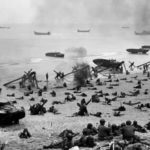
U.S. Representative Bill Johnson (R-OH) is sponsoring H.R. 2070, a bill that would place a plaque bearing the text of President Roosevelt’s D-Day prayer for U.S. troops at the Memorial.


The D-Day prayer, offered on June 6, 1944, states:

My fellow Americans: Last night, when I spoke with you about the fall of Rome, I knew at that moment that troops of the United States and our allies were crossing the Channel in another and greater operation. It has come to pass with success thus far.

And so, in this poignant hour, I ask you to join with me in prayer:

Almighty God: Our sons, pride of our Nation, this day have set upon a mighty endeavor, a struggle to preserve our Republic, our religion, and our civilization, and to set free a suffering humanity.

Lead them straight and true; give strength to their arms, stoutness to their hearts, steadfastness in their faith.

They will need Thy blessings. Their road will be long and hard. For the enemy is strong. He may hurl back our forces. Success may not come with rushing speed, but we shall return again and again; and we know that by Thy grace, and by the righteousness of our cause, our sons will triumph.

They will be sore tried, by night and by day, without rest-until the victory is won. The darkness will be rent by noise and flame. Men’s souls will be shaken with the violences of war.

For these men are lately drawn from the ways of peace. They fight not for the lust of conquest. They fight to end conquest. They fight to liberate. They fight to let justice arise, and tolerance and good will among all Thy people. They yearn but for the end of battle, for their return to the haven of home.

Some will never return. Embrace these, Father, and receive them, Thy heroic servants, into Thy kingdom.

And for us at home — fathers, mothers, children, wives, sisters, and brothers of brave men overseas — whose thoughts and prayers are ever with them–help us, Almighty God, to rededicate ourselves in renewed faith in Thee in this hour of great sacrifice.

Many people have urged that I call the Nation into a single day of special prayer. But because the road is long and the desire is great, I ask that our people devote themselves in a continuance of prayer. As we rise to each new day, and again when each day is spent, let words of prayer be on our lips, invoking Thy help to our efforts.

Give us strength, too — strength in our daily tasks, to redouble the contributions we make in the physical and the material support of our armed forces.

And let our hearts be stout, to wait out the long travail, to bear sorrows that may come, to impart our courage unto our sons wheresoever they may be.

And, O Lord, give us Faith. Give us Faith in Thee; Faith in our sons; Faith in each other; Faith in our united crusade. Let not the keenness of our spirit ever be dulled. Let not the impacts of temporary events, of temporal matters of but fleeting moment let not these deter us in our unconquerable purpose.

With Thy blessing, we shall prevail over the unholy forces of our enemy. Help us to conquer the apostles of greed and racial arrogancies. Lead us to the saving of our country, and with our sister Nations into a world unity that will spell a sure peace a peace invulnerable to the schemings of unworthy men. And a peace that will let all of men live in freedom, reaping the just rewards of their honest toil.

Thy will be done, Almighty God.

Amen.


According to Matt Cover’s article in CNSNews.com, the Director of the Bureau of Land Management (BLM), Robert Abbey, testified to a House subcommittee:

It is not a judgment as to the merit of this new commemoration, simply that altering the memorial in this way, as proposed in H.R. 2070, will necessarily dilute this elegant memorial’s central message and its ability to clearly convey that message to move, educate, and inspire its many visitors.

Abbey added:

The Department strongly believes that the World War II Memorial, as designed, accomplishes its legislated purpose to honor the members of the Armed Forces who served in World War II and to commemorate the participation of the United States in that conflict.

Of course, Director Abbey isn’t opposed to the prayer nor is he making a judgment about its value.  Instead, Abbey opposes the inclusion of FDR’s prayer because it would “intrude” on the Memorial, which is expressly prohibited by federal law:

The Commemorative Works Act specifically states that a new commemorative work shall be located so that it does not encroach upon an existing one. It is not a judgment as to the merit of this new commemoration, simply that altering the Memorial in this way, as proposed in H.R. 2070, will necessarily dilute this elegant memorial’s central message.

In other words, the Director Abbey is keeping FDR’s prayer from being included in the Memoria is because he believes Congress is attempting to create a separate memorial.

Representative Johnson called Director Abbey’ opposition “unconscionable,” saying that there was no reason to oppose its inclusion in the Memorial:

President Roosevelt’s prayer gave solace, comfort, and strength to our nation and our brave warriors as we fought against tyranny and oppression. These words should be included among the tributes to the Greatest Generation memorialized on the National Mall.

One nation devoid of God...


Tracing the argument Director Abbey offers in his testimony, it is clear that this is a not-too-thinly veiled attempt to keep religious expression out of government.  The “dirty little secret” is that Director Abbey was not speaking for himself but doing the bidding of his patron, President Obama.


To read Matt Cover’s article in CNSNews.com, click on the following link:
http://cnsnews.com/news/article/dept-interior-adding-fdr-s-d-day-prayer-wwii-memorial-would-dilute-its-central-message

LinkedInRedditPrintFriendlyShare

The criticism of Obamacare is a little late in the political process, no?

With the so-called Obama healthcare “reform” law and the horses out of the barn, Catholic leaders are now complaining with a fevered pitch that the administration’s definition of a “religious employer” is going to force Catholic and other pro-life  healthcare providers to choose between violating their  consciences or curtailing access to care.  Catholic educational institutions will also be forced to provide employees  with healthcare plans that are inconsistent with the Church’s moral teachings.


Testifying before the House Energy and Commerce Subcommittee, the Chancellor and General Counsel of the Archdiocese of Washington, Jane Belford, said that if the definition of religious employer is not changed:

Catholic schools that teach abortion is morally wrong could have to pay  for abortifacient drugs for their employees; and Catholic health  clinics that refuse to provide contraception or sterilization for  patients could have to subsidize contraception and sterilization for  their employees.

Criticism has become more vocal since the Secretary of Health and Human Services, Kathleen Sebelius, approved new regulations that order nearly all private health plans to  cover FDA-approved “contraceptive methods, sterilization procedures, and  patient education and counseling” as part of their “preventive services”  for women.  The new regulation defines a  religious employer as a non-profit organization that “inculcates”  religious values and primarily hires and serves people who share  its religious tenets.

The problem this definition presents is that it excludes many “employers of  conscience”—including Catholic hospitals, universities and social  services—which serve all people in need, regardless of their religion and whose commitment to Christian service is not intended primarily to  inculcate religious values.

The President and CEO of the Alliance of Catholic Health  Care, William J. Cox, said this narrow definition HHS has overlooked “the contributions of Catholic health care and undid  centuries of religious tolerance.”  Cox testified:

It is particularly ironic that HHS is substantially burdening  Catholic institutional ministries because they respectfully avoid  inculcating religious beliefs, and compassionately serve persons of all  faith traditions and those having no faith tradition at all…

Simply  stated churches and religious institutions have the right  to define and govern themselves free from government interference and  entanglement.

The Catholic leaders were unanimous in imploring Congress to pass the Respect for Rights of Conscience Act (HR 1179), which aims to expand the religious exemption allowed under Obamacare.

The criticism is accurate: The definition is exclusive rather than inclusive.  It divides rather than unites.  It’s dismissive of rather than accommodating.

At the same time, however, isn’t much of it a bit late in the “game”?  After all, in the debate leading up to the passage of the so-called Obamacare “reform,” many Catholic leaders seemed very content to accept the “promises” the President and members of his administration offered them while lobbying for their support of the so-called “healthcare reform” scheme.


Having danced with wolves, why should the critics be unhappy that the wolves have bit the hand that fed them?

So, the horses are now out of the barn and the critics are hoping that the other side of the aisle will come to their aid.  Let’s hope so!

But, having provided support in opening the barn door to this anti-life scheme, isn’t the criticism coming a little late?  Who duped whom?

LinkedInRedditPrintFriendlyShare

The United Nations and human life issues…

The folks at C-FAM have been doing a wonderful job and have provided a wonderful service by tracking issues concerning human life at the United Nations (UN).  Their “Friday Report” is a “must read” for anyone who is interested in a quick, weekly update concerning these issues.


One “beneath the radar” effort at the UN that C-FAM has been tracking is the long-term strategy on the part of UN officials and agencies to make abortion legal internationally.  For example, last summer—during the months when UN press coverage is minimal—the UN Secretariat released a report from the UN Human Rights Council calling on all nations to accept that “women and girls must be granted access to legal abortion” in order that they might “fully enjoy their human rights.”

UN Special Rapporteur, Anand Grover, wrote the report which links abortion on demand with the fundamental right to the highest attainable standard of physical and mental health.  Grover noted:

Criminal laws penalizing and restricting induced abortion are the paradigmatic examples of impermissible barriers to the realization of women’s right to health and must be eliminated….States must take measures to ensure that legal and safe abortion services are available, accessible, and of good quality. Safe abortions, however, will not immediately be available upon decriminalization unless States create conditions under which they may be provided. These conditions include establishing available and accessible clinics; the provision of additional training for physicians and health-care workers; enacting licensing requirements and ensuring the availability of the latest and safest medicines and equipment.

How far the UN’s mission has “progressed” (or has it really wandered astray?) since the 1950s when its focus was primarily upon the noble goals of promoting world peace, feeding the world’s children, and improving world health!

Today, “world peace” seems to imply advocating the murder of unborn infants, thus decreasing hunger among the world’s children and making medicines—like artificial forms of birth control and abortofacients—-a “human right” for women.

Interestingly, UN Secretary General, Ban Ki-moon, introduces Grover’s report, stating that he “has the honour” of presenting the report to the UN General Assembly.  That’s hardly in keeping with the UN’s official stance of neutrality on abortion.  But, then, so also is Grover’s report.


To read the C-FAM report or to subscribe to it, click on the following link:

http://www.c-fam.org/fridayfax/volume-14/un-official-says-abortion-is-a-human-right,-secretary-general-endorses-report.html

LinkedInRedditPrintFriendlyShare

Standing for everything will get you nowhere fast…


G.K Chesterton is reputed once to have opined: “It’s not the man who stands for something who scares me.  It’s the man who stands for everything.”

Sadly, it appears the same is true when it comes to peoples’ religious affiliations.

Remember when the United States was considered the dominion of the White-Anglo/Saxon-Protestant (WASP) man?

Well, it seems that the once-powerful Episcopalian denomination in the United States which once stood for something and now stands for everything has come upon very tough times.  It now counts less than 2M as members.  In fact, a statistical report produced by the denomination notes that its member rolls have shrunk by 40% between 1965 and 2010 even as the U.S. population has increased by more than 50%.

Consider some of the grim statistics:

  • In 1965, there were more than 3.5M+ U.S. Episcopalians.  In 2010, there were 1,951,907 members.
  • The denomination’s 10-year change in active  membership (2000-2010) dropped 16% while attendance decreased by 23% to 657,831 in 2010.
  • Parishes are closing.  In 2010, 100 parishes closed.
These statistics certainly don’t bode well for the future of the Episcopalian denomination in the United States.  As the remaining Episcopalian congregations increasingly age, they will become increasingly disconnected from Episcopalian youth.
Is there a causal relationship between being “progressive”—all of that diversity and inclusion stuff—and the death of once-powerful Christian denominations?  Perhaps “yes” in the sense that the more traditional wing of the Anglican Church is growing.  Perhaps “no” in the sense that membership in mainline Protestant denominations is declining across the board which could have much to do with a culture whose members are charmed by secularism, materialism, and consumerism.
But, one thing is for sure.  The statistics suggest that short of divine intervention, Protestant denominations which stand for everything are going to have a very difficult time surviving into the next generation.
To read the 2010 statistical summary of the  Episcopal denomination, click on the following link:
http://www.episcopalchurch.org/documents/Domestic_FAST_FACTS_Trends_2006-2010.pdf
LinkedInRedditPrintFriendlyShare

What inspires much of the practice of Catholic social justice in the United States?

The focus of many U.S. Catholic social justice advocates is directed at atrocities being perpetrated in African nations like Darfur and Somalia. At the same time, their disproportionate lack of attention to the actual atrocities that Muslims are perpetrating upon Catholics in nations like Egypt, Nigeria, and Afghanistan is puzzling.

This lack of attention raises the question: What is the advocates’ true inspiration?

Is it Catholic social justice inspired by the virtue of charity, as Pope Benedict XVI discussed in Deus caritas est?  Or, a Marxist socio-political-economic critique of capitalism?

Consider the fact that the U.S. State Department has announced in its latest International Religious Freedom Report (IRFR) that not one public Christian church is left in Afghanistan, the last public Christian church being razed in March 2010. IRFR also reports that “there were no Christian schools in the country.”

4X3-video-frame.jpg

Muslim Taliban reading the charge that
led to the beheading an Afghan Christian,
Abdul Latif

That’s one decade after the United States first invaded and overthrew the Islamist Taliban regime in Afghanistan. That’s also after $440B of taxpayers’ money has been spent to support Afghanistan’s new government. And that’s to say nothing about the more than 1.7k U.S. military personnel who have died serving in Afghanistan.

According to IRFR:

There is no longer a public Christian church; the courts have not upheld the church’s claim to its 99-year lease, and the landowner destroyed the building in March [2010]….The government’s level of respect for religious freedom in law and in practice declined during the reporting period, particularly for Christian groups and individuals. Negative societal opinions and suspicion of Christian activities led to targeting of Christian groups and individuals, including Muslim converts to Christianity. The lack of government responsiveness and protection for these groups and individuals contributed to the deterioration of religious freedom.

The religious situation in Afghanistan is such that most Christians in that nation now “refuse to state their beliefs or gather openly to worship.”

In addition, Christian aid from the international community is being redirected to aid the “[cash] strapped government budget.”  According to IRFR:

There were no explicit restrictions for religious minority groups to establish places of worship and training of clergy to serve their communities, however, very few public places of worship exist for minorities due to a strapped government budget.

The burning of a Coptic Orthodox Church in Egypt

No doubt, these atrocities represent a violation of the United Nations’ Declaration on Human Rights, an issue that should be of especial concern to Catholic social justice advocates. Yet, they remain stunningly silent about much of this Muslim-inspired atrocity against Christians, in general, and Catholics, in particular.

Why?

Could it be that their intent is purely secular—social, political, and economic in its inspiration—what they call “systemic injustice” that is anti-capitalistic?

To read the State Department’s latest International Religious Freedom Report concerning Afghanistan, click on the following link: http://www.state.gov/g/drl/rls/irf/2010_5/168240.htm

To learn more about the atrocities begin perpetrated by Muslims upon Christians and Catholics, click on the following link: http://barnabasfund.org/anti-christian-attacks-threaten-worse-to-come.html

LinkedInRedditPrintFriendlyShare

The Rev. Dr. Martin Luther King, Jr. Memorial: Preaching civil rights without a mention of their divine origin?

An article in the Church Report Daily makes note of something The Motley Monk didn’t know and hadn’t heard reported on any of the news reports: The word “God” does not appear in any of the quotes attributed to the Rev. Dr. Martin Luther King, Jr. on his new memorial in Washington, DC.  This omission, despite the fact that the civil rights leader preached often about the divine origin of these rights.


The Rev. Dr. Martin Luther King, Jr. Memorial
in Washington, DC


The Director of the Christian Defense Coalition in Washington, DC, the Rev. Patrick J.  Mahoney, commented:

Just a few days ago I walked to the Dr. King Memorial for a moment of  inspiration, reflection and prayer. It was the first time I had visited the  memorial.

The setting and  vision of the memorial was powerful and moving and served as a prophetic reminder that we must always stand for human  rights and justice.

As I  walked around the memorial, I was stunned and shocked to see that the mention of  “God” was not included in any of the quotes from Dr. King on the granite wall  surrounding his sculpture.

Dr.  King was an ordained Christian minister and pastor who made faith in God and the  teachings of Christ the central part of his life and message.  The heart of the  civil rights movement was rooted in the Church and drew its strength from  the timeless truths proclaimed by God.

Not to include any mention of “God” in the quotes at the  memorial is a betrayal of the life, legacy and teachings embraced and lived by  Dr. King.  I think he would have been stunned and disappointed to see this  oversight.


This omission—the failure to include the mention of God in  the memorial—strikes, like the Rev. Mahoney as betraying Dr. King’s life, legacy, and teachings.  After all, he was an ordained Christian minister and preacher.

As bad as that betrayal may be, perhaps this “omission” is actually a “commission,” that is, a deliberate and stealthy act to avoid using the word “God” in the King Memorial.  If so, this act provides clear evidence not just of a culture that has sold itself out to the gospel of political correctness but which is also hellbent on removing public expressions of faith and God from the public square.

What’s next?  To remove the references to God and the Creator in the nation’s founding documents?


To read the article in the Church Report Daily, click on the following link:
http://www.thechurchreport.com/index.cfm?fuseaction=siteContent.default&objectID=141441

LinkedInRedditPrintFriendlyShare

Is it all just a bunch of “BS”?

A former Washington Post editor, Jeanne McManus, has written a delightful article describing her experience as a student at Blessed Sacrament School, located east of Chevy Chase in Washington, DC.  It’s a story that relates the experience of many who attended Catholic parochial schools between 1950 and 1967.


Some of the highlights:

  • The black-and-white photo of  the Class of 1961 contains mini-portraits of 53 students with their hair smoothed into submission, their collars somewhat straight for  picture day.
  • Each class was presided over by one Holy Cross  nun.  Students didn’t shuffle down the halls and change rooms for different classes, fused as they were that one nun and she to her students every day from 8:30 until 3:15, except for a  brief mid-morning recess and a lunch break.
  • Despite the student-teacher ratio, the students managed to read and write, solve math problems, learn world  history and geography and, importantly, how to conduct ourselves in public.
  • Under the iron rule of that one nun, tiny Sister Gonzaga, those 53 kids spilled out into the world of high school, from which they might  graduate in 1965, then on to college, from which they might graduate in 1969.   These are the children of the ’60s on the launch pad of that tumultuous decade,  boys with flat-tops and girls with Peter Pan collars.


Sound familiar?  Been there?  Experienced that?

There’s a lot more in McManus’ article that deserves reading.

The Motley Monk grew up in Chicago, sharing a very similar experience, one that many others have commented they have also experience as well in locales as far flung and different as San Francisco, St. Louis, Detroit, New York, Boston, Grand Rapids, and Philadelphia.  Could it that Catholic parochial schools were as uniform as were the uniforms that students wore?

You betchya!

But, The Motley Monk also happens to know personally about Blessed Sacrament School.  In the late-1990s, he conducted a faculty in-service program for the school’s dedicated faculty.

When someone made an announcement over the loudspeaker system, The Motley Monk’s attention was drawn to one of the speakers.  He noted the school’s letters emblazoned on on the speaker and as well as on all of the other speakers in the hall and, quite likely, on patches sewn onto every uniform.

Thinking back nearly four decades to seventh grade at Our Lady of the Wayside School in Arlington Heights, Illinois—where The Motley Monk was a student and the speakers and uniforms were similarly emblazoned with “OLW”—The Motley Monk asked the faculty if they ever wondered whether everything that blared over those speakers was “BS.”

Sister Gerald Francis, O.P., would never have approved of The Motley Monk’s observation.  But, she surely would have laughed, just as the faculty and principal did.


To read Jeanne McManus’ article, click on the following link:
http://www.washingtonpost.com/opinions/remembering-school-days-at-blessed-sacrament/2011/10/05/gIQAXATFRL_story.html?wpisrc=nl_opinions


LinkedInRedditPrintFriendlyShare

The Decline in Vocations: Celibacy Isn’t the Issue

In a recent interview, the Prefect of the Congregation for the Clergy, Cardinal Mauro Piacenza, said that celibacy is not the cause of the lack of priestly vocations.

The Cardinal cites some statistics to support his assertion:

  • More than 40% of marriages fail, while only 2% of priests fail in celibacy.  The crisis in the sacrament of marriage as one and indissoluble is obviously greater magnitude than is the decline in the number of vocations to the priesthood.
  • The decline in the number of births in recent decades inevitably has led to fewer young men and, thus, of priestly vocations.
  • Protestant denominations which do not require their clergy to be celibate are in a state of deep crisis regarding vocations to the ministry.

In Cardinal Piacenza’s estimation, the issue from which these problems stem is much larger in scope:

[The issue is] the contemporary inability to make definitive choices, in the dramatic reduction of human freedom that has become so fragile as not to pursue the good, not even when it is recognized and intuited as a possibility for one’s own existence.

Discourse concerning mandatory celibacy, the Cardinal believes, must not begin with the assumption that freedom is the absence of ties and permanent commitments.  Instead, this discourse must begin with the assumption that freedom consists in the definitive gift of self to the other and to God.  Every human being, in freedom, must understand and welcome one’s vocation and must work every day more and more to become what God created that person to be.

Continue reading

LinkedInRedditPrintFriendlyShare

The Sebelius regulations: Is it time for the USCCB to stop negotiating in private and to catechize in public?

As others have noted, the United States Catholic Conference of Bishops has now weighed in.

In an “urgent” call to action bulletin insert, the USCCB called the new federal regulations proposed by Health and Human Services’ (HHS) Secretary, Kathleen Sebelius, a potential “unprecedented threat to individual and institutional religious freedom.”  The bulletin insert also included the URL of a page on the USCCB website that allows an individual to send an email message to Ms. Sebelius protesting her proposed regulations as well as a page containing the comments the USCCB has submitted to HHS.  Under the proposed regulations, the USCCB claims that Jesus would not qualify for a religious exemption.

In this digital age, perhaps this is how the nation’s Catholic bishops can best motivate their flock to act, as President Obama would say, by “taking off the bedroom slippers and putting on the marching boots” to join in fighting this potential unprecedented threat.

But, should Catholics be optimistic?

After all, for all of the USCCB’s “dancing with wolves,” what has its approach achieved with the Obama administration?

Some facts:

  • The White  House has moved away from upholding the 1996 Defense of Marriage Act that defined marriage at the  Federal level as the union of a man and a woman, and bolstering the rights of  states not to recognize same-sex unions performed elsewhere.
  • The end of the “Don’t Ask, Don’t Tell.”
  • And, now, the Sebelius’ regulations that include contraceptives and abortofacients.

Perhaps this “behind-the-scenes, make nice” approach to negotiating with the Obama administration is wrongheaded.

Why doesn’t the USCCB come forward into the public arena—using cable television and talk radio venues—and challenge those, like Ms. Sebelius and those who hold her definition of “Catholic,” to defend how it is possible as Catholics to propose federal regulations that are antithetical to Church teaching?  Should catechizing the nation not be the USCCB’s first priority?

“Taking the case to the public” undoubtedly would allow the USCCB to educate the public.  At the same time, it might also generate greater attention and respect for Church teaching as well as put more boots on the ground.


LinkedInRedditPrintFriendlyShare

Digitial warfare: Drones and lethal autonomy…

The image that war oftentimes conjures up is a bloody one.  It also is an image that is said to permanently change a person who has witnessed its horrors.

But, the age of digital warfare has arrived and the image of war increasingly is becoming a much more impersonal image as “drones” and “lethal autonomy” become normative.

Drones are undoubtedly changing the face of war.  They lessen the need for “boots on the ground.”  They take war directly to the enemy.  They reduce collateral damage.  And, they also may be legal under international law because they arguably are a form of self-defense.


It sounds good…almost too good.

Almost silent and invisible, predators in the sky offer the promise of ridding the world of the lawless who would like to inject chaos into it.  Intelligence officials in Langely, VA, can pinpoint an enemy and armed services personnel located thousands of miles away from the battlefield can then direct joy sticks and press buttons that obliterate the “target,” filming the sortie for later analysis.

The Washington Post has also reported new robotic technologies that may very well transform the image of war.  For example, “autonomous robotics” may one day allow drones to search for human targets and then make identifications based upon facial-recognition  or other software.  Once a match is confirmed, a drone could launch a missile to kill the target.  It’s called “lethal autonomy.”


Even if international law sanctions lethal autonomy, is its use moral and ethical?

Yes, lethal autonomy takes war directly to the enemy.  Yes, it lessens the need for standing armies and assists in keeping troops out of harm’s way.  Yes, it can be effective in ridding the world of heinous criminals.

According to the Washington Post article:

In the future, micro-drones will reconnoiter tunnels and buildings, robotic mules will haul equipment and mobile systems will retrieve the wounded while under fire. Technology will save lives.

However, the most troubling aspect of lethal autonomy is that it also has the potential to remove human beings and personal responsibility from the decision-making calculus.  Even if the tools of lethal autonomy were directly linked to their human operators, these machines process so much more data than human beings can process at any given moment in time that it may be near to impossible for armed forces personnel to manage more than one drone and autonomous robot at one time.  Then, too, as an enemy become increasingly sophisticated about how to do battle with drones and autonomous robots, there is no doubt that the amount of time available to make decisions will be reduced and the new technologies will have to be allowed to operate on their own.

The author of Governing Lethal Behavior in Autonomous Robots, Ronald C. Arkin, told the Washington Post that ethical military drones and robots—capable of using deadly force while programmed to adhere to international humanitarian law and the rules of engagement—can be built.   Software would instruct them machines to return fire with proportionality, to minimize collateral damage, to recognize surrender, and, in the case of uncertainty, to maneuver to reassess or wait for humans to assess the situation.  In other words, Arkin believes that the rules of warfare that humans understand can be converted into mathematical algorithms for machines to follow on the battlefield.

Who’s to know with certitude?

What is for sure is that making determinations about the legal, moral, and ethical, and legal implications of digital warfare, in general, and this technology, in particular, require a careful and sober assessment.


To read the Washington Post article, click on the following link:
http://www.washingtonpost.com/national/national-security/a-future-for-drones-automated-killing/2011/09/15/gIQAVy9mgK_story.html?wpisrc=nl_headlines

LinkedInRedditPrintFriendlyShare

Some ideas to motivate your pastor…

In his book Futurecast, George Barna details a two-decade-long downward spiral in religious belief and behavior on the part of U.S. adults.

Futurecast: What Today's Trends Mean for Tomorrow's World  -<br />
By: George Barna</p>
<p>

Barna’s most important finding?

Although more U.S. adults today claim to have accepted Jesus as their Savior and expect to go to Heaven, they continue to drift away in large numbers from active membership in institutional churches.  This finding demonstrates itself in specific behavior:

  • In 1991, 24% of U.S. adults did not attend church.  In 2011, it’s 37%.
  • In 2011, more U.S. adults in 2011 than in 1991 reported that they haven’t attended church in the past six months, except for special occasions like funerals or weddings.

This weakening of institutional affiliation is true for every U.S. subgroup: religion, race, gender, age, and region.

Nowhere is this weakening more true than when it comes to doctrine.  For example, Barna reports that only 7% of the adults surveyed believe in the 7 essential doctrines of Christian faith, as these have been defined by the National Association of Evangelicals’ Statement of Faith.

Barna theorizes this weakening of institutional affiliation mirrors American society writ large.  He notes:

We are a designer society.  We want everything customized to our personal needs—our clothing, our food, our education.   Now  it’s our religion…America is headed for 310 million people with 310 million religions.

So, it should not prove surprising that increasing numbers of U.S. adults are matching their religious faith with personal preferences.  According to Barna:

People say, “I believe in God. I believe the Bible is a good book. And then I believe whatever I want.”

Who’s to blame?

In so far Barna is concerned, pastors deserve some of the blame.  He writes:

Everyone hears, “Jesus is the answer. Embrace him. Say this little Sinners Prayer and keep coming back.”  It doesn’t work.  People end up bored, burned out and empty.  They look at church and wonder, “Jesus died for this?”

Agree or not with Barna’s methodology, data, or interpretations, his findings depict much of what has transpired in the U.S. Catholic Church since the 1960s.

Barna’s solution?

Maximum Faith

In his new book, Maximum Faith, Barna details new research describing four barriers U.S. adults have identified that keep them from developing deeper faith.  These include:

  1. commitment (only 18% of those surveyed describe themselves as totally committed to their spiritual development);
  2. repentance (only 12% reported feeling “devastated” by their sinfulness and need for God);
  3. activity (spiritual disciplines are not practiced with sufficient frequency to make much if any difference); and,
  4. spiritual community (only 21% of self-identified Christians say it’s necessary to be part of a community of faith to grow spiritually).

To assist adults to overcome these barriers, Barna presents three challenges to pastors.

The first challenge: don’t confuse tools with expectations.

While laudable, preaching about the tools—-to worship and evangelize, to be disciples, to practice stewardship and service, and to form community—misses the goal of deepening faith.  As Barna rightly notes, faith development requires being motivated to meet high expectations.  Focus upon high expectations—the purpose of faith—to provide the foundation for deeper faith, not vice versa.

The second challenge: assist adults to embrace suffering and sacrifice with the goal of surrendering and submitting to God.

Barna argues that spiritual growth occurs when adults embrace their brokenness—to be broken people—not by concealing it.  But, they need exemplars.  Barna suggests that pastors identify the experiences of members of the faith community who have suffered for their faith, that is, the pain they endured through personal crises, their prolonged commitment to spiritual growth, and their increasing practice of spiritual discipline.  For example, preaching about these exemplars teaches selflessness and inspires hope in adults that they can also experience victory in deepening faith.

Barna’s third challenge: get adults to perceive and experience the faith community as a vital support system in the pursuit of deepening one’s faith.

Slightly more than 25% of self-described Christians meet during the week for Bible study, prayer, or life sharing; however, many of these meetings are primarily a means for creating community and a sense of connection to the larger church, the product of which oftentimes is a combination of knowledge and comfort, not commitment and the application of faith to real-life.  These meetings, while helpful for personal and perhaps spiritual growth, oftentimes do not get translated into the “fruit” of deeper faith: personal, congregational, and cultural transformation.

Barna believes that pastors should redefine “success” when it comes to motivating adults to overcome the four barriers to deepening their faith.  He notes that typical measures—attendance at church and program attendance/completion—demonstrate little correlation with deeper faith.  What pastors should focus upon is “plowing the ground”—the stuff of deeper faith—rather than “pruning the vines”—providing programs—if the pastoral goal is to effect the transformation of all things in Christ.

Adult Catholics who are serious about deepening their faith and strengthening their affiliation to the Church might consider discussing Barna’s findings and challenges with their pastors.  Think about it: Were Sunday homilies to integrate each of Barna’s three challenges effectively, it is likely the adults in the congregation would perk up, listen, and consider the stuff of a deeper Catholic faith: character change, lifestyle shifts, and attitudinal transitions.  They might even practice spiritual discipline more frequently and make a greater commitment to the life of the Catholic faith by developing parish-based programs to assist their peers to deepen their faith.


For information about Futurecast, click on the following link:
http://www.christianbook.com/futurecast-todays-trends-mean-tomorrows-world/george-barna/9781414324067/pd/324067

For information about Maximum Faith, click on the following link:
http://www.amazon.com/dp/0983172900/?tag=googhydr-20&hvadid=10542143139&ref=pd_sl_1jh9v597tj_b

LinkedInRedditPrintFriendlyShare

Crying “foul” after “aiding and abetting”…

It would be mildly amusing is wasn’t so sad to read emails and brochures produced by well-intentioned but hyper-reactive Catholic organizations calling for petition drives to demand that President Obama revoke some of the regulations associated with his “healthcare reforms.”

With Notre Dame University having honored President Obama in 2009, he subsequently turned on his heels by allowing his Secretary of Health and Human Services (HHS), Kathleen Sebelius, to roll out new regulations flagrantly violating not only his word but also Church teaching.

These new regulations include:

  • requiring women’s health plans to cover sterilization and contraception, including  “abortifacients”;
  • mandating many Catholic organizations—including schools and colleges/universities, hopsitals, and Catholic charities—to violate their Catholic identity by providing health benefits that violate Church teaching; and,
  • compelling the insurance plans offered by Catholic organizations to offer free birth control and sterilization to college girls.

No doubt, these regulations are something the Church should protest.

Yet, all of this is amusing in that the majority of U.S. Catholics not only supported the President’s election but Catholic politicians also played crucial roles in crafting the healthcare “reform” bill and, now, designing the regulations.

Where was the United States Conference of Catholic Bishops, the Catholic Health Association, the Association of Catholic Colleges and Universities, and Catholic Charities USA in 2008 and 2009 prophetically warning of the potential ill-effects of Obamacare?

For the most part, they were “working with the Administration,” believing the promises being made by their President, Catholic politicians, and the Secretary of Health and Human Services.  But, the truth is that they were “true believers,” savoring the limelight and empty promises made by Democrat politicians—whose Party’s platform explicitly promotes anti-life policies.

Now that the “hopium” has worn off with the reality of the new HHS regulations, it’s almost laughable that the United States Conference of Catholic Bishops is launching a nationwide campaign at parishes this weekend.  About the new regulations, the bulletin insert states: “This poses an unprecedented threat to individual and institutional religious freedom.”

Well, duh!  Isn’t that just great…after the fact?  Where was the leadership…before the fact?

Dancing with wolves, these U.S. Catholics weren’t just snookered.  They’ve also been taught a lesson…one they should have known all along.  Putting partisan politics ahead of Church teaching, the “hand which was to feed them” has “slammed the door in their faces.”

So, now they cry foul and organize protests?  It’s almost laughable if it wasn’t so sad.

How can these true believers possibly believe their protests are going to effective now that they’ve thrown the weight of their support behind the conditions which allowed the horse to be let out of the barn in the first place?

LinkedInRedditPrintFriendlyShare

Education and out-of-wedlock children…

Those who worry about the state of marriage in the United States might want to read a recent Brookings Institute study.  “The Marginalization of Marriage in Middle America” examines the  marital status of the 51% of young adults between 25 and 34 years of age who have completed  high school but haven’t earned a college degree.


According to study, college-educated Americans generally marry before the birth of their first child and divorce levels among this demographic have fallen to levels comparable  with the early 1970s.  For college educated American women, the likelihood of having a child outside of marriage is 6%.  For moderately educated American women (finished high school and may or may not have attended some college or professional school), the likelihood of having a child outside of marriage is 44% of births.  But, among  women who did not finish high school, it’s 54%.

The findings indicate that this increase in births outside marriage correlates with higher levels of  cohabitation, not the cultural and economic factors that are most oftentimes cited as making it necessary for couples to cohabit today.  The report cites 3 cultural shifts that have changed the decision-making process:

  1. Attitudes towards sexual activity and childbearing outside marriage  have changed. Combined with the introduction of contraception, cohabitation and childbearing outside of marriage are more accepted than in the early 1970s.
  2. There has been a significant decline in religious participation  among people in Middle America.  Compared to the 1970s,  church attendance among this group has dropped from 40% to 28%.
  3. Since the early 1970s and the introduction of “no-fault divorce,” the jurisprudence affecting family life has been re-oriented, from being  supportive of marriage to emphasizing individual rights.


The problem is that the relationship among cohabiting couples is inherently unstable.  65%  of children living in a household where the adults are cohabiting will see that relationship break up before they are 12 years old.  This compares to 24% for children born to intact marriages.  These children are also 3 times more likely to be abused.  Drug use,  problems at school, and miscreant behavior are also more common among these children.

These findings shouldn’t surprise anyone.  In fact, they parallel those of the folks at Smart Marriages and what they have been arguing for almost two decades.


SmartMarriages


Perhaps the best explanation for all of this is the change in jurisprudence.  Marriage is now a “choice” rooted in individual rights rather than selfless love, fidelity, and trust.  Where those are absent, how likely is it that a marriage or a family will be healthy?


To read the Brookings Institution report, click on the following link:
http://www.brookings.edu/papers/2011/0810_strengthen_marriage_wilcox_cherlin.aspx

To learn about the research conducted by the folks at Smart Marriages, click on the following link:
http://smartmarriages.com/index.html

LinkedInRedditPrintFriendlyShare

Follow us!

Bookmark and Share

Subscribe by email!

Enter your email address:

Vatican Endorsed & Imprimatur

Recent Comments

RealCatholicTV.com

Digest of Top Posts in St. Blogs

Visitors to our website

Our Subscribers…

Archives

TAC works best with these browsers: